

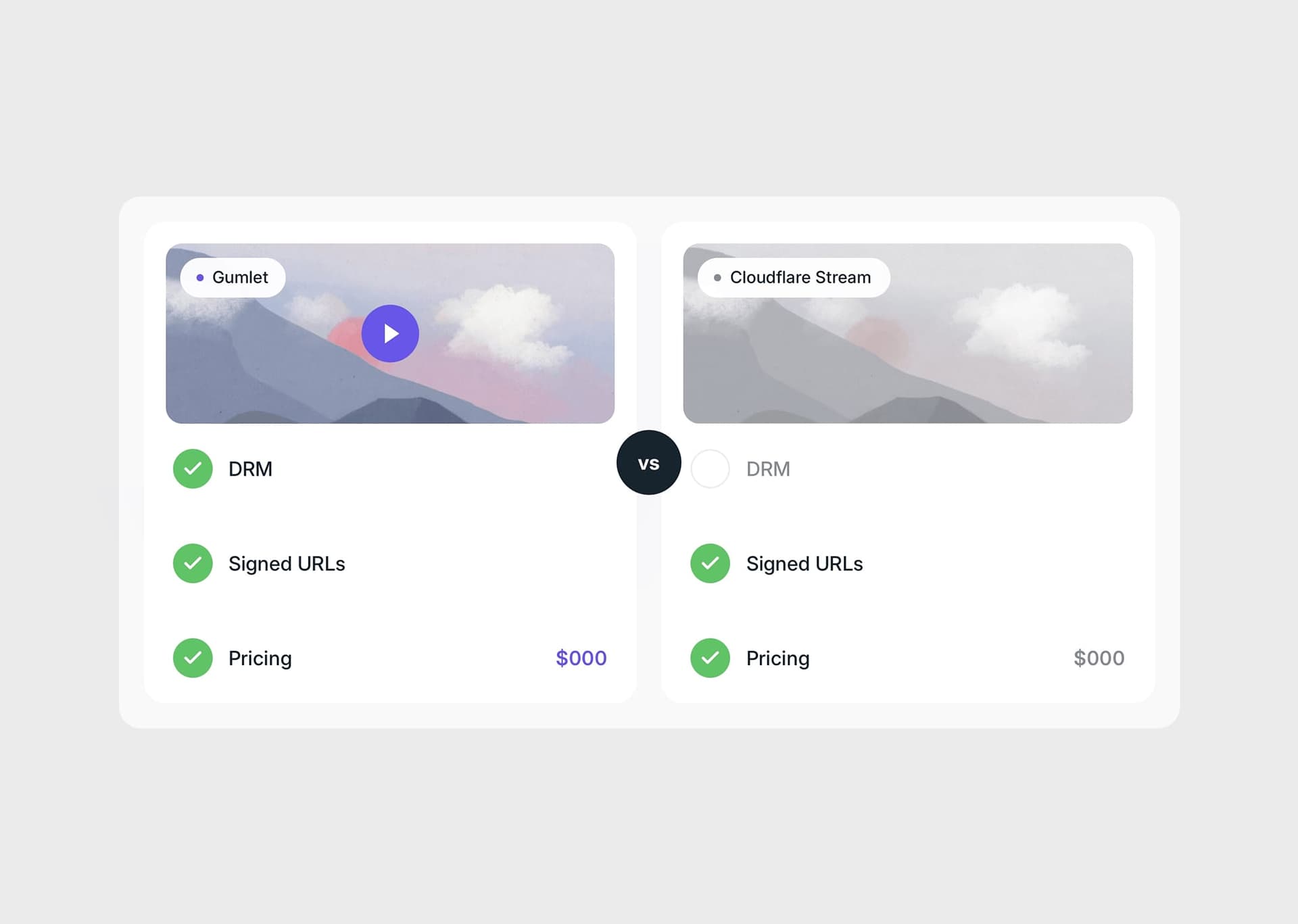
By default, any Cloudflare Stream video can be watched by anyone who has its video ID, according to Cloudflare’s Secure your Stream documentation, updated in October 2026. Turning on signed URLs closes that gap, but a signed Cloudflare token can stay valid for up to 24 hours, and anyone holding it inside that window can request the stream.
That is the difference buyers looking for the best video hosting with DRM need to see in a Gumlet vs. Cloudflare Stream decision: a signed URL controls the link, and DRM (digital rights management) controls whether the video plays at all.
Cloudflare Stream’s documentation, as of November 2026, describes signed URLs, allowed origins, and IP or country rules, and no Widevine or FairPlay DRM, so pick Gumlet when the video itself is the product and Cloudflare Stream when tokenized access is enough at high delivered volume.
Gumlet is an all-in-one video hosting platform that protects on-demand video with signed URLs, dynamic watermarking, and Widevine and FairPlay DRM for course creators, SaaS teams, and media publishers. Signed URLs start on our Growth plan and dynamic watermarking on Business, while Widevine and FairPlay DRM is free for your first 5 videos on any Gumlet plan, including Free, and DRM for more videos is a $99/month add-on on paid plans.
The sections below compare the two platforms across 12 security and pricing rows, walk through each signed-URL flow step by step, and price three traffic levels so you can see where each one wins.
Key Takeaways
- Gumlet's DRM covers Widevine and FairPlay, while Cloudflare Stream offers signed URLs, allowed origins, IP or country rules, and no native DRM video protection, as of November 2026.
- A Cloudflare Stream token can stay valid for up to 24 hours, and a Gumlet signed URL stops playing at expiry even mid-playback, so both protect the link rather than the decrypted video.
- Widevine and FairPlay DRM is free for your first 5 videos on any Gumlet plan, including Free, and DRM for more videos is a $99/month add-on on paid plans.
- The Bitrate Break-Even: above about 2.2 Mbps average delivered bitrate, a Cloudflare Stream delivered minute costs less than the same minute billed as Gumlet Business overage.
- Gumlet's protection controls apply to on-demand video only, and neither platform documents DRM for live streams.
Gumlet vs. Cloudflare Stream: Overview of 12 Security and Pricing Differences
Gumlet and Cloudflare Stream both offer signed URLs, domain restrictions, and country controls, but only Gumlet documents Widevine and FairPlay DRM and viewer-specific dynamic watermarking. Cloudflare Stream bills per minute stored and delivered, while Gumlet sells plans with included bandwidth.
Every Cloudflare Stream detail below comes from Cloudflare's own documentation and pricing pages, checked in November 2026.
| Feature | Gumlet | Cloudflare Stream |
|---|---|---|
| DRM | Widevine and FairPlay; free for the first 5 videos on any plan, then a $99/month add-on on paid plans; included in Enterprise. | No native DRM video protection. |
| Signed URLs | Available on Growth plan and above. | Enabled per video using requireSignedURLs. |
| Token Expiry | Set by your backend; playback stops at expiry, even mid-playback. | Maximum 24 hours after signing; the /token endpoint defaults to 1 hour. |
| IP and Country Rules | Geo-blocking with allow-list or block-list modes on every plan. | Up to 5 access rules per token, based on IP or country. |
| Embed or Domain Lock | Referrer whitelisting by domain, wildcard subdomain, or Android and iOS bundle ID; available on Creator plan and above. | Allowed Origins per video, which also restricts manifest and segment requests from custom players. |
| Watermark | Static watermark on every plan; dynamic, viewer-specific watermark on Business. Visible only. | Static image watermark profile applied at upload through the API. |
| HDR and 4K | 4K and HDR10 available on every plan, including Free. | HDR uploads are re-encoded and delivered as SDR. |
| Codecs | H.264 on every plan; AV1 on Business and Enterprise. | H.264 recommended for uploads; output codecs are not listed on the pages checked. |
| Live-Stream Protection | Protection controls and DRM do not apply to live streams. | Signing keys documented for Live WebRTC tokens; no DRM described. |
| DRM Setup | One-click setup through the Gumlet player; custom players request licenses from Gumlet's license servers. | Not applicable. |
| Billing Units | Plans include a certain amount of streaming GB, with per-GB overage charges. | $5 per 1,000 minutes stored (prepaid) and $1 per 1,000 minutes delivered. |
| DRM Cost | $99/month add-on with 100,000 DRM views included, then $1 per 1,000 views. | Not applicable. |
Verified against each vendor's public pages in November 2026.
The practical difference is where the rules live. Cloudflare Stream lets you scope each token to an IP range or a country, which suits apps that mint tokens per user session.
Gumlet applies geo-blocking and referrer whitelisting to every request, managed from one dashboard alongside our other domain and access controls, which suits teams that want rules set once rather than coded per token.
Gumlet wins wherever the threat is an authorized viewer copying or re-sharing content, because it adds licensed decryption and a traceable watermark on top of the access controls both platforms share.
Cloudflare Stream wins on billing simplicity for large catalogs, because a delivered minute costs the same at 480p or 1080p. The two tie on basic access control: both can lock playback to approved domains and filter by country.
Choose Gumlet when a license or paid catalog requires Widevine and FairPlay, and choose Cloudflare Stream when time-limited access is the only control the content needs.
Does Cloudflare Stream Support DRM Like Gumlet?
Cloudflare Stream's security documentation covers signed URL tokens, allowed origins, and IP or country access rules, but it does not offer DRM as of November 2026. Gumlet's DRM, license servers, and documentation cover Widevine and FairPlay. Teams that need licensed DRM playback should treat Cloudflare Stream as an access-control layer only.
DRM works through a license exchange. Under the W3C Encrypted Media Extensions (EME) specification, the browser's Content Decryption Module (CDM) asks a license server for a license, and only a device holding a valid license receives the key that decrypts the video. Google's Widevine runs that exchange in Chrome, Edge, and Android, and Apple's FairPlay Streaming runs it in Safari and on iOS. A downloaded DRM file without a license is unplayable data.
Cloudflare's Stream documentation describes a different model. Its Secure your Stream page covers signed tokens, Allowed Origins, and accessRules, and its Secure your content guide lists hotlink protection, Stream signed URLs, and Cloudflare Access as the tools for protecting media. Cloudflare's watermark feature applies a static image profile when a video is uploaded through the API, so it brands a video without identifying the viewer.
Our reading of the Stream documentation is that a team needing Widevine or FairPlay on Cloudflare would have to license and integrate a separate DRM service, which those docs do not cover.
Allowed Origins is the strongest control Cloudflare documents beyond tokens. It limits which domains can embed the player and, for custom players, which domains can request the HLS and DASH manifests and video segments. Cloudflare's docs note two edge cases: there is no path support, and listing example.com does not cover www.example.com.
Signed URLs vs. DRM vs. HLS Encryption: What Each Control Stops
Signed URLs control who can request a stream and for how long. DRM encrypts the video and releases the key only to a licensed device. HLS (HTTP Live Streaming) encryption scrambles segments but hands the key to any player that can fetch it. Signed URLs stop casual link sharing but leave an authorized viewer's stream playable during its valid window.
| Control | How It Works | What It Stops | What It Cannot Stop |
|---|---|---|---|
| Signed URL | Your server signs a playback URL with a secret and an expiry time. | Links used after expiry and players without a valid token. | Playback by anyone holding a valid token; capture by an authorized viewer. |
| HLS Encryption (AES-128) | Segments are encrypted, and the playlist's EXT-X-KEY tag points to the key. |
Copying raw segment files from storage or a CDN cache. | Any player or downloader that can fetch the key and decrypt the content. |
| DRM (Widevine, FairPlay) | Encrypted video is protected by a license server that releases keys only to a licensed CDM. | A downloaded file playing on another device; key capture by ordinary download tools. | Every form of screen recording or a phone camera pointed at the screen. |
A signed URL decides who can request a video; DRM decides whether the bytes are playable once they arrive. The two controls answer different threats, so a paid library usually needs both: tokens to keep strangers out and DRM to keep paying viewers from walking away with a working file.
The EXT-X-KEY behavior comes from RFC 8216, the HLS specification, and our explainer on HLS encryption versus DRM covers the key-delivery details.
For token formats and implementation patterns beyond these two platforms, read our guide to signed URLs versus DRM.
Can a student share a signed course link?
A student can share a signed link, and it works until the token expires. Suppose a course platform issues a Cloudflare Stream token valid for 12 hours and a student pastes the player URL into a group chat: everyone who opens it in the next 12 hours can watch, because the token proves possession rather than identity. Shortening the expiry narrows the window without closing it.
On Gumlet, a short expiry has a cost of its own. Our signed URLs stop playing once they expire, even mid-playback, so the expiry has to outlast the lesson plus any pauses. What reduces re-sharing is a combination: your app issues a fresh token per logged-in viewer, DRM keeps a captured file from playing elsewhere, and dynamic watermarking puts the viewer's identity on screen.
Gumlet's dynamic watermark is on the Business plan. It shows the viewer's IP address by default, or custom text such as an email address passed through the watermark_text embed parameter, and it moves around the frame. A dynamic watermark does not block a recording; it makes the recording traceable to the account that played it. Apple doesn't allow custom overlays during native iOS playback, so the dynamic watermark doesn't appear there.
How Signed URLs Work on Gumlet and Cloudflare Stream
Both platforms sign playback with a server-side secret and an expiry. Gumlet generates a token from a secret key and expiry timestamp on the Growth plan and above. Cloudflare Stream issues tokens through a /token endpoint, a signing key, or a Workers binding, with expiry capped at 24 hours and up to five IP or country rules per token.
| Step | Gumlet | Cloudflare Stream |
|---|---|---|
| Turn It On | Enable the Signed URL option in Gumlet's video protection settings (Growth plan and above). | Set requireSignedURLs on each video through the API or a Workers binding. |
| Generate the Token | Your backend signs the playback URL and an expiry timestamp using the secret key provided by Gumlet. | Use a /token API call, a signing key created once, or the Workers binding. |
| Expiry | Set any expiry time; playback stops at expiry, even mid-playback. | Maximum 24 hours after signing, with an optional not-before time. |
| IP and Country | Geo-blocking rules are checked against each viewer's IP-based location, available on every plan. | Up to 5 accessRules per token, based on IP range or country. |
| Embed Lock | Referrer whitelisting by domain, wildcard subdomain, or app bundle ID (Creator plan and above). | Set Allowed Origins per video. |
A Cloudflare Stream token cannot expire more than 24 hours after it is signed, according to Cloudflare's documentation. The /token endpoint returns a 1-hour token per API call, is rate limited, and is recommended by Cloudflare only for testing or under 1,000 tokens a day, so production apps use a signing key or the Workers binding.
What is the authorized-playback flow on Cloudflare Stream?
The Cloudflare Stream flow takes five steps, and your application owns three of them.
- Turn on requireSignedURLs for the video, which stops public links and the default player embed from working without a token.
- Authenticate the viewer in your own application, because the token only proves that your server approved the request.
- Mint a token with your signing key, setting exp no more than 24 hours ahead, an optional nbf, and up to five accessRules.
- Pass the token to the player in place of the video ID, either in the iframe URL or in the HLS or DASH manifest URL.
- Let exp lapse, after which the token stops working and your app issues a fresh one for the next session.
Cloudflare’s documentation says a token stops working after exp and that accessRules are evaluated continuously while a video is being viewed, but they do not say whether an expired token cuts off a stream already playing. Test it with a short-lived token before you rely on it (see the checklist below).
How does the Gumlet signed URL flow differ?
The Gumlet flow has the same shape with fewer settings to manage. Your backend signs the playback URL with the secret key Gumlet provides and appends the token and expiry, and we refuse requests once the URL expires; our guide to signed URL implementation walks through the code. A Gumlet signed URL stops playing at expiry, even mid-playback, so its expiry has to cover the full video. MP4 outputs play without a token, so turn off MP4 generation for videos protected with signed URLs.
Gumlet DRM Without a License Server: Which Players Need Setup
As of November 2026, Gumlet runs the Widevine and FairPlay license servers, so a team embedding the Gumlet player turns on DRM and configures no license endpoint. Custom players built on Gumlet HLS, ExoPlayer, or AVPlayer must request licenses from Gumlet's license servers and set up the player. DRM covers on-demand HLS and DASH streams only.
We built DRM as a one-click, no-code setup through the Gumlet player, so embedding our player and turning on the DRM add-on is the whole job, with Gumlet's license servers answering every Widevine and FairPlay license request behind it.
Custom players take more work. If you play Gumlet HLS through your own web player, ExoPlayer on Android, or AVPlayer on iOS, the player has to request licenses from Gumlet's Widevine and FairPlay license servers, which means your team configures the license endpoints and the player's DRM settings.
Gumlet's native iOS and Android SDKs ship with built-in Widevine and FairPlay playback for teams that want that wiring done for them, and our guide to Widevine without a license server compares the setup paths in detail.
Which DRM limits should you plan around?
Gumlet's DRM has four documented conditions worth knowing before rollout:
- DRM applies when a video is processed or reprocessed, so videos uploaded before you turned DRM on need reprocessing to be protected.
- DRM works on HLS and DASH on-demand streams, not on MP4 delivery and not on live streams.
- Widevine covers Android, Chrome, Edge, and Firefox on desktop; FairPlay covers iOS and Safari.
- Casting through AirPlay or Chromecast is not supported on DRM-protected playback.
Cloudflare Stream has no equivalent step to compare here, because its documentation describes no license server. The full set of Gumlet DRM options, from device coverage to offline licenses, lives on our Gumlet video DRM hub.
Gumlet vs. Cloudflare Stream Pricing in 2026, Worked at Three Traffic Levels
As of November 2026, Gumlet Growth costs $19 per month billed annually with 3,000 GB of streaming included, and DRM is free for the first 5 videos, then a $99/month add-on. Cloudflare Stream charges $5 per 1,000 stored minutes and $1 per 1,000 delivered minutes. At a 3 Mbps average bitrate, Gumlet Growth costs less below about 229,000 delivered minutes a month.
The two platforms meter storage the same way and delivery differently. Both count storage in minutes of source video, regardless of file size. Gumlet meters delivery in gigabytes, so a higher bitrate costs more, while Cloudflare Stream meters delivery in minutes, so bitrate never changes the bill.
Gumlet Video’s Business plan is $99 per month billed annually ($149 billed monthly), with 15,000 storage minutes, the same 3,000 GB, and $0.06 per extra GB. The DRM add-on includes 100,000 DRM views a month and charges $1 per 1,000 views after that, and Enterprise includes DRM; our Free Forever plan carries 100 GB of monthly streaming.
Cloudflare Stream sells storage in prepaid $5 blocks and states that ingress, encoding, and bandwidth are included in its prices.
What does each platform cost at 10,000, 100,000, and 1 million minutes?
The worked example below assumes 1,000 stored minutes, a 3 Mbps average delivered bitrate, and a 20-minute average view, so DRM views stay inside the 100,000 included. At 3 Mbps, one minute is 3 × 60 ÷ 8 = 22.5 MB, or 0.0225 GB, counting 1 GB as 1,000 MB. At a 3 Mbps average bitrate, 100,000 viewing minutes move about 2,250 GB of video.
| Monthly Delivered Minutes | GB Delivered | Gumlet Growth | Growth + DRM | Gumlet Business | Business + DRM | Cloudflare Stream (No DRM) |
|---|---|---|---|---|---|---|
| 10,000 | 225 GB | $19 | $118 | $99 | $198 | $5 + $10 = $15 |
| 100,000 | 2,250 GB | $19 | $118 | $99 | $198 | $5 + $100 = $105 |
| 1,000,000 | 22,500 GB | $19 + $1,950 = $1,969 | $2,068 | $99 + $1,170 = $1,269 | $1,368 | $5 + $1,000 = $1,005 |
Note: Arithmetic on each vendor's published rates as of November 2026, billed annually for Gumlet; not quotes, and excluding taxes.
At 1 million minutes, Gumlet's 22,500 GB exceeds the 3,000 GB allowance by 19,500 GB, which costs $1,950 on Growth and $1,170 on Business. Setting Growth's total, $19 + $0.10 × (0.0225 × minutes − 3,000), against Cloudflare's $5 + $0.001 × minutes puts the crossover near 228,800 delivered minutes; for Business it lands near 245,700.
Below those volumes Gumlet costs less, and above them Cloudflare Stream costs less when you do not need DRM.
What is the Bitrate Break-Even?
The Bitrate Break-Even is the average delivered bitrate at which one minute of Gumlet overage costs the same as one Cloudflare Stream delivered minute. A minute at b Mbps moves 0.0075 × b GB, and Cloudflare charges $0.001 a minute, so the break-even sits at 1.33 Mbps against Growth's $0.10/GB and 2.22 Mbps against Business's $0.06/GB.
Above about 2.2 Mbps average delivered bitrate, a Cloudflare Stream delivered minute costs less than the same minute billed as Gumlet Business overage. Inside the 3,000 GB every paid Gumlet plan includes, the marginal minute on Gumlet costs nothing, and AV1 on Business and Enterprise is one lever for lowering the delivered bitrate.
Is Cloudflare Stream cheaper if you need Widevine and FairPlay?
Cloudflare Stream is not shown to be cheaper once DRM is a requirement, because Cloudflare does not offer native DRM capability. Any third-party DRM service would need its own quote and integration work, so its cost cannot be added to the table honestly.
Calculate your average delivered bitrate before comparing prices, and treat any per-GB versus per-minute comparison without one as unreliable. Our breakdown of video DRM cost models covers how other vendors price DRM.
If the numbers above point toward encrypted playback without building a DRM stack, see how teams move to Gumlet as a Cloudflare Stream alternative.
Which Platform Fits Paid Courses, OTT, SaaS Apps, and Marketing Video?
Choose Gumlet for paid courses, subscription libraries, and any catalog a license says must use Widevine and FairPlay DRM. Choose Cloudflare Stream for developer-built apps already on Cloudflare Workers that need tokenized access, per-minute billing, and no DRM. Neither platform's on-demand protections fit live events that need DRM.
| Use Case | Recommended Platform | Why |
|---|---|---|
| Paid Online Courses | Gumlet | Widevine and FairPlay DRM prevent captured files from playing elsewhere. Business-plan dynamic watermarks help trace recordings to individual viewers. |
| Subscription OTT Library | Gumlet | Supports content licensing requirements that require DRM, which Cloudflare Stream's documented controls do not meet. |
| Private Enterprise Training | Either; Gumlet if viewer identification is needed. | Both support playback restrictions by approved domains and countries. Only Gumlet documents viewer-specific watermarks. |
| Developer-Built SaaS with Video Inside the Product | Cloudflare Stream if using Workers and DRM isn't required; Gumlet if customer content needs DRM. | Cloudflare's Workers binding generates tokens without a separate API call. Gumlet provides DRM through its player. |
| Public Marketing Video | Either; Gumlet for in-video lead capture. | Access control is less important for public videos. Gumlet offers lead capture forms starting on the Growth plan. |
Cloudflare Stream is delivery infrastructure with access control: you write the token service, the entitlement checks, and any extra protection yourself.
Gumlet is a managed secure video hosting workflow, with the player, license servers, watermarking, and protection settings in one dashboard and API access from the Creator plan for teams that automate.
Cloudflare Stream has three documented strengths. Its Workers binding generates tokens inside a Worker with no separate API call, delivery carries no egress fee on top of the per-minute price, and per-minute billing keeps high-bitrate catalogs predictable. For a broader shortlist that includes DRM-first vendors beyond these two, see our comparison of DRM video hosting platforms.
Do not choose Gumlet to protect live streams. Our protection controls and DRM apply to on-demand video only, so a live event that needs encrypted playback needs a different setup.
How to Test Gumlet and Cloudflare Stream Before You Choose
Run the same 10 checks on both platforms with one test video before you sign, and drop any configuration that plays when it should fail. Each check needs only a test video and a browser.
- Play the video through an authorized session and confirm it starts on desktop and mobile.
- Issue a 5-minute token, start playback, and keep watching past expiry.
- Copy the signed URL into a private browser window on another network.
- Embed the player on a domain that is not on your allowed list.
- Request a video segment directly, without the player.
- Try a browser downloader extension on the playing video.
- Play the video in Safari on iOS and Chrome on Android.
- Check the top rendition's resolution and whether HDR survives.
- Watch one full view, then compare the metered usage with the minutes actually watched.
- Time the setup from upload to protected playback for each platform.
Test an expired token, a copied URL, and an unapproved domain on both platforms, and drop any setup that still plays.
Frequently Asked Questions
Is DRM worth $99 a month if signed URLs already stop link sharing?
DRM is worth $99 a month when an authorized viewer re-sharing or recording the video is the threat. Signed URLs block unauthorized links, but a valid token still plays. Gumlet's DRM, license servers, and documentation cover Widevine and FairPlay, and the first 5 videos are free on any plan. Add DRM when paying viewers, not strangers, is the leak risk.
Can screen recording software still capture DRM-protected Gumlet videos?
Screen recording can still capture some DRM-protected Gumlet videos. DRM helps prevent screen recording on Android and iOS devices, but Gumlet's own docs note that DRM cannot stop every screen recording, and no DRM stops a phone camera. Pairing DRM with Gumlet's Business-plan dynamic watermark makes a leaked recording traceable to the viewer who played it.
Can I move my library from Cloudflare Stream to Gumlet?
You can move a Cloudflare Stream library to Gumlet, with two limits. Cloudflare does not let you download the exact original file, only encoded MP4s, so keep your masters if you still have them. Gumlet's dashboard importers cover Vimeo, Wistia, and Mux, not Cloudflare Stream, so upload from your masters, Google Drive, or object storage.
Does Cloudflare Stream charge for buffering or videos viewers abandon?
Cloudflare Stream does charge for buffered and preloaded video. Its pricing docs count delivery by HTTP requests for video segments, rounded to 4-second segments for uploaded content, so preloaded and buffered video counts even when the viewer leaves early. Budget on delivered minutes, which run above watched minutes.
Choose Gumlet When the Video is the Product
Choose Gumlet when a license, a paid catalog, or a content partner requires Widevine and FairPlay, because Cloudflare Stream's documentation describes no DRM as of November 2026.
Choose Cloudflare Stream when time-limited, IP-scoped access is all the content needs and your average delivered bitrate sits above the Bitrate Break-Even of about 2.2 Mbps at high volume.
Gumlet is the all-in-one video hosting platform for paid or licensed video that needs Widevine and FairPlay. Start with DRM free on your first 5 videos, then match the plan to your library with our layered video protection options.


