Most DRM cost guides benchmark EZDRM against CastLabs, land on a range of $99–$500/month, and call that useful. It isn't.
Those prices cover DRM licensing only: not video hosting, CDN delivery, content packaging, or the engineering hours required to wire all four together. The cost you actually pay each month is the sum of all those layers, and most existing comparisons show you just one of them.
There is also a pricing architecture that almost no comparison article acknowledges: a set of video hosting platforms where multi-DRM is offered as an add-on, along with video hosting and delivery.
On these platforms, the per-license counter does not exist. The relevant question for most operators is not "which DRM vendor has the best per-license rate"; the actual question is whether a per-license model applies to their situation at all.
This article covers all three DRM cost models: self-implementation, pay-per-license services, and hosting with DRM add-on, with real numbers pulled from live pricing pages as of May 2026.
It includes a worked example for a 1,000-student course platform, the exact monthly cost under each model, and a section on the volume threshold where standalone DRM pricing actually wins. By the end you will have a specific monthly budget figure and the decision criteria to pick the right architecture for your viewer volume.
TL;DR
- DRM pricing splits into three models: build your own, pay-per-license services, and hosting with DRM add-on. The model determines the total cost, not the vendor.
- Standalone DRM services start at $99–$299/month in base fees, then charge $0.003–$0.005 per license request on top. That fee covers only DRM, not hosting, CDN, packaging, or engineering.
- Video hosting platforms that offer DRM as an add-on included do not charge a per-license fee. Gumlet's DRM add-on covers Widevine and FairPlay DRM at $99/month and can be implemented across all Gumlet tiers.
- For a course platform with 1,000 students watching 10 videos each per month, Gumlet's full stack costs $198/month (Business Plan at $99/month + $99/month DRM add-on). Mux charges $134.50 for DRM alone at that same volume, before their hosting fees.
- Building DRM in-house costs $10,000–$50,000 to set up and $500–$2,000/month in engineering maintenance. It makes financial sense only above roughly 1 million monthly streams.
- The costs that actually blow video budgets: DASH/HLS packaging infrastructure, CDN delivery, player SDKs, and engineering time. None of these appear on any DRM vendor pricing page.
Which DRM Model Applies to Your Platform?
Before reading the full pricing breakdown, answer three questions. Your answers determine which section of this article is most relevant to your budget.
1. Do you deliver more than 1 million video streams per month with a backend engineering team already maintaining video infrastructure?
If yes: Model 1 (self-implementation) is worth evaluating for your scale. Start with the self-implementation section.
2. Do you already have a dedicated video hosting platform under contract, and you need DRM added on top of it?
If yes: Model 2 (DRM-as-a-Service) is the relevant comparison. Jump to the EZDRM, Mux, and Bunny pricing section.
3. Are you selecting a video platform now, building your first protected content stack, or looking to consolidate your current video and DRM spend into one bill?
If yes: Model 3 (DRM-included hosting) almost certainly produces the lowest total-stack cost at your volume. Gumlet's DRM add-on is available for all tiers. The worked example in this article shows the exact monthly math.
Most EdTech platforms, SaaS products with gated video, and professional course creators answer “Yes” to the third question. If that is you, the comparison table and worked example below show why the platform model wins at mid-scale, and the Gumlet’s pricing page shows specifically what is included for each of its plans.
🔒 Try Multi-DRM Free on Your First 5 Videos
Gumlet applies Widevine and FairPlay DRM to your first 5 videos at no additional cost on any paid plan, with one-click, no-code setup and no vendor request.
Need more than 5 videos? Add unlimited Multi-DRM for $99/month on any paid plan.
DRM Pricing Comes in 3 Models, and the Model Matters More Than the Vendor
The most common error in DRM cost research is comparing vendors within a single model while ignoring the structural choice of which model to use.
Benchmarking EZDRM against CastLabs is useful only if standalone DRM is already the right architecture for your scale. That decision itself determines whether DRM adds $0 or $2,000 per month to your stack, a much larger variable than which per-license rate you negotiate.
Across the three models the practical 2026 range is $105 to $250 a month for a platform under 50,000 monthly license requests, $250 to $500 for standalone multi-DRM with separate hosting, and $1,600 or more for a self-hosted build once engineering time is counted.
The three models, stated plainly:
- License Stack (standalone DRM service): A dedicated DRM provider sits alongside your existing hosting platform. You pay a base fee and a per-license charge for every playback event. CDN, packaging, and player are separate.
- Platform Stack (DRM-included hosting): A video hosting platform where multi-DRM is either a built-in infrastructure feature at a specific plan tier, or an add-on feature applicable for all tiers. One monthly bill, no per-license counter, no overage risk at standard volumes.
- Self-implemented DRM: You deploy Widevine and FairPlay license servers directly on your own infrastructure. Highest one-time cost, highest ongoing maintenance requirement.
| Model | Who it suits | Billing structure | DRM within the hosting bill? |
|---|---|---|---|
| Self-implemented | 1M+ monthly streams | Engineering cost + infra | No |
| DRM-as-a-Service | 10K–500K licenses/month | Base fee + per-license charge | No |
| DRM-included hosting/Video Host that offers DRM as an Add-on | Under ~1M views/month | One flat platform plan | Yes |
This table is what most DRM cost guides skip entirely. The row you sit in determines your total monthly cost far more than which column-2 vendor you select.
Model 1: Self-implementing Widevine and FairPlay
Self-implementation means running your own Widevine license server and Apple FairPlay Streaming (FPS) module.
Google's Widevine CDM is free to license for streaming, as documented in Google's official Widevine developer documentation, but requires a full packaging and license-serving infrastructure alongside it. Apple's FPS Deployment Package is also free to obtain, but your platform needs a Key Security Module (KSM) implementation to handle license issuance.
One dated change matters more than any current figure in this section. Google retires the Widevine Cloud License Service on 13 April 2027. That service is the no-fee, no-SLA license endpoint that most self-hosted Widevine deployments have been built on. After that date, every self-hosting platform must move to a certified third-party license service, which is a paid, recurring line item.
Practically, this means the "free to license" part of Widevine now has an expiry attached to the cheapest way of using it. If you are pricing a self-hosted build in 2026, price the migration too, and price the third-party license service that will carry your traffic after April 2027. A build that pencils out today on the assumption of a free license endpoint does not pencil out across a normal three-year infrastructure horizon.
- Realistic one-time engineering cost: $10,000 to $50,000.
- Ongoing infrastructure and engineering maintenance: $500 to $2,000 per month.
This is before CDN, storage, and player costs. At roughly 1 million monthly license requests, the per-unit economics start becoming competitive with managed DRM services. Below that volume, self-implementation is almost always the most expensive path once engineering hours are counted.
Only consider self-implementing DRM if you are already delivering 1 million or more monthly streams and have a backend engineering team capable of maintaining Widevine packaging pipelines and FairPlay KSM infrastructure long-term. For every EdTech platform, SaaS product, and media operator under that threshold, the setup cost alone disqualifies the model.
Model 2: DRM-as-a-Service and the Mechanics of Per-license Billing
Here is what vendors do not explain on their pricing pages. A DRM license is issued every time a video player requests the decryption key for an encrypted piece of content.
One viewer, one video, one device equals one license. The complication is that several common scenarios generate multiple license requests per play.
Switching from Chrome to mobile mid-session triggers a second license request. Watching the same video on desktop then phone triggers two requests.
Bunny's MediaCage Enterprise documentation sets out how it counts: each unique HD playback of a video on a device is one license, and SD streams are not billed at all. Extra licenses appear in specific situations rather than on every play. A second audio track issues its own license, a long video can renew mid-playback, and restarting the same video in a different browser can bill again. Bunny's own worked example bills 150,000 licenses for 10,000 users watching 15 HD videos each, which is one license per play. Actual license volume on a typical EdTech or SaaS platform still runs 15–25% above raw play counts. Plan for the exceptions that apply to your library rather than assuming a blanket multiplier.
Warning: Before committing to any per-license DRM pricing model, calculate your actual monthly license volume including re-request overhead and multi-key doubling, not your raw play count. Most platforms discover their real license volume is 20–30% higher than initial estimates. Budget on the higher number.
Per License or Per Viewer: The Billing Unit Changes the Answer
Not every DRM-as-a-Service provider bills per license. Some bill per monthly active user, meaning one viewer who plays forty videos costs the same as one viewer who plays one. Which unit your provider uses can move the bill by an order of magnitude, in either direction, at the same viewer count.
The split runs like this. Mux and Bunny meter licenses issued. DoveRunner sells monthly active user tiers, starting at $299 for the first 1,000 users and dropping to $0.06 per user for the next 9,000. EZDRM lets you choose: metering on licenses issued or on unique service users, with volume pricing available above 20,000 licenses or 2,000 users per month.
The rule that follows is simple. Divide your monthly plays by your monthly unique viewers. Course platforms and subscription libraries usually land between 8 and 20 plays per viewer, and at those ratios per-user billing is cheaper. Live events and one-off releases land close to 1, and at that ratio per-license billing is cheaper. Run your own number before you compare any two quotes, because the two models are not comparable until you do.
Model 3: Hosting with DRM
In 2021 and 2022, every video hosting platform assumed you would manage DRM separately, because separate was the only option. Developers integrated EZDRM or BuyDRM via SDK, maintained their own token-signing logic, and debugged FairPlay edge cases on iOS in their own engineering queue.
In 2026, a subset of video hosting platforms, including Gumlet and Kinescope, have absorbed multi DRM as a standard infrastructure layer. A single platform plan covers hosting, delivery, and protection, either as a built-in feature for specific tiers, or as an add-on feature applicable for all tiers, with no separate DRM contract and no per-license billing
The financial difference at mid-scale is not marginal. It is structural. One monthly invoice, one vendor relationship, and no overage risk if a course launch sends plays through the roof. If your question is how to run DRM without operating a license server rather than what it costs, the implementation paths are covered in our guide to enabling Widevine DRM without a license server.
The 3-Model DRM Cost Framework: Model 1 (self-implemented) suits 1M+ monthly streams with in-house engineering. Model 2 (DRM-as-a-Service) suits 10K–500K licenses/month and existing video infrastructure. Model 3 (Hosting with DRM) suits under 1M views/month and any platform building its stack from scratch. The model determines the total cost far more than the vendor within each model.
DRM-as-a-Service Pricing in 2026: EZDRM, CastLabs, Mux, and Bunny
All prices below were pulled from public pricing pages as of May 2026 and how the DRM-included platforms compare on features. DRM pricing changes often; verify against current pages before finalizing any budget.
| Provider | Model | Base fee/month | Per-license cost | FairPlay included | Offline DRM | Total for 1,000-student platform |
|---|---|---|---|---|---|---|
| Gumlet | DRM Add-on (Applicable for all Gumlet Plans) | $99 | $0 | Yes | Yes | $198/month (Gumlet’s Business Plan at $99/month + $99/month DRM Add-on) |
| Mux DRM add-on | DRM-as-a-Service | $100 | $0.003/license; volume discounts available | Yes | Yes | ~$215–$285/month |
| Bunny MediaCage Enterprise | DRM-as-a-Service | $99 | $0.005 to 20K; $0.004 to 100K; $0.003 to 500K; contact for higher | Yes | No | ~$207–$257/month |
| EZDRM Universal DRM | DRM-as-a-Service | $199.99 | Contact for overage | No (Widevine + PlayReady + WisePlay only) | Not published | ~$280–$430/month + hosting |
| EZDRM Universal Complete | DRM-as-a-Service | $299.99 | Contact for overage | Yes | Not published | ~$380–$500/month + hosting |
| EZDRM PlayReady | DRM-as-a-Service | $99.99 | Contact for overage | No (PlayReady over DASH only) | Not published | Not comparable, single-DRM |
| DoveRunner Standard (MAU) | DRM-as-a-Service | $299 covers first 1,000 monthly active users | $0.06/user to 10,000; $0.04/user to 20,000 | Yes | Yes | ~$379–$499/month + hosting |
| CastLabs DRMtoday Starter | DRM-as-a-Service | $299 | Contact for overage tiers | Yes | Yes | ~$379–$499/month + hosting |
| Self-implemented | Self-build | $500–$2,000/month / engineering | Infrastructure cost | Yes | Yes | $1,600+/month |
BuyDRM, CastLabs beyond its Starter tier, and Axinom do not publish list pricing for multi-DRM, so any figure quoted for them elsewhere is either a negotiated contract or an estimate. Treat published rates and quoted rates as different categories when you build the budget.
What this table shows: At 1,000 students watching 10 videos each per month, Gumlet's $198/month (Business Plan + DRM Add-on) covers DRM, offline support, dynamic watermarking, signed URLs, and geo-blocking in a single bill. Every other option in this table either adds a separate per-license charge on top of a base fee, requires a separate hosting contract alongside it, or both. The cost comparison above shows DRM spend in isolation; the total-stack comparison later in this article shows the full picture. Gumlet's $99 Business rate is the annually billed price; on month-to-month billing the plan is $149, which puts the same stack at $248. Every competitor base fee in this table is a month-to-month rate, so compare annual against annual before you sign.
Bunny's $99 base is the lowest entry point for true multi-DRM among the standalone services. The variable to watch is not the headline rate but what generates a license on your library: additional audio tracks, long-form sessions that renew, and viewers who restart the same video on a second device. A single-audio-track course library of 20 to 40 minute lessons will track close to one license per play. A multi-language catalogue will not.
Mux DRM is also worth examining as an architectural difference. It is an add-on to Mux's broader video hosting product, not a standalone service. If you are already on Mux for hosting, the $100/month entry point is reasonable to evaluate. If you are not on Mux for hosting, adding DRM through Mux means evaluating their entire infrastructure stack, not just the DRM line item.
Insider Take: EZDRM and CastLabs are the right evaluation for one specific scenario: you already have dedicated video hosting infrastructure, a backend team that can own the DRM integration, and a separate hosting contract already running. If that description does not fit your platform, you are not choosing between DRM vendors. You are choosing between two fundamentally different cost models, and the math in this article shows which one produces the lower total bill.
What Gumlet and Kinescope Actually Charge
Gumlet's DRM add-on feature costs $99/month, and includes Widevine and FairPlay DRM, offline DRM support, and no per-license fee. The add-on attaches to any paid tier, so the plan you pick is set by storage and bandwidth rather than by DRM: Creator at $6/month, Growth at $19/month, or Business at $99/month, each billed annually, with the same $99 DRM add-on on top. Gumlet’s DRM add-on is applicable for all Gumlet plans, providing flexibility for users to opt for the plan that meets their requirements.
Gumlet also offers password protection, and geo-blocking as standard features for all plans. Dynamic watermarking is available as a standard feature for the Business plan ($99/month; billed annually), while signed URLs is available for Growth, Business, and Enterprise plans.
GrowthSchool, a paid professional education platform serving millions of learners, runs DRM-protected course video on Gumlet, a use case that represents exactly the volume range where the Business plan's flat-fee model produces the clearest cost advantage over per-license alternatives.
Kinescope is the only other platform in this model category worth naming directly. Its Super plan starts at €10/month with usage-based CDN and storage billing, and Widevine plus FairPlay DRM included at no per-license fee. For a platform with 200 hours of video and 2,000 active users, Kinescope's pricing calculator benchmarks a comparable all-in monthly cost.
Gumlet’s Advantage Over Kinescope for DRM Implementation
For many buyers evaluating both, the decision comes down to four specific differences where Gumlet holds the advantage.
Predictable Billing Under Volume Spikes
Gumlet's Business offers DRM as an add-on feature at $99/month, applicable for all Gumlet tiers, and is far more affordable compared to industry average of $500/month. Kinescope bills per GB at usage rates. A course launch or cohort kick-off that doubles your delivery volume doubles your Kinescope delivery cost that month. For subscription-based platforms with predictable audiences, Gumlet's flat ceiling removes that variable entirely.
Gumlet also includes offline Widevine and FairPlay licenses, viewer-specific dynamic watermarking, and SOC 2 Type II and ISO 27001 certification, all of which are covered in the protection stack section below. Kinescope does not publicly confirm offline DRM availability at its base paid tier.
Kinescope is a legitimate option for low-volume individual creators where usage-based billing is an advantage. For EdTech platforms, SaaS products with gated content, and any operator projecting audience growth, Gumlet's fixed-fee model and enterprise-ready compliance stack produce a cleaner total cost and a shorter sales cycle with enterprise buyers.
Warning: Bunny's MediaCage Basic DRM uses clear-key encryption, not true Widevine or FairPlay hardware DRM. Clear-key provides download protection but does not deliver OS-level screen recording prevention. If screen recording protection is a hard requirement for your platform, confirm you are evaluating MediaCage Enterprise, not Basic, before comparing Bunny's pricing to multi-DRM alternatives.
The Exact Monthly DRM Cost for a 1,000-student Course Platform
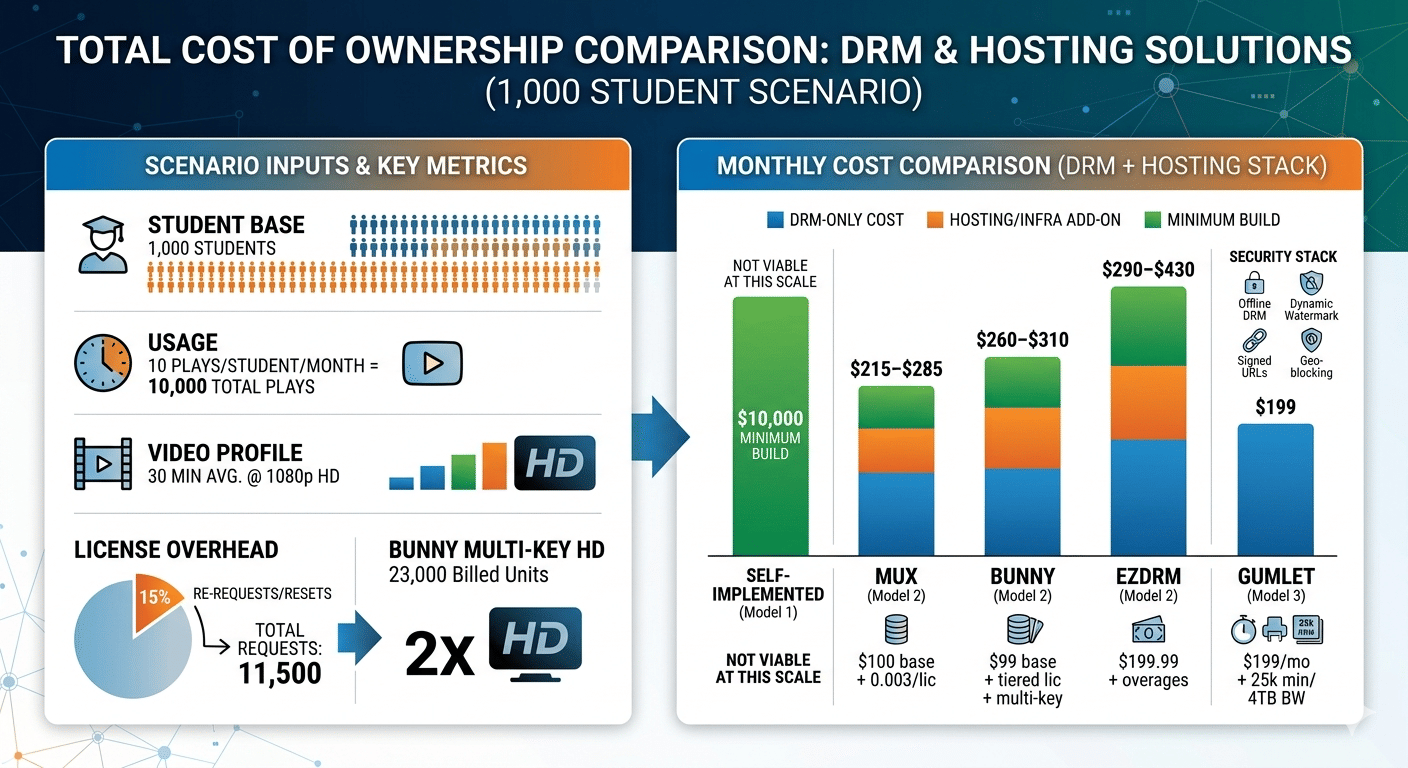
Set up the inputs first, so you can substitute your own numbers.
Scenario:
1,000 students, 10 video plays per student per month, average video duration 30 minutes at 1080p HD, playback split across web browser and mobile, 15% license overhead for re-requests from device changes and session resets.
License count:
10,000 base plays × 1.15 overhead = 11,500 license requests. Add a second license for each video that carries an additional audio track, and one more for any session that renews mid-playback.
First, a Smaller Scenario: 200 Viewers and 1,600 Plays a Month
At startup scale, DRM costs $105 to $150 a month on almost any managed option, and the base fee is the whole story. Take 200 active viewers, 8 videos each, 1,600 plays, roughly 1,840 license requests after re-request overhead. Every per-license charge in that range is under $10. What you are actually choosing between is what each provider's $99 or $100 base fee includes.
Here is the same 1,840 requests priced across the models:
| Option | DRM cost/month | Hosting cost/month | Total/month |
|---|---|---|---|
| Gumlet Creator + DRM add-on | $99 | $6 | $105 |
| Gumlet Growth + DRM add-on | $99 | $19 | $118 |
| Mux DRM add-on + Mux hosting | $105.52 | ~$20 - $40 | ~$126 - $146 |
| Bunny MediaCage Enterprise + Stream | $108.20 | ~$10 - $30 | ~$118 - $138 |
| EZDRM Universal Complete + separate hosting | $299.99 | ~$20 - $50 | ~$320 - $350 |
| DoveRunner Standard + separate hosting | $299 | ~$20 - $50 | ~$319 - $349 |
Gumlet plan prices are annual rates. The three cheapest options land within roughly $30 of each other, and at that spread the deciding factor is not price. It is whether the base fee buys you DRM alone or DRM plus hosting, delivery, and a player that already handles license exchange. Mux and Bunny sell the first. Gumlet sells the second.
One more thing worth knowing before you pay anything: Gumlet applies DRM to your first 5 videos at no additional cost, which is enough to test playback on your real devices before the add-on starts billing.
Model 1: Self-implemented DRM
Setup cost amortized over 12 months: approximately $833/month (assuming a $10,000 minimum build). Ongoing infrastructure and engineering: $800 - $1,500/month. Hosting is still separate on top of this.
Total DRM-only cost:
$1,600 - $2,300/month. This model is not viable at this scale. Move on.
Model 2: Mux DRM add-on
DRM cost: $100 + (11,500 × $0.003) = $134.50/month for DRM alone. Mux hosting for this volume (encoding, storage, 1080p delivery): approximately $80 - $150/month additional.
Total stack: Approximately $215 - $285/month.
Model 2: Bunny MediaCage Enterprise (keep as H3)
DRM cost: $99 + (11,500 × $0.005) = $156.50/month for DRM alone, with every license inside Bunny's first tier. Any plays your students watch in SD are not billed, so the real figure sits at or below this. Bunny Stream hosting: approximately $50 - $100/month additional.
Total stack: Approximately $207 to $257/month.
Model 2: EZDRM Universal
$199.99/month covers 10,000 licenses. The 1,500 licenses above that trigger overage billing.
Total DRM cost:
Approximately $210–$230/month. Separate hosting still required: $80 - $200/month.
Total stack: Approximately $290–$430/month.
If the goal is true multi-DRM coverage including FairPlay for iOS and Safari, EZDRM's relevant product is Universal Complete at $299.99/month (not the $199.99 Universal DRM, which does not include FairPlay).
Universal Complete covers 20,000 licenses per month with a $199.99 one-time setup fee. At 11,500 licenses, the plan covers usage comfortably. DRM cost: $299.99/month. Separate hosting: $80–$200/month. Total stack: approximately $380–$500/month.
Model 3: Gumlet DRM Add-on
Cost: $198/month ($99/month for DRM add-on + $99/month for Gumlet’s Business plan). Per-license cost: $0. Hosting coverage: 15,000 storage minutes, more than sufficient for this scenario. Protection stack included: DRM, offline DRM, dynamic watermarking, signed URLs, geo-blocking.
Total stack: $198/month.
| Model | DRM cost/month | Hosting cost/month | Total/month |
|---|---|---|---|
| Self-implemented | $1,600 to $2,300 | Separate | $1,600+ |
| Mux DRM + Mux hosting | $134.50 | ~$80 - $150 | ~$215 - $285 |
| Bunny Enterprise + Stream | $156.50 | ~$50 - $100 | ~$207 - $257 |
| EZDRM + separate hosting | ~$215 | ~$80 - $200 | ~$295 - $430 |
| Gumlet DRM Add-on | $99 | $99 (Business Plan) | $198/month |
At this volume Gumlet's $198/month is the lowest total-stack figure in the table, and it is the only one that already includes hosting, delivery, and the player. Mux's DRM line alone is cheaper at $134.50, but that number buys DRM and nothing else; once Mux hosting is added the stack lands at $215 to $285. Compare the totals, not the DRM rows.
Gumlet's Video Protection Stack: Flexibility the $99/month DRM Add-on Offers
The cost comparison above shows why the Platform Stack beats the License Stack at mid-scale. What it doesn't detail is exactly what sits inside that platform stack. If you are evaluating Gumlet against a standalone DRM service, this is what the two options are actually being compared against.
Gumlet’s DRM Add-on offers flexibility for users to add it to their preferred Gumlet plan, without being forced to sign-up for a plan that exceeds their requirements. Considering the 1000-student scenario, Gumlet’s Business Plan along with the DRM add-on offers five protection layers into a single plan, with no per-license billing on any of them.
The five layers, and what each one covers:
1. Multi-DRM: Widevine L1 and FairPlay
Gumlet’s video DRM includes Widevine, which covers Android, Chrome, and Edge, and FairPlay that covers iOS, Safari, and macOS. Both enforce hardware-level encryption where the device supports it, blocking screen recording at the OS level on L1-capable hardware. No separate licensing contract, no per-license counter.
2. Offline DRM Support
The Widevine and FairPlay offline license flow is included in Gumlet’s DRM add-on feature. Learners on mobile can download course modules and watch without connectivity, with the content key stored in the device's secure enclave and tied to their authorization. Most standalone DRM services gate offline support behind enterprise-only tiers or charge an additional fee for it.
3. Dynamic Watermarking
With dynamic watermarking applied, a viewer-specific identifier tied to the playback session is embedded into the video stream at delivery time. If a recording leaks, the source viewer is traceable from the watermark data alone. This layer covers the screen recording gap that exists on Widevine L3 devices and older browsers where hardware enforcement is unavailable.
4. Signed URLs and Allowed Referrers
Restricts playback to authorized sessions and specific domains. Prevents link sharing and unauthorized embedding without writing code or managing a separate access control service.
5. Geo-blocking and Password Protection
Limits playback by geography for territory-licensed content. Password protection adds a viewer-facing credential gate as a second access control layer on top of session-based authentication.
All five layers are configured through Gumlet's dashboard. Given that standalone DRM integration typically runs 20 - 40 engineering hours to set up, as covered in the hidden costs section above, the no-code activation path eliminates that implementation cost from the budget entirely.
The Number: Gumlet holds SOC 2 Type II and ISO 27001 certifications, and has blocked over 150 million unauthorized downloader install attempts across its customer base. For EdTech and SaaS platforms selling to enterprise buyers, this matters directly: enterprise procurement teams run security questionnaires, and a video hosting vendor without audited certifications creates a compliance blocker that DRM capability alone does not clear.
If you want to see how these layers price against your current viewer volume, Gumlet's pricing page shows the full Business tier breakdown along with the DRM add-on.
For the technical walkthrough of how each layer functions, the Gumlet DRM learning hub and video hosting overview cover the full implementation picture.
The 4 Costs That Never Appear on any DRM Vendor Pricing Page
The DRM license fee is rarely what breaks a video budget. These four costs are what operators consistently underestimate.
1. DASH/HLS Packaging and CMAF Encryption Infrastructure
Before a DRM license server can protect your content, video files must be encrypted and packaged into CMAF or HLS format. On AWS infrastructure, this means Elemental MediaPackage or MediaConvert, a separate usage-based charge that does not appear on any DRM vendor's pricing page.
At mid-scale content libraries (100 hours of video, 10,000 monthly streams), packaging costs run $100 - $300/month. On DRM-included hosting platforms, this layer is absorbed into the platform infrastructure. On standalone DRM, it is your problem.
2. CDN Delivery Bandwidth
DRM protects the content. CDN carries it. At 1,000 students × 10 videos × 30 minutes at 1080p adaptive bitrate, you are delivering approximately 1.5 - 2 TB of video data per month. At standard CDN rates of $0.01 - $0.05 per GB, that is $15 - $100/month in delivery charges alone, separate from any DRM or hosting fee.
Mux bills delivery by the minute at $0.001/minute for 1080p video. AWS CloudFront bills by data transfer volume. Neither of these costs appears on a DRM pricing comparison.
3. Player and SDK Licensing
Certain DRM configurations require a player that handles token signing and license exchange correctly across device types. Open-source options like HLS.js paired with Shaka Player are free but carry real engineering overhead to deploy and maintain.
Licensed enterprise players, including Bitmovin, THEOplayer, and castLabs PRESTOplay, run $500 - $2,000/month with support agreements. On DRM-included hosting platforms, a licensed player is part of the stack. On standalone DRM, it is a separate procurement line.
4. Engineering and Maintenance
Initial DRM integration on any standalone service involves implementing token signing, configuring license server callbacks, managing device entitlements, and debugging Widevine L1/L3 and FairPlay edge cases across browsers and native app contexts.
Even with well-documented SDKs, this runs 20 - 40 hours of setup time. Ongoing maintenance, including certificate renewals, new device support, and playback failure debugging, adds 5 - 10 hours per month. At $100 - $150/hour for a senior backend engineer, that is $500 - $1,500/month in recurring cost that never appears in a DRM vendor pricing comparison.
One cost that is easy to miss in pricing research: Apple requires an active Apple Developer Program membership ($99/year) to obtain the FairPlay Streaming Deployment Package needed for iOS and Safari DRM. On video hosting platforms such as Gumlet that offer DRM as an additional feature, this is handled at the platform level. On standalone DRM services such as EZDRM Universal Complete, you supply the FairPlay certificate from your own Apple Developer account. Budget for the membership fee if you are not already an Apple Developer Program member.
The Number: Across platforms using standalone DRM with separate hosting, the fully-loaded monthly cost including packaging, CDN, player, and engineering typically runs 2 - 3x the headline DRM license fee at mid-scale. Budget from the multiplied number, not the base rate.
Where Standalone DRM Wins: The Honest Crossover Point
Under 50,000 monthly license requests: DRM-included hosting or hosting platforms that offer DRM as an add-on feature win on total-stack cost in almost every scenario. No separate contract, no per-license overage, no DRM integration project.
Between 50,000 and 500,000 monthly license requests: The answer requires running complete stack math across hosting, packaging, CDN, player, and engineering for both architectures. Before signing a standalone DRM contract at this tier, calculate the full cost of each path side by side. The DRM line item alone will produce the wrong answer.
Above 500,000 monthly license requests: Standalone providers, including EZDRM, BuyDRM, and CastLabs, offer volume pricing that drops below $0.003 per license. At this scale, a negotiated enterprise contract often delivers better per-unit economics. Gumlet's Enterprise tier addresses this range, but pricing at 500,000+ monthly requests is negotiated, not published.
Insider Take: Most platforms evaluating DRM for the first time overestimate where they sit on the volume curve. A course platform with 2,000 active students watching 5 videos per month generates roughly 10,000 - 13,000 DRM license requests, including re-request overhead. That sits well inside the range where a DRM-included hosting plan beats standalone services on total cost without any additional math required.
Signed URLs vs. DRM: Two Threat Models, Two Different Answers
Signed URLs and DRM protect against different attacks. Treating them as equivalent options is how platforms end up either overbuilding their security stack or leaving a gap that a motivated viewer can exploit in under 10 minutes.
Signed URLs verify that a playback request comes from an authorized session. They prevent unauthorized link sharing, block playback on unauthorized domains, and expire access when a session ends.
What signed URLs cannot do: protect video segments after delivery. Once a segment reaches a browser or device, a signed URL has no mechanism to prevent screen recording, HLS stream extraction, or downstream redistribution.
DRM operates at the decryption layer. Content remains encrypted in transit. The decryption key is issued only to a hardware-enrolled device's secure enclave, as specified in Apple's FairPlay Streaming technical documentation and Google's Widevine architecture guidelines. At Widevine L1, which is hardware-enforced on most modern Android devices and Chrome, screen recording is blocked at the operating system level regardless of the recording application used.
For platforms with paid content that has material resale value, signed URLs alone leave a recoverable gap. DRM closes it at the OS level. For platforms whose content is lower-stakes: publicly shareable material, free-tier content, or content without meaningful resale value. For these platforms, signed URLs paired with domain referrer restrictions cover the most common attack vectors at zero additional cost.
Signed URLs are included on Gumlet's Growth, Business, and Enterprise plans. The choice between them is a threat-model decision, not a budget decision.
Frequently Asked Questions
1. How much does video DRM cost per month?
Video DRM cost in 2026 depends on the pricing model you are using. Standalone DRM services start at $99–$299/month in base fees, then add $0.003–$0.005 per license request. At 11,500 monthly licenses (accounting for re-request overhead), total DRM spend runs $130–$250/month before hosting. Video hosting platforms like Gumlet charge a flat fee of $99/month for DRM across all its plans.
For most course platforms and SaaS products under 50,000 monthly streams, the DRM-included model produces a lower total-stack cost. Calculate your actual license volume including re-request overhead and multi-key doubling before getting vendor quotes.
2. What is a DRM license, and is it the same as a video play?
A DRM license is the decryption credential a player device requests when it needs permission to play an encrypted video. In most cases, one play on one device equals one license request. However, switching browsers mid-session, moving from mobile to desktop, and multi-key DRM implementations all generate additional requests.
Bunny's MediaCage Enterprise documentation counts one license per unique HD playback per device, and adds licenses for separate audio tracks, mid-playback renewals on long videos, and restarts in a different browser. On platforms with multi-device audiences, real license volume typically runs 15–25% above raw play counts. Use the higher estimate when budgeting for any per-license pricing model.
3. Is Widevine free to use?
Google's Widevine CDM is free to license for streaming platforms, per Google's official Widevine documentation. But free to license is not zero cost. Implementing Widevine requires deploying a license server, packaging content into encrypted CMAF or DASH format, and integrating a compatible player that handles token exchange.
For most platforms, the practical cost of Widevine is the engineering and infrastructure required to run it, not a direct charge from Google. DRM-as-a-Service providers abstract that infrastructure and bill for it via base fees and per-license rates. DRM-included hosting platforms absorb it into the plan. One dated caveat matters for anyone budgeting a self-hosted build: Google retires the Widevine Cloud License Service on 13 April 2027, after which self-hosters move to a paid third-party license service and the free tier of that architecture disappears.
4. Does Gumlet include DRM in all of its plans, or is it an add-on?
Gumlet offers Widevine and FairPlay DRM as a $99/month add-on that attaches to any paid plan, with the first 5 videos protected at no additional cost. Offline DRM support is also included, which matters for mobile-first EdTech platforms where learners download content.
DRM is an add-on feature on Gumlet. If your platform is approaching 1 million monthly views, confirm the right tier with Gumlet's team regarding the appropriate plan that applies to your specific use case.
5.Can I test video DRM without paying for it?
Yes. Gumlet applies Widevine and FairPlay DRM to your first 5 videos at no additional cost, with no vendor request and no enterprise contract, which is enough to verify playback on your own devices before any DRM charge starts. Beyond 5 videos, the Multi-DRM add-on is $99/month on any paid plan.
Among standalone DRM services, EZDRM and DoveRunner both offer time-limited proof-of-concept or trial accounts on request rather than a free allowance. If your goal is to confirm that FairPlay works on your iOS build before committing budget, a free allowance on a hosting platform gets you there faster than a trial that has to be provisioned.
6. At what monthly viewer volume does self-implemented DRM become cheaper than a managed service?
Based on 2026 engineering rates and publicly available infrastructure pricing, self-implemented DRM becomes cost-competitive with managed DRM services somewhere between 500,000 and 1,000,000 monthly license requests, assuming an in-house engineering team that can maintain the infrastructure without dedicated headcount.
Below that threshold, the setup cost ($10,000–$50,000) and ongoing engineering maintenance ($500–$2,000/month) make self-implementation more expensive than any DRM-as-a-Service option. Do not evaluate self-implementation unless you already have a senior backend engineer experienced in Widevine packaging and you are projecting volume growth past 500,000 monthly streams within 12–18 months.
7. Why do some video platforms charge per DRM license while others include it in the plan?
The difference is architectural. Standalone DRM providers run dedicated license server infrastructure and bill by usage because their cost structure scales with license volume. DRM-included hosting platforms or platforms that offer DRM as an additional feature absorb the license server cost into platform infrastructure and recover it through plan margin. Neither model is inherently better. It depends on whether you are buying a complete hosting stack or assembling one from components.
If you already have video infrastructure and need DRM layered on top, a per-license service can make sense. If you are selecting a hosting platform from scratch, a DRM-included plan or as an add-on feature almost always produces a lower total-stack cost below 500,000 monthly views. Evaluate total stack cost in both cases, never the DRM line item in isolation.
8. Can I use signed URLs instead of DRM, or do I actually need both?
Signed URLs and DRM protect against different attack types and serve different threat models. Use signed URLs to prevent unauthorized link sharing, block playback outside authorized domains, and expire access after sessions end, at no additional cost on most hosting platforms. Add DRM when your content has meaningful resale value, when screen recording prevention is a firm requirement, or when you are operating in markets with high redistribution risk.
For platforms selling premium paid content, certification material, or proprietary training, signed URLs alone leave a screen recording gap that DRM closes at the OS level. Gumlet offers DRM as an add-on feature for all of its plans. The choice is entirely a threat-model decision, not a cost decision.
The Right DRM Model for Your Platform: Next Steps
If your platform falls in the range this article covers, the practical next step is straightforward. Gumlet's $99/month DRM add-on feature covers Widevine and FairPlay DRM and offline DRM. Pair with it Gumlet’s Business plan, and you get dynamic watermarking, signed URLs, and geo-blocking with a 1 million view/month ceiling and no per-license fee.
Gumlet’s pricing page shows the full Business tier and the Enterprise tier for platforms approaching or exceeding that ceiling.
If you want to see how the protection stack performs on your specific content before committing, you can book a demo with Gumlet or signup for a Free plan, where you can upload content, activate DRM, and verify playback acoss your target devices before signing anything.
For platforms with more complex requirements, including high-volume licensing, enterprise procurement needs, or custom CDN configuration, Gumlet's team handles scoping calls directly through the same page.
The math in this article shows where the savings are. The trial removes the remaining variable.