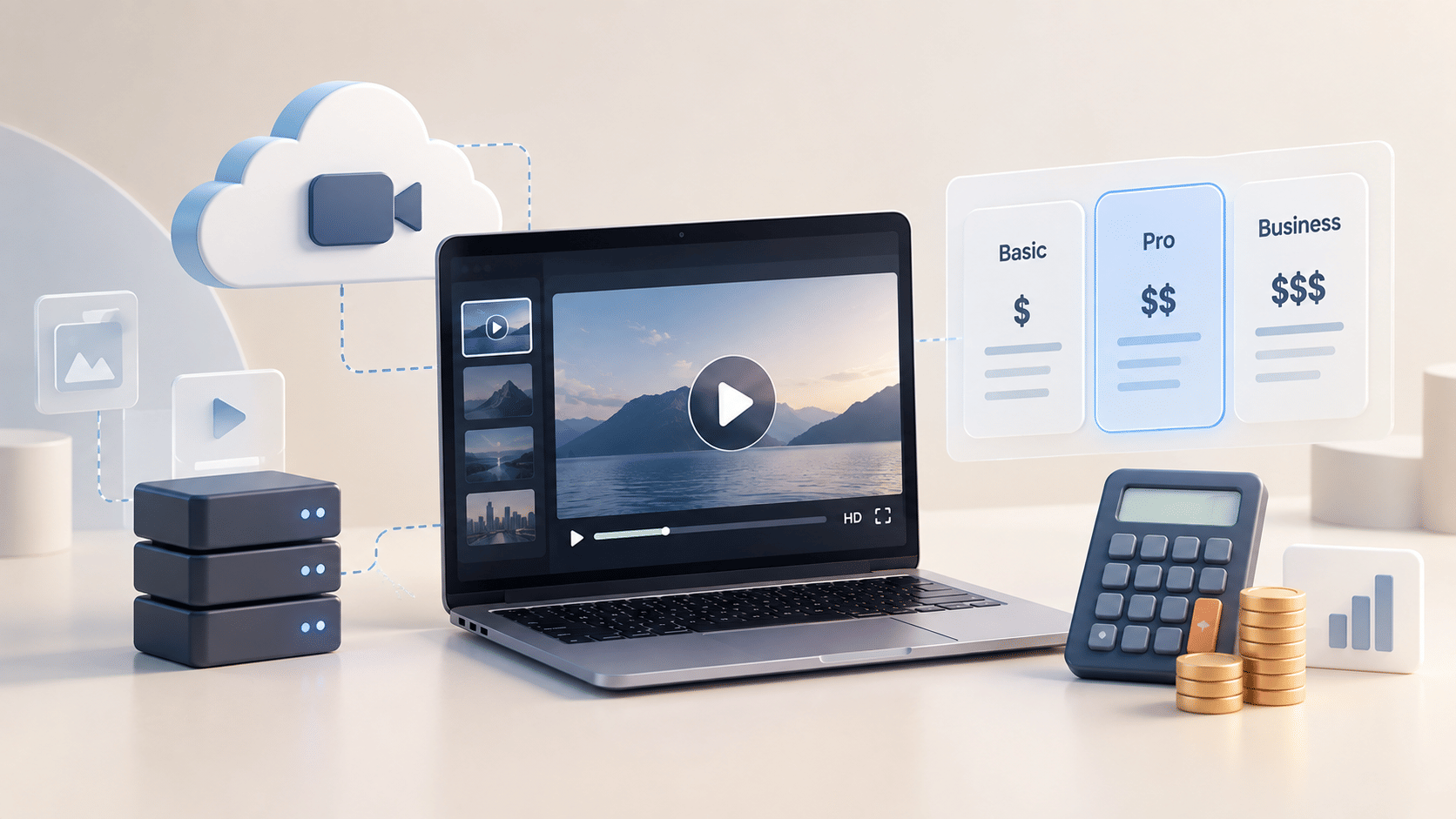

Wistia and Vimeo don't protect your course videos. They protect the page your videos are on.
That single distinction determines whether a student with a browser extension and five minutes can download your entire paid library and sell it on a Telegram channel. Most course creators running on these platforms don't know it. This article exists to close that gap.
This article compares four platforms on the criteria that actually determine what kind of course business you can build: content protection architecture, pricing model, analytics depth, and LMS compatibility.
Here's the specific argument: at non-enterprise pricing in 2026, multi-DRM protection is no longer exclusive to Brightcove-tier enterprise contracts, and the real choice between platforms is not "cheap vs. expensive" but "which security model and analytics stack fits the business I'm building right now."
By the end, you'll know exactly which platform fits your current course revenue, your piracy risk profile, and your marketing stack. Not which one has the cleanest landing page.
Key Takeaways
- Wistia and Vimeo restrict access to the page your video is on. They do not encrypt the video stream. Neither platform offers DRM protection on self-serve plans.
- As of mid 2026, full multi-DRM (Widevine + FairPlay) is available for $99/month from Gumlet and from $149/year from VdoCipher, putting enterprise-grade protection within reach of independent course creators.
- Vimeo's 2TB/month bandwidth cap applies equally to every self-serve tier, from the $12/month Starter plan to the $75/month Advanced plan. Only Enterprise buyers get custom bandwidth.
- Wistia rebuilt its entire pricing model on March 17, 2026. Legacy tier names (Plus, Pro, Advanced) are retired. Current plans are Free ($0, 25GB), Business ($79/month billed annually), and Enterprise (custom).
- The real split between Gumlet and VdoCipher is not security depth but platform scope: Gumlet combines DRM with full marketing analytics and CRM-event triggers; VdoCipher is a DRM specialist priced on annual bandwidth credits.
- GrowthSchool migrated from Vimeo to Gumlet and recorded a 52% increase in video completion rates. Their library of 100,000+ videos now serves 6.5 million learners from a 50TB+ content base.
TL;DR: If your course is priced above $200 per seat, you need DRM, not just a private link. Gumlet ($99/month add-on) and VdoCipher ($149/year) are the only two platforms in this comparison that provide it at non-enterprise pricing.
Wistia is the right choice when your course business depends on CRM-connected marketing and piracy is not a primary risk. Vimeo works for low-piracy content under 2TB/month of delivery. All four platforms are evaluated below on the dimensions that determine actual security, not just the ones that appear on marketing pages.
What Course Video Hosting Actually Needs To Do (and Where Most Platforms Stop Short)
Course video hosting has four real requirements: content protection that blocks actual piracy (not just unauthorized page access), playback that completes on slow mobile connections during launch spikes, analytics that trace back to revenue, and LMS integrations that don't break when you update your course platform.
Most platforms on the market solve one or two of these well and paper over the rest with marketing language. The most dangerous gap is the first one, and understanding it requires a distinction that almost no comparison article bothers to make.
The Protection Theater Test: Access Restriction vs. Content Encryption
Restricting who can reach your video is not the same as protecting the video itself.
When Wistia or Vimeo marks a video as "private" or "password-protected," it controls who can navigate to the page where the player loads. But once the player loads in an authenticated browser, the video is being streamed as a standard HTTP-accessible file.
A viewer who passes authentication can open browser developer tools, inspect the network tab, copy the raw .m3u8 HLS URL, and pass it to a free tool like yt-dlp to download the full video in minutes. This is documented publicly and takes no coding knowledge.
Digital Rights Management (DRM) works at a completely different layer. Widevine (Google) and FairPlay (Apple) are encryption protocols that tie each playback session to a cryptographic license issued by a license server.
Widevine handles DRM on Chrome, Firefox, Android, and most non-Apple environments. FairPlay handles DRM on Safari and iOS. Any course with meaningful mobile and desktop delivery needs both. A platform offering Widevine-only protection leaves iOS learners unprotected. This is why "multi-DRM" specifically means Widevine and FairPlay operating together, not either one in isolation.
The raw video stream is never decryptable outside the licensed player for that specific session. There is no URL to copy because the decryption key lives in the licensed playback environment, not in the file itself.
Access restriction vs. DRM: The One-line Difference
Access restriction controls who can reach the page where your video plays. DRM controls whether the video file itself can be decrypted, regardless of who reaches it. A password-protected video is accessible to anyone who passes the password. A DRM-protected video is unplayable to anyone without a valid session license, even if they have the file.
Here is a quick way to pressure-test any platform's security claims before you commit:
- Upload a test video and mark it as private or protected.
- Open the video in a browser, authenticate normally, and then inspect the network requests.
- Find the .m3u8 or .mp4 URL the player is fetching.
- Try to open that URL in an incognito tab or a new session.
If the video plays without requiring authentication in the second session, the platform is offering access restriction, not content protection. Wistia and Vimeo both fail this test on all self-serve plans. Gumlet (with the DRM add-on) and VdoCipher both pass it.
"Most course creators discover the gap between 'private' and 'protected' only after a piracy incident. By then the damage is done and the content is already circulating."
The 2TB Bandwidth Wall That Catches Every Vimeo User at Launch
Vimeo's 2TB/month bandwidth cap is the other structural problem that doesn't appear on any pricing comparison table.
It applies identically to every self-serve plan: Free, Starter ($12/month), Standard ($25/month), and Advanced ($75/month). A course creator who invests in Vimeo Advanced believing they're buying a scalable platform is on the same bandwidth ceiling as someone paying $12/month.
Exceeding 2TB in two separate months within a 12-month window, or delivering 10TB in a single month, triggers a mandatory upgrade conversation with Vimeo's enterprise sales team.
Enterprise plans are reportedly priced starting around $6,000/year. That is not a scalability path. That is a pricing trap.
Wistia in 2026: The Right Choice for Marketing-led Course Businesses (and the Wrong Choice for DRM)
Wistia is the right platform when your course business runs through marketing funnels, CRM-connected video attribution, and lead capture from video engagement, and when content piracy is not a material business risk.
That is a genuine use case. The problem is that "private" settings and "SOC 2 attestation" have been misread by many course creators as equivalent to content protection, and they are not.
Wistia has never offered DRM. This is confirmed directly in Wistia's security documentation. The platform's security controls are: domain restrictions (referrer-based), password protection on individual videos or channels, HTTPS delivery, and SOC 2 Type 1 and Type 2 attestations.
These are meaningful controls for a marketing platform. They are not a piracy deterrent for paid content.
Wistia's real strengths are in the marketing analytics stack: per-viewer engagement heatmaps, Turnstile lead capture forms that gate video play with email collection, and deep HubSpot, Marketo, and Pardot integrations.
These tools are genuinely differentiated. No other platform in this comparison matches Wistia's native CRM integration depth at the base Business plan tier, though that statement has a pricing asterisk.
Wistia's March 2026 Pricing Restructure: What Changed and What it Means
In March, 2026, Wistia retired all of its legacy tier names (Plus, Pro, Advanced) and moved to a new structure for all new customers. Current pricing is:
- Free: $0, 25GB storage, 1 user
- Business: $79/month billed annually, 250GB storage, 3 users included
- Enterprise: Custom pricing, 1TB+ storage, custom user count
The shift from video-count billing to storage-based billing matters practically. Wistia's previous plans capped video count at a fixed number per tier. The new Business plan at $79/month billed annually instead measures usage against 250GB of storage, plus a 10-video cap on the free tier.
A 30-hour course library with moderate quality settings will consume 250GB faster than a 50-video count limit, particularly if videos are stored at higher resolutions.
There is a second cost layer to consider. The CRM integrations that make Wistia worth its price for marketing-driven course businesses, specifically the HubSpot, Marketo, and Pardot connections, require the Automation Suite add-on.
That add-on costs $250/month billed annually, stacked on top of the $79/month Business plan. A course creator using Wistia for its marketing functionality is looking at $329/month before any enterprise features enter the picture.
Wistia makes complete sense for a course creator whose primary product is a live cohort, a high-LTV coaching program, or a webinar-based offer where the live element is the value and piracy risk is structurally low. If you're selling downloadable course access to thousands of students, the DRM gap matters more than the analytics depth.
Best for: Established course creators running active HubSpot or Marketo funnels, high-LTV cohort programs, and live coaching businesses where replay piracy is low-stakes.
Vimeo in 2026: Still a Clean Player, Structurally Capped at 2TB
Vimeo's value proposition for course creators has always been simple: an ad-free, professionally-styled player that embeds cleanly in any LMS, with basic privacy controls that work out-of-the-box. That proposition is still real. The structural limits around it have become harder to ignore.
Vimeo was acquired by Bending Spoons, an Italian software holding company, for $1.38 billion. The acquisition took Vimeo private and removed it from Nasdaq. Bending Spoons has a documented post-acquisition pattern across its portfolio: it acquired Evernote and relocated nearly all U.S. operations to Europe; it acquired WeTransfer and cut 75% of the workforce within two months of closing.
Vimeo cut 10% of its workforce in September 2025, while the acquisition was still pending. Then on January 20, 2026, two months after the deal closed, Bending Spoons confirmed a second round of layoffs that former employees described as covering most of the company, including the entire video engineering team, with reports of more than 1,000 employees affected globally.
According to Gumlet's May 2026 press release, Gumlet saw a 200% increase in inbound migration requests from teams leaving Vimeo in the six months following the acquisition close.
The pricing certainty that Vimeo once offered is now an open question. Annual billing commitments on a platform whose pricing direction is controlled by a capital allocator with a track record of post-acquisition cost recovery carries a risk that monthly subscribers can absorb more easily than annual pre-pays.
Current Vimeo Pricing in 2026:
| Plan | Annual billing | Monthly billing | Storage | Bandwidth |
|---|---|---|---|---|
| Starter | $12/mo | $20/mo | 2 TB | 2 TB/mo |
| Standard | $25/mo | $41/mo | 4 TB | 2 TB/mo |
| Advanced | $75/mo | $125/mo | 7 TB | 2 TB/mo |
| Enterprise | Custom | Custom | Custom | Custom |
Notice the bandwidth column. Every self-serve plan carries the same 2TB/month ceiling, regardless of price paid.
To put that ceiling in practical terms: a course with 1,000 students watching a 90-minute video in HD will consume approximately 900GB to 1.2TB of bandwidth in a single session. A launch week with 2,000 active students will breach the 2TB ceiling in days.
DRM on Vimeo Means Enterprise, Not Advanced
This is the point most comparison articles miss. Vimeo's Advanced plan ($75/month) lists "advanced privacy and security features" in its marketing materials. DRM is not one of them.
Vimeo DRM is gated behind Enterprise contracts, which independent sources report start around $6,000/year for base access. A course creator who reads "advanced security" and infers DRM is available at the Advanced tier is reading past a significant pricing disparity.
Before committing to Vimeo for a paid course library, confirm in writing whether DRM is available on your plan. The standard reply from Vimeo support confirms it is Enterprise-only. If your content is worth protecting, that confirmation should happen before you upload 200 videos.
At an independently reported starting price of approximately $6,000/year, that is roughly 7x the annual cost of Vimeo's Advanced plan ($900/year billed annually) to unlock a feature that Gumlet offers at $99/month and VdoCipher includes from $149/year.
Best for: Course creators whose content is low-to-moderate piracy risk, whose launch traffic stays under 2TB/month, and who want a clean branded player that their students already recognize from other platforms.
VdoCipher: Multi-DRM at Annual-credit Pricing, Built for EdTech Piracy Prevention
VdoCipher is the most commonly misrepresented platform in this comparison. Third-party articles repeatedly describe it as "enterprise-priced" or "best for large EdTech companies."
The actual pricing tells a different story. VdoCipher's Starter plan begins at $149/year, which works out to roughly $12.5/month. That is cheaper annually than one month of Wistia's Business plan.
VdoCipher's security stack is genuine. Widevine L1/L3 is default-integrated for all trial and paid accounts. FairPlay is available for all paid tiers (Apple requires a separate application, but VdoCipher handles the setup process).
VdoCipher also implements Google Play Integrity API to block video playback on rooted or emulated Android devices, which is a specific exploit that standard DRM does not address. Dynamic watermarking overlays the viewer's email address or IP address on the video stream, creating forensic traceability for any unauthorized screen recording that makes it online.
Where VdoCipher is genuinely limited is outside the security layer. The platform does not offer heatmap-level engagement analytics, CRM-event triggers, in-player lead capture forms, or retargeting pixel integration. These are not incidental features.
For a course creator whose business model includes marketing funnels, upsells, and video-triggered email sequences, VdoCipher's analytics layer is not designed to support that workflow. It handles delivery and security. Marketing attribution is out of scope.
VdoCipher's Annual Bandwidth Credit Model: What "Credits" Actually Means in Practice
VdoCipher's pricing model is structurally different from every other platform in this comparison. You purchase annual bandwidth credits rather than a monthly recurring subscription.
The plan ends when your bandwidth credits are consumed or when 12 months have passed, whichever comes first. There are no monthly bandwidth limits, which is actually an advantage during launch spikes, but the model requires reasonable estimation of annual consumption at the time of purchase.
Plans scale based on storage and annual bandwidth allocation. Overages can be negotiated as custom bandwidth additions on top of the base plan.
VdoCipher's customers include over 3,000 businesses across 120+ countries. The platform reports that its DRM and watermarking infrastructure has helped customers secure video libraries representing over $200 million in protected course and media revenue.
Best for: EdTech platforms, coaching institutes, test prep providers, and medical training companies where piracy prevention is the primary infrastructure decision and marketing analytics run on a separate stack.
Gumlet in 2026: DRM at Non-enterprise Pricing, With the Full Platform Stack
Gumlet is, as of May 2026, the only platform in this comparison that combines multi-DRM protection with a full marketing analytics stack at non-enterprise pricing. That is not a soft differentiator. It is a structural gap in how every other platform has chosen to bundle features.
Gumlet is a secure video hosting and delivery platform for SaaS teams, EdTech platforms, and course creators at scale. The examples and data below come from the platform's customer case studies and independently verified migration records."
Gumlet's Current Pricing in 2026:
| Plan | Monthly price | Key features |
|---|---|---|
| Creator | $6/month | Ad-free, domain restrictions, referrer protection, CTAs, lead capture |
| Growth | $19/month | Custom domain, member-only access, CRM integration, AI chapters, subtitles |
| Business | $99/month | VAST ad support, 10 team seats, 15,000 storage minutes, viewer analytics, H.265 |
| DRM add-on | $99/month | Widevine + FairPlay, dynamic watermarking, signed URLs, available on any paid plan |
The DRM add-on structure matters. Gumlet decoupled DRM from its Business plan entirely in mid 2026, meaning teams that need basic hosting don't pay for piracy infrastructure they don't use.
Teams that do need DRM pay $99/month, compared to an industry average of approximately $500/month for standalone DRM solutions.
Gumlet's DRM Update: What Changed for New Accounts
In a recent product update, Gumlet changed how DRM credentials are provisioned. All new signups now automatically receive both FairPlay and Widevine credentials in their account, with no separate request to Apple required.
Every account, including free-tier users, can process and test up to five DRM-protected videos without activating the add-on. This removes the previous friction point where creators had to request Apple FairPlay access through a manual review process that could take days to weeks.
The practical implication: any course creator evaluating Gumlet for video DRM can test the full protection stack before committing to the $99/month add-on.
Gumlet's LMS Integration
Gumlet supports embedding via iframe, HLS (M3U8), MP4, and DASH (MPD) formats, and is confirmed compatible with Thinkific, Moodle, Circle.so, WordPress, Salesforce, Webflow, and custom-designed LMS frameworks.
Teachable and Kajabi work via standard iframe embed code that both platforms support natively; no native plugin is required.
The platform supports Embed.ly, OEmbed, and Iframely. Beyond embedding, Gumlet includes native one-click import tools for both Vimeo and Wistia libraries, which means migration does not require manual video-by-video reuploading.
How Gumlet's DRM Compares to VdoCipher at the Technical Layer
Both Gumlet (with add-on) and VdoCipher deliver Widevine + FairPlay multi-DRM, dynamic watermarking, and signed URL access control. The security protection depth is comparable.
Three practical differences separate them:
- Provisioning friction: Gumlet auto-provisions FairPlay and Widevine for all new accounts. VdoCipher requires a separate Apple FairPlay application, which VdoCipher assists with but does not automate.
- Platform scope: Gumlet includes heatmap analytics, CRM-event triggers (HubSpot, Salesforce, etc.), in-player lead forms, and retargeting pixel support. VdoCipher does not offer these features.
- Pricing model: Gumlet’s pricing is based on a monthly subscription; VdoCipher is annual bandwidth credits. For creators with unpredictable traffic, Gumlet's monthly model offers more flexibility. For creators with stable, predictable volume, VdoCipher's annual model can offer better unit economics at lower bandwidth tiers.
Gumlet does not include PlayReady in its DRM stack. For the course creator audience in this article, this is not a material limitation. PlayReady is primarily relevant for smart TV and gaming console playback environments. Standard web browsers (Chrome, Firefox, Edge) and mobile platforms (iOS, Android) run on Widevine and FairPlay respectively.
The GrowthSchool Case: What Migration From Vimeo to Gumlet Actually Looked Like
GrowthSchool, an EdTech platform serving over 6.5 million learners, migrated from Vimeo to Gumlet with a library of more than 100,000 videos totaling 50TB+ of content.
The migration completed in under two weeks with zero downtime. Post-migration, GrowthSchool recorded a 52% increase in video completion rates, 150% growth in video consumption volume, a 36% reduction in cloud spend, and a 41% reduction in streaming bandwidth consumption.
"Gumlet didn't just solve our immediate roadblocks. It future-proofed our platform."
- Kamlesh Meghwal, GrowthSchool's Head of Engineering
The 4-platform Comparison at a Glance
| Feature | Wistia | Vimeo | Gumlet | VdoCipher |
|---|---|---|---|---|
| DRM (Widevine + FairPlay) | No | Enterprise only | Yes ($99/mo add-on) | Yes (all paid plans) |
| Dynamic watermarking | No | No | Yes | Yes |
| Signed/tokenized URLs | No | No | Yes | Yes |
| Bandwidth limit | None listed | 2TB/month (all self-serve) | None listed | Annual credit pool |
| Heatmap analytics | Yes | No | Yes | No |
| CRM event integration | Yes (Automation Suite add-on, $250/mo) | No | Yes (Growth plan +) | No |
| In-player lead capture | Yes | No | Yes | No |
| LMS embed compatibility | Most major platforms | Most major platforms | Thinkific, Moodle, WP, Circle.so, Webflow + | WordPress, Moodle + |
| Entry pricing | Free / $79/month - Business Plan (annual pricing) | Free / $12/month - Starter Plan (annual billing) | Free / $6/month - Creator Plan (annual billing) | $149/year - Starter Plan |
| DRM entry pricing | Not available | Available on Enterprise Plan at ~6,000+/year | $99/month (add-on) | Included from the $149/year Starter Plan |
| Best for | Marketing-led course funnels | Clean player, low-piracy content | DRM + full analytics stack | Piracy-first EdTech |
| Migration tools | None | None | One-click Vimeo + Wistia import | None |
Which Platform Fits the Course Business You are Actually Building
The right answer comes down to two variables: your piracy risk profile and your marketing stack requirements. These two dimensions map cleanly to platforms once you know your position on each.
If Your Course is Paid and Priced Above $200 per Seat: Start With DRM
Any paid course with a per-seat price above $200 is worth protecting with DRM. At that price point, a single unauthorized redistribution to a group chat of 50 people represents $10,000 in lost revenue on one incident. Password protection and domain restrictions don't prevent this. DRM does.
Between Gumlet and VdoCipher at this tier: if your course business includes CRM-connected marketing, video-triggered email sequences, or attribution from video engagement to sales pipeline, Gumlet is the platform.
If your marketing stack is separate and your primary need is a locked-down, piracy-resistant delivery layer, VdoCipher's annual pricing model is worth calculating against your expected bandwidth consumption.
If Your Course is Under $100 or Free: Vimeo or Wistia are Viable
Low-priced and free courses have a fundamentally different piracy calculus. When the marginal cost of a pirated copy is minimal and the content doesn't represent a significant per-seat revenue risk, investing in DRM infrastructure is likely over-engineered for the business model. Vimeo and Wistia are both legitimate choices here.
Choose Vimeo if you want a clean branded player your students recognize, your launch traffic fits under 2TB/month, and you don't need per-viewer analytics.
Choose Wistia if your course is part of an active marketing funnel and you're using HubSpot or Marketo for student lifecycle sequences; the engagement heatmaps and lead capture forms justify the price for this workflow.
Quick-match by course business type
| Course business type | Recommended platform | Primary reason |
|---|---|---|
| High-ticket course ($200+ per seat), marketing-driven | Gumlet | DRM + CRM analytics from one account |
| High-ticket course ($200+ per seat), marketing stack separate | VdoCipher | DRM-first at lowest annual cost |
| Cohort program or live coaching, low piracy risk | Wistia | Marketing analytics and lead capture |
| Free or low-priced course (<$100), clean player needed | Vimeo | Ad-free player, basic privacy controls |
| Large EdTech platform migrating from Vimeo | Gumlet | One-click Vimeo migration, DRM, analytics |
The 5-step Decision Framework for Choosing Your Video Host
Work through these in order. Stop when you have your answer.
- Is your course paid and priced above $200 per seat?
If yes, go to step 2. If not, go to step 4.
- Do you need forensic traceability if a video leaks?
If yes, DRM plus dynamic watermarking is required. Both Gumlet and VdoCipher provide this. If not (you're willing to rely on signed URLs and domain restrictions as deterrence), evaluate on platform breadth.
- Do your marketing campaigns depend on CRM-connected video attribution?
If yes, Gumlet. If not, VdoCipher's lower annual pricing may offer better cost efficiency.
- Do you deliver more than 2TB/month during course launches or ongoing?
If yes, Vimeo's self-serve plans are not scalable for your load. If not, Vimeo and Wistia are structurally viable.
- Does your LMS require native plugin integration?
Confirm your LMS against each platform's documented compatibility. Gumlet supports Thinkific, Moodle, Circle.so, WordPress, and Webflow. VdoCipher supports WordPress and Moodle natively. Vimeo and Wistia both embed broadly but have no LMS-specific native plugins.
If a platform cannot demonstrate end-to-end DRM playback protection in a live test before you sign, treat their security as theoretical.
Ask any DRM vendor to walk you through uploading a test asset, attempting an unauthorized extraction, and confirming the watermark trace is recoverable. This is a 30-minute exercise that will tell you more than any security documentation.
Video Hosting for Course Creators in Early 2020s vs. The 2026 Reality
The standard advice for course creators in the early 2020s was to host on Vimeo, set videos to unlisted or password-protected, and treat that as adequate content security. For most creators, the bandwidth was cheap, the player worked everywhere, and the threat model was abstract.
In 2026, three things have shifted:
- First, browser-based video extraction tools are materially simpler and more widely known than they were two years ago, lowering the skill threshold for unauthorized downloads.
- Second, the acquisition of Vimeo by Bending Spoons has introduced pricing uncertainty on a platform many course businesses built critical infrastructure around.
- Third, DRM pricing has dropped enough that enterprise-grade protection is now accessible at the same price point as a basic Vimeo Standard plan.
In 2026, the argument "I'll add DRM when I'm bigger" is backwards. You add DRM before the piracy incident, not after it.
The course video hosting market has also changed in a specific way that favors course creators: Gumlet's May 2026 price cut brought the Business plan from $199/month to $99/month and separated the DRM add-on as a standalone $99/month option.
Across the four platforms in this comparison, the cost gap between basic hosting and DRM-protected hosting has compressed significantly. The decision is no longer primarily financial.
Frequently Asked Questions
1. Does Wistia have DRM for online courses?
Wistia does not offer DRM on any of its current plans, including Enterprise. The platform's security model is built on access restriction: domain-level referrer controls, password protection, HTTPS delivery, and SOC 2 Type 1 and 2 attestations. These controls determine who can reach the video page.
Once a viewer passes authentication, the underlying video stream is accessible via standard HTTP requests and extractable with common browser tools. For course creators whose paid content is at real piracy risk, Wistia's security posture is not sufficient.
For creators where piracy risk is low and the value is in marketing analytics and CRM integrations, Wistia remains a strong platform for those specific requirements.
2. What is the cheapest video hosting with DRM for course creators?
VdoCipher's Starter plan, available from $149/year, includes Widevine and FairPlay multi-DRM plus dynamic watermarking and is the lowest entry point for genuine DRM protection in this comparison.
Gumlet's DRM add-on is available at $99/month on any paid plan, with a free test tier allowing up to five DRM-protected videos on all new accounts. If your annual bandwidth consumption is predictable and moderate, VdoCipher's annual credit model often offers better unit economics at the entry tier.
If you need DRM combined with CRM-connected analytics and flexible month-to-month billing, Gumlet at $99/month for the add-on (on top of the $6/month Creator plan) is the lower-cost path to the full security and marketing stack.
3. Does Gumlet have DRM as strong as VdoCipher?
Both Gumlet (with the DRM add-on) and VdoCipher deliver Widevine L1/L3 and FairPlay, which are the same DRM standards used by Netflix, Disney+, and major streaming platforms. At the encryption layer, protection strength is comparable.
The practical differences are in provisioning, scope, and pricing model. Gumlet auto-provisions FairPlay and Widevine credentials for all new accounts, removing the manual Apple application step. VdoCipher implements Google Play Integrity API to block playback on rooted Android devices, which Gumlet does not currently list as a feature.
For standard web and mobile playback environments, both platforms provide equivalent DRM protection. Choose between them based on whether you need the broader platform capabilities (analytics, CRM, lead capture) that Gumlet adds on top.
4. What happens to my Vimeo plan if I exceed 2TB bandwidth?
Vimeo's 2TB/month bandwidth cap applies to every self-serve plan from Starter through Advanced. If you exceed 2TB in two separate months within a 12-month rolling window, or if you deliver 10TB in a single month, Vimeo will contact you about upgrading to an Enterprise contract.
Enterprise pricing is not published but is consistently reported starting around $6,000/year for basic access. There is no overage billing option that lets you pay per-GB above the cap on self-serve plans; the only path forward is Enterprise. Before committing to annual billing on any Vimeo self-serve plan, calculate your peak monthly delivery volume against the 2TB ceiling and confirm whether your launch weeks could realistically breach it.
5. Can Gumlet integrate with Teachable, Thinkific, and Kajabi?
Gumlet supports embedding on any platform that accepts iframe, HLS (M3U8), MP4, or DASH (MPD) embed formats. Thinkific and Moodle are confirmed in Gumlet's official documentation as compatible platforms. Circle.so, WordPress, Salesforce, and Webflow are also listed as confirmed.
For Teachable and Kajabi, Gumlet embeds work via standard iframe code that both platforms support. Gumlet also supports Embed.ly, OEmbed, and Iframely standards, which broadens compatibility with less common LMS environments.
For platforms requiring native plugin integration rather than embed code, confirm your specific LMS against Gumlet's documentation before migrating your library.
6. Is VdoCipher good for small course creators, or is it enterprise-only?
VdoCipher is not enterprise-only. Its Starter plan begins at $149/year, which averages to roughly $12/month, and includes full Widevine and FairPlay DRM, dynamic watermarking, and secure embedding.
VdoCipher's customer base, as documented on its website, includes individual educators, coaching businesses, and small test prep platforms alongside larger EdTech companies. The pricing model, annual bandwidth credits rather than monthly subscriptions, is different from most SaaS tools and can create budget friction for creators whose traffic is unpredictable.
But the entry cost is accessible to any course creator with a viable paid course business. The main limitation for small creators is not pricing; it is the absence of built-in marketing analytics and CRM integrations, which may require separate tools to replicate.
7. What is the difference between password protection and DRM for online courses?
Password protection controls access to the page where your video is embedded. Once a student enters the correct password and the player loads, the video stream is being served as a standard file over HTTP.
Anyone who passes that authentication can use browser developer tools to locate the raw video URL and download the file directly, or use a browser extension to capture the stream. DRM (Digital Rights Management) works at the encoding layer.
The video file itself is encrypted using protocols like Widevine or FairPlay, and playback requires a valid cryptographic license tied to the specific viewing session. A stolen URL from a DRM-protected video cannot be played back without the session license.
For any paid course priced above $100 per seat, treat password protection as an access gate and DRM as actual content security, because they solve genuinely different problems.
8. Does Wistia work for courses where I need to track individual viewer progress?
Wistia provides per-viewer engagement data through its heatmap and analytics features on the Business plan, including play rate, watch percentage, and engagement curves by individual viewer when viewers are identified through Turnstile lead capture or CRM integration.
For completion tracking in the sense most LMS platforms use (pass/fail thresholds, certification triggers), Wistia does not offer native LMS-grade progress reporting. If individual viewer analytics for marketing purposes matters (who watched what, for how long, from which campaign), Wistia delivers that well.
If you need LMS-grade progress tracking tied to certifications or cohort completion rates, your LMS platform's native completion tracking, combined with video embeds from any of the platforms in this comparison, will serve that use case more directly.
9. Can I migrate from Vimeo or Wistia to Gumlet without re-uploading everything?
Yes. Gumlet includes a native one-click import tool for both Vimeo and Wistia libraries. The importer transfers video files, folder structure, and metadata without requiring manual re-upload. For Vimeo, the migration also preserves privacy settings and workspace organisation. For large libraries, the process runs in the background and does not affect live embeds during transfer. GrowthSchool completed a migration of 100,000+ videos and 50TB+ of content in under two weeks with zero downtime.
The Bottom Line
Your video hosting choice is a product architecture decision, not a software subscription decision.
The platform you pick determines what kind of paid content business you can build: one where piracy is a theoretical concern you'll address later, or one where the video infrastructure itself prevents unauthorized distribution from day one.
For course creators with priced content above $200 per seat, the math on DRM has changed. Gumlet's $99/month DRM add-on and VdoCipher's $149/year Starter plan both deliver Widevine and FairPlay protection at a price point that was unimaginable three years ago. The "I'll add DRM when I'm a real business" reasoning is no longer grounded in cost; it's grounded in inertia.
If you're evaluating Gumlet specifically against your current Wistia setup, the Gumlet Wistia alternative guide is the most direct comparison available, covering feature depth, migration mechanics, and pricing side-by-side.
The migration from Wistia is a native one-click process; Gumlet's docs include a dedicated Wistia import tool that transfers your entire video library without manual reuploading.
The platforms that compound a course business over time are the ones where the security infrastructure and the analytics infrastructure work from the same data layer. Bolting DRM onto Wistia is not possible. Bolting marketing analytics onto VdoCipher is a separate software project.
Only one platform in this comparison solves both from a single account, and that is Gumlet. The Gumlet pricing page includes a free plan with no credit card required. For teams with an existing library, the one-click Wistia or Vimeo import takes minutes.