A creative agency recently described their Wistia setup to us: six clients, one account, folders named "Client A - Draft" and "Client B - All."
Their solution for preventing a junior editor from browsing a confidential client's library was a verbal rule: "don't click into the other folders."
That is not client isolation. It is an honor system.
The problem is not the platform choice, but it is the architectural mismatch. Most video hosting platforms are built for one company, one brand, and one library. Agencies run multiple brands, multiple access levels, and multiple clients who expect their data to stay separate. Wistia gates real isolation behind Enterprise pricing. Vimeo does the same with workspaces.
When a single-brand tool gets stretched across six clients, no amount of folder discipline fixes it.
This article scores the leading video hosting platforms against a four-criteria agency framework, and shows you which ones were actually built for multi-client work.
Key Takeaways
- Most video hosting platforms are built for single-brand teams. Their seat limits, workspace restrictions, and storage-tier structures quietly become a scaling tax once an agency crosses four or five active clients.
- Workspace limits are a pricing mechanism, not a technical constraint. Vimeo and Wistia both gate multi-client isolation behind enterprise tiers that most agencies never budget for.
- The four criteria that actually matter for agency video infrastructure: client isolation architecture, branding scalability, analytics portability, and cost linearity.
- Wistia's Business plan at $79/month covers three users. Add the $250/month Automation Suite for CRM integration and you are at $329/month before you have added a fourth collaborator.
- Gumlet's collections-first architecture gives agencies no hard cap on collections, 10 team seats at $99/month, and a decoupled DRM add-on at $99/month, a setup built for multi-client management that Wistia and Vimeo were not designed to deliver.
- Vimeo is now owned by Bending Spoons, which restructured Evernote and WeTransfer within months of each acquisition. Any agency committing to Vimeo in 2026 is also betting on that ownership's pricing intentions.
How the Leading Video Hosting Platforms Score on the Agency Framework
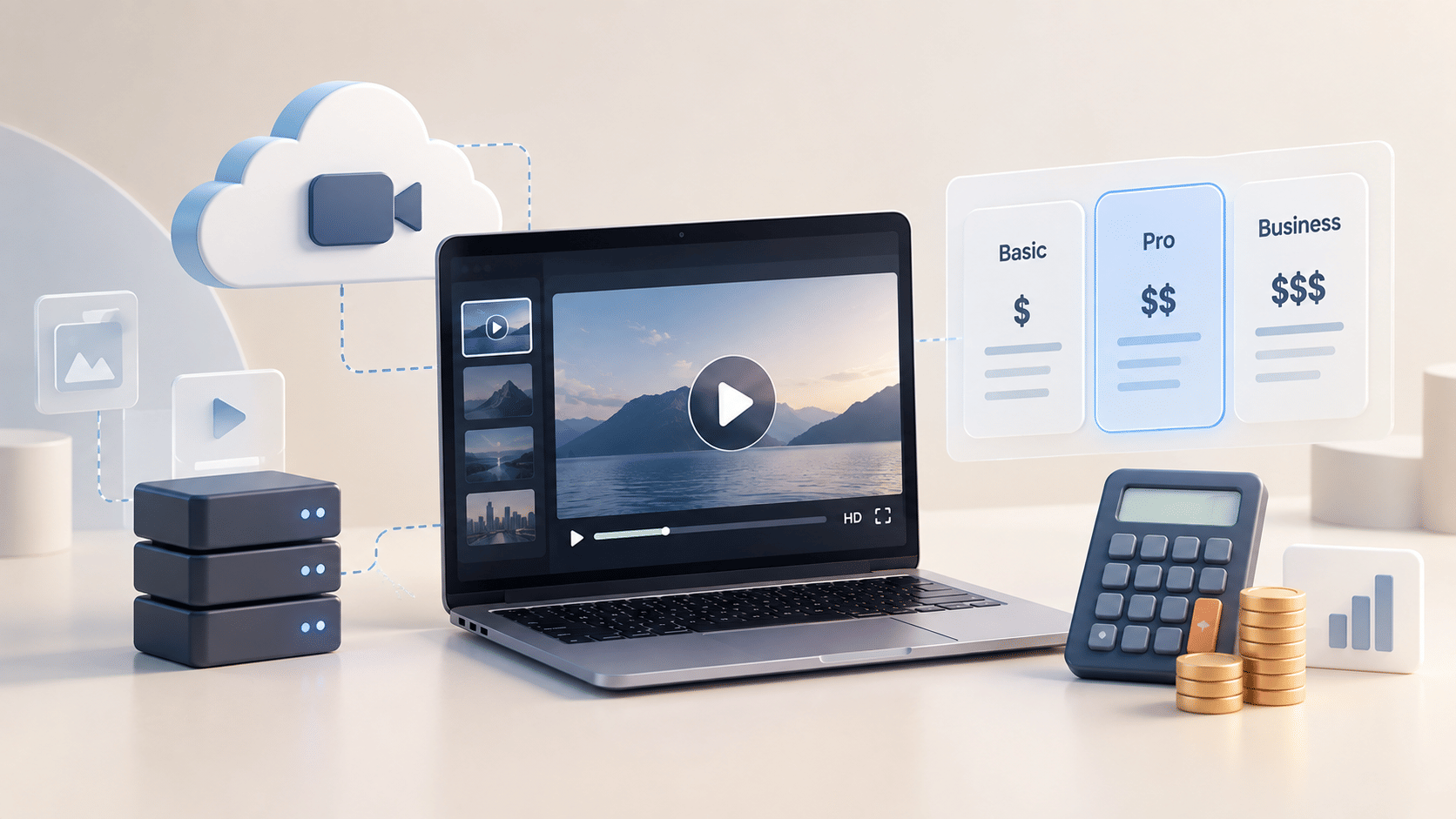
The table below gives an honest assessment. No platform is perfect. Gumlet scores well on architecture and cost; SproutVideo is worth considering for agencies whose primary need is straightforward private hosting with solid security controls; Wistia remains a strong choice for single-brand marketing teams but struggles at agency scale.
| Platform | Client Isolation Architecture | Branding Scalability | Analytics Portability | Cost Linearity |
|---|---|---|---|---|
| Gumlet | Collections-first; sub-account scoping per collection | White-label player on all paid plans | Per-collection analytics available | Linear: storage + fixed seat count, no per-collection charge |
| Wistia | Folder-based; account-wide access | Full white-label on Business plan | Account-level only; filtering required | Non-linear: per-seat gating above 3 users |
| Vimeo | Enterprise-only workspaces | Advanced on Standard+; full on Enterprise | Good on Advanced tier | Non-linear: workspace isolation gated at Enterprise |
| SproutVideo | Folder-based with some permission controls | Good white-label across plans | Per-folder reports available | Reasonably linear; storage-based scaling |
1. Gumlet: Collections-first, DRM Without Enterprise Gates
Gumlet's collections model is the architectural difference that matters most for agencies.
Collections are first-class objects in the platform. You can assign sub-account access scoped to a specific collection, meaning a junior editor or client contact can log in and see only their content.
There is no hard cap on the number of collections you can create, and advanced video analytics, workspaces, and 24/7 live support are included on every paid plan, not gated at enterprise tier.
The Business plan at $99/month (down 50% from $199/month as of June 2026) includes 10 team seats, 15,000 storage minutes, custom viewer analytics, H.265 codec support, and technical integration support. For a five-person agency team with six clients, this is a viable single-account setup.
The DRM story is also relevant for agencies with EdTech or OTT clients. Gumlet has decoupled video DRM from its Business plan entirely. As of the latest platform update, all new signups automatically receive both FairPlay and Widevine credentials in their account.
Every account can process and check up to five DRM-protected videos at no cost. For agencies whose clients need content protection, the $99/month DRM add-on is a fraction of the $500/month industry average, with zero setup fees and no additional contract.
This matters because it means agencies can offer DRM-grade protection to an EdTech client without forcing that client into an enterprise tier they do not otherwise need.
GrowthSchool, an EdTech platform that previously ran on Vimeo, migrated more than 100,000 videos to Gumlet in under two weeks with zero downtime. After switching, GrowthSchool saw a 52% increase in video completion rate across its library, a 36% reduction in cloud spend, and a 150% growth in video consumption.
The infrastructure requirements GrowthSchool solved: per-library analytics, DRM at scale, and a single account managing a large growing video library across multiple product lines, map directly to what agencies encounter across their client roster.
2. Wistia: Strong on Marketing Analytics, Structurally Expensive for Agencies
Wistia is genuinely well-built for what it is: a marketing video platform with excellent engagement analytics, heatmap-level viewing data, CRM integrations, and clean lead generation tools.
The product is coherent and the analytics depth is real. The structural issue is that Wistia's architecture was designed for a single marketing team, and every tier boundary reinforces that assumption.
At $79/month for 3 users, Wistia's Business plan works for a two-person agency or a freelancer with a couple of clients. Once you need a fourth collaborator, you are in Enterprise territory at custom pricing.
The HubSpot/Marketo/Pardot integration requires the $250/month Automation Suite add-on, paid separately.
For agencies with three or fewer clients who primarily need branded video analytics and marketing automation, Wistia is defensible. For agencies managing five or more clients with distinct access requirements, the math breaks.
3. Vimeo: Powerful Enterprise Product, Uncertain Pricing Trajectory
Vimeo's enterprise offering is genuinely robust. The workspace model, when accessed at Enterprise tier, does give a distinct folder-based organization with user permissions and branding controls.
The review and collaboration workflow is solid for creative agencies that need client feedback loops on video content.
The complication as of June 2026 is ownership. Bending Spoons acquired Vimeo for $1.38 billion. Bending Spoons is not a video infrastructure company. It is a capital allocator with a documented operational pattern: after acquiring Evernote, it relocated operations to Europe and cut the majority of US staff.
After acquiring WeTransfer, it reduced headcount by 75% within two months. With Vimeo, it has reduced the workforce by 10% and restructured pricing plans. Every infrastructure and pricing decision Vimeo makes from this point forward will be filtered through that ownership mandate.
An agency building its video delivery stack on Vimeo in mid-2026 is making a long-term vendor commitment to a company whose pricing architecture is being reoptimized by a firm whose stated strategy is post-acquisition cost recovery. That is a risk worth pricing into the decision.
For agencies already on Vimeo's Advanced plan, the migration path to Gumlet is one-click: the entire library including files, folders, and metadata transfers with zero downtime and no manual reconstruction.
The 4 Criteria Agencies Actually Need
Evaluating video hosting platforms by checking a feature grid misses the question that actually matters for agencies: does this platform's architecture support multi-client management, or does it require workarounds?
The four criteria below form what we call the Agency Video Stack Audit. Score any platform against them before committing.
| Criterion | The Question to Ask | Green Flag | Red Flag |
|---|---|---|---|
| Client Isolation Architecture | Can I scope a team member's access to one client's content without a separate account? | Collection-level permissions within one billing account | "Create a new account per client" |
| Branding Scalability | Can each client's embedded player look different without manual reconfiguration? | Per-collection player settings | Global player settings only |
| Analytics Portability | Can I export one client's video performance data without filtering out everyone else's? | Per-collection analytics export | Full-account CSV only |
| Cost Linearity | Does my monthly cost stay flat as I add client #7 and #8? | Flat storage + seat pricing | Per-workspace or per-seat scaling |
1. Client Isolation Architecture: Collections vs. Workspaces
Client isolation (in video hosting): The ability to create separate, permission-gated content environments for different clients within a single platform account, so that a user assigned to Client A cannot view, edit, or access Client B's videos, folders, or analytics. True client isolation is structural, not organizational. Folder naming conventions and verbal rules are not client isolation.
Client isolation architecture describes whether a platform lets you create separate content environments per client, with distinct access permissions, within a single billing account.
Workspace-first platforms (like Vimeo and Wistia) treat the account as the primary container. Folders or projects exist within that single workspace, and access management is applied at the account level. If you want real isolation, you need separate accounts, which means separate billing.
Collection-first platforms treat collections (the equivalent of per-client libraries) as first-class objects with their own access controls. You can scope a sub-account or team member's permissions to a specific collection, meaning they can upload, edit, and view only their assigned client's content. The account is the billing unit; collections are the operational unit.
This architectural distinction is the single most important factor in an agency's platform selection and it appears on almost no vendor comparison page.
2. Branding Scalability: Per-plan or Per-client
White-label player customization sounds like a feature. At agency scale, it is a delivery requirement.
If you are managing a fitness brand, an EdTech startup, and a SaaS company on the same account, you need the embedded player on each client's site to match their brand, not yours or the platform's.
The question is not whether white-label exists. The question is at which plan it is available, and whether it can be configured independently per client or requires manual reconfiguration each time you switch context.
On Wistia's Business plan, removing Wistia branding from the player is included, but player settings are applied globally, as in, there is no collection-scoped player configuration, so switching the player appearance for Client B means temporarily changing the settings that Client A's embed is also using.
On Gumlet, video player branding is configurable per collection, meaning each client's embedded player is set once and stays independent. Platforms that reserve full white-label customization for enterprise tiers are making a clear statement about who they built the product for.
3. Analytics Portability: Per-client Reports vs. Account Totals
Every video platform offers analytics. Almost none of them make it easy to generate a per-client performance report without manually filtering and exporting the entire account's data.
For an agency delivering a monthly video performance report to Client B, pulling data that includes Client A's numbers, then filtering them out, and then formatting the output into a client-facing report is three steps that should be one.
Before selecting a video hosting platform for agency use, ask the vendor to show you the specific workflow for generating a per-collection or per-project analytics export. If the answer is "export the full account data and filter in Excel," the analytics architecture is not built for multi-client reporting.
4. Cost Linearity: Pricing That Stays Flat as the Client Roster Grows
The question is not what a platform costs today. The question is what it costs when you add your 8th client.
Pricing models that gate workspaces, cap seats at a plan floor, or require separate billing accounts per client multiply the cost per client in a way that compresses agency margin over time. A pricing model tied to storage and a fixed seat count stays predictable regardless of how many client collections you create.
Most agency operators price their video hosting cost as a line item in their retainer and absorb the overages internally. This works with two clients. By client six, the hidden infrastructure tax has become large enough to matter.
What Multi-Client Setup Actually Looks Like on Gumlet
Three scenarios that illustrate how the architecture maps to real agency workflows.
Scenario 1: A Content Agency With Six Brand Clients
One Gumlet Business account. Six collections, one per client. Each collection is white-labeled with the client's brand color and logo in the embedded player. The account owner and lead editor have full access.
Junior editors are scoped to their assigned collection only. Monthly analytics exports go to each client's reporting doc without manual filtering.
Scenario 2: An EdTech Content Agency Managing Course Libraries for Three Learning Platforms
Same account structure as above, with the DRM add-on enabled. Each client's course videos are protected with Widevine and FairPlay. Tokenized URLs mean a stolen link expires before it can be reshared in a group chat. Per-collection analytics let the agency report separately on each client's learner engagement data.
Scenario 3: A B2B SaaS Agency Managing Product Demos and Onboarding Videos for Four Clients
The CRM integration (HubSpot or Salesforce) fires video engagement events from each client's player into that client's CRM instance. In-player CTAs and lead capture forms are configured per collection. The agency bills each client for a proportional share of the $99/month Business plan rather than running four separate Wistia accounts.
The multi-property management model Simplotel runs: one platform, client-level isolation, zero downtime across a large migration, is structurally identical to how agencies scale their video library management.
Simplotel, a hospitality technology platform managing websites and booking engines for more than 3,000 hotel properties across 26 countries, achieved a 61% reduction in operational spend after migrating to Gumlet.
The relevant infrastructure detail for agencies: Simplotel's migration required no code or API changes and completed in two days with zero downtime. A platform that can migrate at that scale without downtime handles multi-client library growth without the operational fragility that single-account-per-client models create.
The Workspace Limit Was Always a Pricing Mechanism
Every example in the sections above points to the same conclusion. Wistia has restructured its pricing model more than once in response to user pressure, each time shifting where the billing friction sits, from storage overages to seat counts to add-on gates.
The mechanism changes. The underlying pattern does not. The billing lever will always be placed at the point where multi-client use starts to scale, because that is where the upgrade incentive is strongest.
Wistia's three-user Business plan ceiling has no technical basis. Running four simultaneous users in a shared video library creates no meaningful infrastructure cost differential. The seat limit is a pricing optimization, not a server constraint.
The same logic applies to Vimeo's workspace-level isolation sitting exclusively at Enterprise tier. The feature works the same way at any tier. The gate exists to push buyers toward higher contract values.
The relevant question for agency operators is not "does this platform support multi-client management" but "at what price point does real client isolation actually become available." If the honest answer is "Enterprise, custom pricing," the platform was not designed for you.
In 2026, two things have changed compared to the video hosting landscape of a few years ago.
First, collection-first platforms have matured enough to offer enterprise-grade delivery quality (multi-CDN routing, GPU transcoding, SOC2/ISO 27001 certification) at plan pricing rather than enterprise contract pricing.
Second, the Bending Spoons acquisition of Vimeo has introduced a pricing uncertainty into the market that did not exist in 2023. Agencies that locked in Vimeo contracts before November 2025 are watching a different company manage their video infrastructure than the one they signed with.
Both shifts mean the agency video hosting decision in mid-2026 looks different than it did two years ago. The incumbent platforms have not gotten cheaper or more structurally friendly to multi-client workflows. The alternatives have gotten meaningfully better.
Frequently Asked Questions
1. Can I manage video libraries for multiple clients from a single Gumlet account?
Yes, and the architecture is built for it. Gumlet's collections function as isolated client environments within a single account. You can create a separate collection per client, white-label the player for each, and scope sub-account access so team members or clients can only view and manage their own collection.
There is no hard cap on the number of collections you can create. Advanced analytics, 24/7 support, and team seat allocation are included on all paid plans, so you are not paying per-client to access the features that make multi-client management workable.
If you are currently running separate Wistia accounts per client, a single Gumlet Business account at $99/month handles ten seats, making the cost comparison straightforward.
2. What is the difference between a workspace and a collection in video hosting?
A workspace is an account-level container: all users on the account share access to everything inside it, with permission levels applied globally. A collection is an object-level container: access permissions can be scoped specifically to that collection, so a user with access to Collection A cannot see Collection B.
This distinction determines whether client isolation is genuinely structural or just organizational. Workspace-first platforms like Vimeo and Wistia require separate accounts for real isolation.
Collection-first platforms like Gumlet build isolation into the architecture without separate billing accounts. For multi-client agency management, the architectural model you choose determines your operational ceiling.
3. Is Wistia too expensive for agencies managing more than three clients?
For most agencies with four or more clients, yes, the math breaks. Wistia's Business plan at $79/month includes three users and 250 GB of storage, with no additional seats available below Enterprise tier. The CRM integration via HubSpot, Marketo, or Pardot requires the $250/month Automation Suite add-on.
That is $329/month for three users in a single workspace before you have addressed the multi-client isolation problem. At six clients with a four-person agency team, the per-client cost structure makes Wistia an expensive choice relative to platforms designed for multi-tenant workflows.
Before committing to Wistia at agency scale, calculate your total monthly cost including the Automation Suite and project what that number looks like at your target client count in 12 months.
4. Does Gumlet support white-label video players for agencies?
White-label player customization is available on all Gumlet paid plans, not gated at an enterprise tier. You can configure the player colors, branding, and controls per collection, meaning Client A's embedded video player on their website looks different from Client B's.
This is a plan-level feature at Gumlet; at Vimeo, full white-label without platform branding requires the Advanced plan at minimum and full custom branding at Enterprise. The practical implication: you can deploy branded players for all of your clients from a $99/month Gumlet Business account without a custom enterprise contract.
5. Which video hosting platforms support per-client analytics reporting?
Among the major platforms, per-collection or per-project analytics are available from SproutVideo (per-folder reports), Gumlet (per-collection analytics on Business plan), and to a limited degree from Vimeo at the Advanced tier. Wistia's analytics are account-level, requiring manual filtering to isolate client-specific data.
The practical test: ask any platform to show you how you would generate a monthly video performance report for one specific client without seeing any other client's data. The workflow complexity of that answer tells you whether the analytics architecture was designed for multi-client reporting or retrofitted to support it.
If the answer involves exporting a full account CSV and filtering in a spreadsheet, budget the manual hours into your operational model.
6. How do I give a client access to only their own videos without exposing other clients' content?
Use collection-level sub-account access. On collection-first platforms, you create a collection per client and assign sub-account credentials scoped to that collection. The assigned user can upload, edit, and view only their collection.
On workspace-first platforms, the standard workaround is a separate billing account per client, which multiplies your subscription cost proportionally. The specific workflow in Gumlet: create a collection, go to collection settings, and add team members with role-based access.
Those users will not see other collections in the account. Check that any platform on your shortlist supports collection-scoped access, not just account-level roles, before committing.
7. Does Gumlet support DRM for agencies with EdTech or OTT clients?
Yes, and the implementation model changed significantly in 2026. All new Gumlet signups now automatically receive both FairPlay and Widevine credentials in their account. Every account can process and check up to five DRM-protected videos at no additional cost.
For clients that need DRM at scale, the $99/month add-on enables Widevine and FairPlay protection across the full library at roughly one-fifth the industry average cost of $500/month.
For an agency managing a single EdTech client who needs course protection, this makes DRM viable without forcing an enterprise-tier contract on a client whose other requirements are mid-market.
Pair DRM with tokenized URLs for time-limited session-level access, and the security model handles most EdTech and OTT content protection requirements without additional tooling.
8. What happens to Vimeo pricing after the Bending Spoons acquisition?
Vimeo was acquired by Bending Spoons for $1.38 billion, with the deal closing in November 2025. Bending Spoons has restructured Vimeo's workforce and pricing plans since closing. Its track record across prior acquisitions (Evernote, WeTransfer) involves significant operational restructuring within the first year.
Vimeo's current published pricing may not reflect where the platform lands in 12 to 18 months. If you are signing a Vimeo contract in mid-2026, verify the pricing lock-in terms carefully and consider what the platform costs if pricing changes at renewal. The migration path from Vimeo to Gumlet is one-click and includes full library transfer with zero downtime.
9. Is there a free way to evaluate Gumlet for multi-client agency use before committing?
Yes. Gumlet's free plan is available with no credit card required and includes access to the collections architecture, player customization, and analytics, the three features that matter most for evaluating whether the platform fits your agency's workflow.
To test multi-client isolation specifically, create two collections, assign different sub-account access to each, and verify that each user can only see their assigned collection. The Business plan at $99/month unlocks 10 team seats, 15,000 storage minutes, and the full feature set.
DRM evaluation is also possible on the free plan, every account can process and check up to five DRM-protected videos at no cost before adding the $99/month DRM add-on.
Closing Thoughts
The clearest signal that a platform was not built for agency workflows is when the fix for "my clients' content is mixed together" is a verbal rule.
Real client isolation is an architectural decision, and the platforms that built it in at the plan level made a deliberate choice to support multi-tenant workflows. Those that did not, made an equally deliberate choice about who their product is for.
For agencies currently managing multiple clients on Wistia and running into the three-user ceiling, or on Vimeo and facing the Enterprise pricing wall for workspace isolation, the architecture comparison is worth taking seriously.
Gumlet's full breakdown of how it approaches the workflows Wistia leaves underbuilt is covered in its Wistia alternative guide, including a direct feature and pricing comparison.
The video hosting decision in 2026 is not just about playback quality or CDN reach, both of which the leading platforms handle adequately. It is about whether the organizational model your infrastructure assumes matches the organizational model your agency actually runs. For most agencies, those two things are currently not the same.