
GumletGumlet logo
Get a demoSign Up
Pricing
Login
Get a demo
Signup

Video Marketing

30 min read

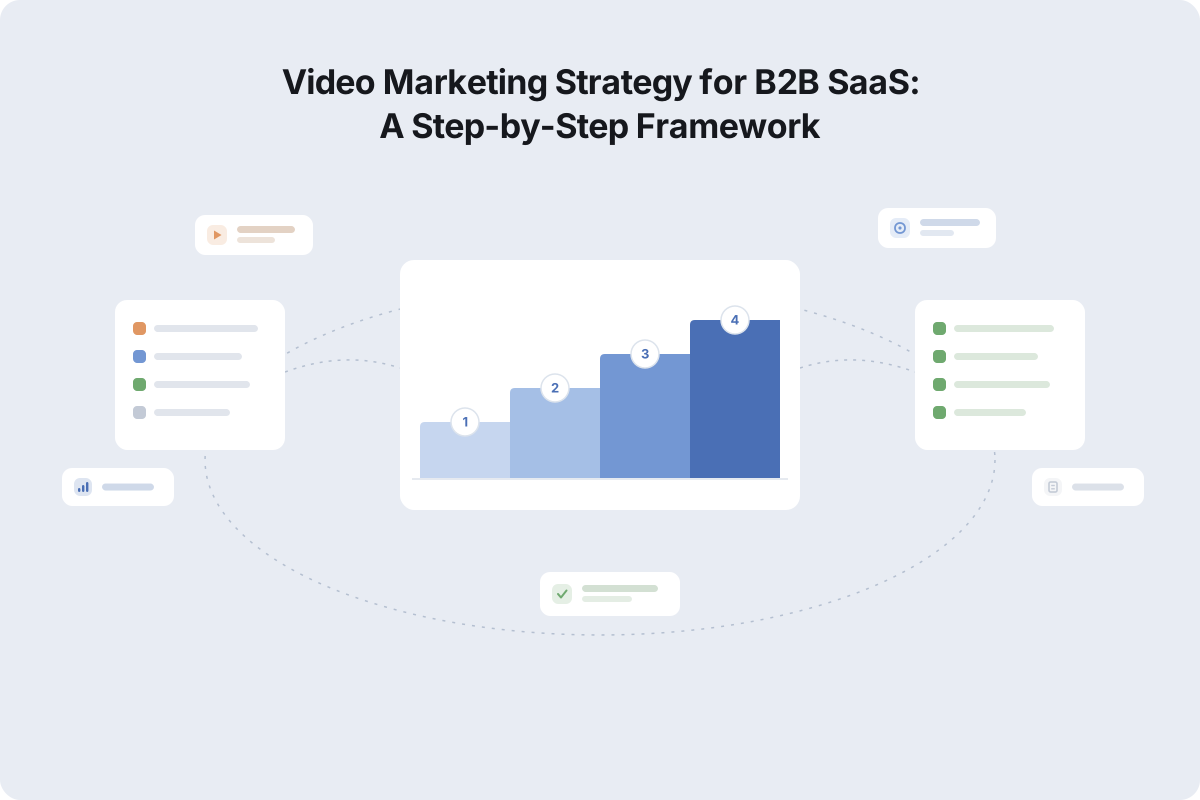
Video Marketing Strategy for B2B SaaS: A Step-by-Step Framework

A video marketing strategy for B2B SaaS assigns every video a funnel stage, a metric, and a path into your CRM. Here are seven ordered steps, from strategy to production to distribution to measurement, with real SaaS examples, so your video budget survives the next planning cycle.

Nisha Manoj
Written by
Nisha Manoj
Shubham Hosalikar
Reviewed by
Shubham Hosalikar
Updated on Aug 17, 2026
Video Marketing Strategy for B2B SaaS: A Step-by-Step Framework

Share this Article

Summarize and analyze this article with
ChatGPTPerplexityGrokGoogle AIClaude

A video marketing strategy for B2B SaaS is the system that assigns every video a funnel stage, a metric, and a path into your CRM, so each asset has a defined job instead of a vague hope that someone useful is watching.

Build it well and video compresses a multi-week evaluation into a few high-intent sessions. Build it as a pile of disconnected clips and you get a cost nobody on the revenue team can defend.

The numbers say video itself is settled. As of 2026, 91% of businesses use video as a marketing tool, matching an all-time high, and 82% of video marketers report positive ROI, according to Wyzowl's 2026 State of Video Marketing report.

At that adoption level, using video is not the advantage anymore. Using it with a system is.

This article is for B2B SaaS marketers, demand-gen leads, and founder-led teams who already know video matters and want a repeatable framework instead of another "video is important" lecture.

You get seven ordered steps, each with a real SaaS example and a number, moving from strategy to production to distribution to measurement.

It ends where most strategies fall apart: showing you how to measure the thing so your video budget survives the next planning cycle.

Key Takeaways

  • A video marketing strategy for B2B SaaS is a system, not a content calendar. Every video gets one funnel stage, one metric, and one route into the CRM before anyone writes a script.
  • Video type has to match the buying stage: thought-leadership and social clips up top, product tours and webinars in the middle, demos and customer stories at the bottom. Sending a demo to a stranger converts nobody.
  • The decision that separates programs that work from programs that quietly die is not production quality. It is distribution and measurement. Most B2B SaaS video fails because nobody watched it or nobody could prove it drove pipeline.
  • This is a 7-step framework, the Pipeline-First Video Loop, running from tying a video to a revenue goal all the way to scoring video-qualified leads (VQLs) inside your CRM.
  • A view is not a result until it is attached to a contact record and a pipeline number. Everything before that is potential, not proof.

Why B2B SaaS Needs a Video Strategy (Not Just Videos)

B2B SaaS buying is long, committee-driven, and heavy on product complexity, which is exactly why video is the format that carries the most weight when it has a job.

It demos the product, builds trust across a buying committee that never all joins the same call, and shortens evaluation, but only when each video is assigned a stage and a metric rather than posted and forgotten.

Here is the part most teams skip. A video's job in B2B SaaS is not to be watched. It is to move a named account one step down the funnel. That reframing changes what you make, where you put it, and how you grade it.

The table below maps the funnel to video type, goal, and a current benchmark. This is the reference layer to build your own plan against.

Funnel stage Best video type Primary goal Benchmark to aim at
TOFU (awareness) Thought-leadership, short social clips Reach and watch time Videos under 1 minute hold the highest completion, around 65%, per Vidyard's benchmark of nearly 1 million B2B videos; LinkedIn video posts average roughly 5.6% engagement versus static formats, as per Socialinsider's 2025 LinkedIn Benchmarks
MOFU (consideration) Explainer, product tour, webinar Viewer-to-lead rate About 24% of viewers submit an in-player lead form and 16% click an in-video CTA as per Wistia's 2026 State of Video report; webinars rank as a top-two impact format
BOFU (decision) Demo, customer story, ROI video Influenced pipeline and close rate Landing pages with an embedded video see up to 86% higher conversion as per Hostinger's 2026 Landing Page Statistics report; product demos and testimonials rank as the highest-ROI B2B formats, as per Wyzowl's 2026 Video Marketing Statistics report.

One more reason strategy beats volume: Wistia's 2026 State of Video report found 57% of teams spend more time creating videos than promoting them, and only 20% do the reverse.

The teams winning at video are not making more. They are assigning each video a stage and a metric, then putting real effort into getting it seen.

The 7-Step Video Marketing Framework for B2B SaaS

Call it the Pipeline-First Video Loop. The name matters because a video program that starts from pipeline and ends at pipeline behaves differently from one that starts from "we should make a video."

The loop runs strategy, then execution, then measurement, and then feeds what it learns back into the next asset.

Every step below follows the same pattern: the decision the step forces, how to do it, a real B2B SaaS example, the tool or entity that enables it, and one line worth quoting.

We built the Pipeline-First Video Loop by watching how B2B SaaS teams on Gumlet actually wire video into their CRM, not by starting from a theory of what should work. Across 200 accounts we reviewed, the pattern was consistent: teams that skipped straight to production without Step 1 (assigning a pipeline goal) were the same teams that could not answer Step 7 (which videos actually influenced a deal) months later. The seven steps below are ordered to close that gap, strategy first, measurement last, because that is the order the teams who could prove ROI actually followed it in. 

Step 1: Tie Every Video to a Pipeline Goal, Not a View Count

Before anyone scripts a word, the video gets a job and a single metric it will be judged on. That job is one of four: awareness, lead capture, sales enablement, or expansion.

Do it in three moves:

  1. Pick the funnel stage.
  2. Pick the one metric that proves the job got done, whether that is reach, VQLs, influenced pipeline, or demo-to-close rate.
  3. Write both at the top of the brief so every later decision has something to answer to.

Ahrefs is the clean example of this discipline at scale. The company runs a product-led, education-first model with no traditional sales team, and its YouTube channel (672,000-plus subscribers as of July 2026) exists to pull SEO professionals into a self-serve signup flow rather than to farm views.

Every video maps to acquisition, which is why the channel reads as a growth engine instead of a content hobby at a company reported to have crossed $100M ARR.

A video without an assigned metric is not a marketing asset. It is a hobby with a budget.

Step 2: Map Video Types to the B2B SaaS Funnel (TOFU to BOFU)

Match the format to the buying stage so you stop making explainer videos for people who have never heard of you. Mismatched format is the quietest way to waste a good video.

The mapping is straightforward.

  • TOFU gets short thought-leadership and social clips built for reach.
  • MOFU gets product tours, webinars, and explainers that reward a viewer who is actively evaluating.
  • BOFU gets product demos, customer stories, and ROI or comparison videos aimed at a buyer comparing you to two other tools in a spreadsheet.

Full-funnel SaaS programs like HubSpot's and Drift's work because the same team makes different videos for different stages on purpose.

Webinars earn their MOFU slot with unusual staying power: Across the B2B SaaS videos hosted on Gumlet, webinar and product-tour assets in this MOFU slot show a distinct viewing pattern: 40% of plays happen more than a week after the original send date.

Match the video to the stage, not the trend. A demo shown to a stranger converts nobody.

Step 3: Build Messaging Pillars Around Your ICP and Top Use Cases

Decide what the videos actually say by anchoring to your ideal customer profile (ICP), their specific pains, and three to five repeatable use-case themes. Without pillars, you drift back into narrating your feature list.

Start by interviewing sales and customer success for the objections and questions they field every week. Turn each recurring theme into a video subject. Then script to the buyer's language and the outcome they want, not the feature names your product team uses internally.

Notion and Loom both grew on use-case-led content, the "how teams use this to do that" format, rather than feature tours. It works because buyers do not shop for features in the abstract. They shop for someone who has already solved the problem sitting on their desk right now.

Buyers do not watch feature lists. They watch other people solve the problem they have.

Step 4: Choose a Production Model You Can Sustain

Pick scrappy versus studio per funnel stage instead of picking one gear for everything. Authenticity tends to win at the top and bottom of the funnel; polish earns its cost mainly on hero brand assets and the homepage.

In practice that means screen-and-webcam recordings for sales outreach and social, high production reserved for the flagship homepage demo and marquee customer stories, and batch recording so your cadence survives a busy quarter.

Low-production personal video also earns replies that polished ads do not. Vidyard's 2024 Video in Business benchmark data shows sales reps using video for outreach see up to 5x more replies and book up to 4x more meetings than with text alone. You do not need a studio to get those numbers. You need to hit send consistently.

From what we see across Gumlet-hosted SaaS accounts, the split holds at the top of the funnel too: screen-and-webcam social clips retain viewers past the A video marketing strategy for B2B SaaS is the system that assigns every video a funnel stage, a metric, and a path into your CRM, so each asset has a defined job instead of a vague hope that someone useful is watching.

Build it well and video compresses a multi-week evaluation into a few high-intent sessions. Build it as a pile of disconnected clips and you get a cost nobody on the revenue team can defend.

The numbers say video itself is settled. As of 2026, 91% of businesses use video as a marketing tool, matching an all-time high, and 82% of video marketers report positive ROI, according to Wyzowl's 2026 State of Video Marketing report.

At that adoption level, using video is not the advantage anymore. Using it with a system is.

This article is for B2B SaaS marketers, demand-gen leads, and founder-led teams who already know video matters and want a repeatable framework instead of another "video is important" lecture.

You get seven ordered steps, each with a real SaaS example and a number, moving from strategy to production to distribution to measurement.

It ends where most strategies fall apart: showing you how to measure the thing so your video budget survives the next planning cycle.

Key Takeaways

  • A video marketing strategy for B2B SaaS is a system, not a content calendar. Every video gets one funnel stage, one metric, and one route into the CRM before anyone writes a script.
  • Video type has to match the buying stage: thought-leadership and social clips up top, product tours and webinars in the middle, demos and customer stories at the bottom. Sending a demo to a stranger converts nobody.
  • The decision that separates programs that work from programs that quietly die is not production quality. It is distribution and measurement. Most B2B SaaS video fails because nobody watched it or nobody could prove it drove pipeline.
  • This is a 7-step framework, the Pipeline-First Video Loop, running from tying a video to a revenue goal all the way to scoring video-qualified leads (VQLs) inside your CRM.
  • A view is not a result until it is attached to a contact record and a pipeline number. Everything before that is potential, not proof.

Why B2B SaaS Needs a Video Strategy (Not Just Videos)

B2B SaaS buying is long, committee-driven, and heavy on product complexity, which is exactly why video is the format that carries the most weight when it has a job.

It demos the product, builds trust across a buying committee that never all joins the same call, and shortens evaluation, but only when each video is assigned a stage and a metric rather than posted and forgotten.

Here is the part most teams skip. A video's job in B2B SaaS is not to be watched. It is to move a named account one step down the funnel. That reframing changes what you make, where you put it, and how you grade it.

The table below maps the funnel to video type, goal, and a current benchmark. This is the reference layer to build your own plan against.

Funnel stage Best video type Primary goal Benchmark to aim at
TOFU (awareness) Thought-leadership, short social clips Reach and watch time Videos under 1 minute hold the highest completion, around 65%, per Vidyard's benchmark of nearly 1 million B2B videos; LinkedIn video posts average roughly 5.6% engagement versus static formats, as per Socialinsider's 2025 LinkedIn Benchmarks
MOFU (consideration) Explainer, product tour, webinar Viewer-to-lead rate About 24% of viewers submit an in-player lead form and 16% click an in-video CTA as per Wistia's 2026 State of Video report; webinars rank as a top-two impact format
BOFU (decision) Demo, customer story, ROI video Influenced pipeline and close rate Landing pages with an embedded video see up to 86% higher conversion as per Hostinger's 2026 Landing Page Statistics report; product demos and testimonials rank as the highest-ROI B2B formats, as per Wyzowl's 2026 Video Marketing Statistics report.

One more reason strategy beats volume: Wistia's 2026 State of Video report found 57% of teams spend more time creating videos than promoting them, and only 20% do the reverse.

The teams winning at video are not making more. They are assigning each video a stage and a metric, then putting real effort into getting it seen.

The 7-Step Video Marketing Framework for B2B SaaS

Call it the Pipeline-First Video Loop. The name matters because a video program that starts from pipeline and ends at pipeline behaves differently from one that starts from "we should make a video."

The loop runs strategy, then execution, then measurement, and then feeds what it learns back into the next asset.

Every step below follows the same pattern: the decision the step forces, how to do it, a real B2B SaaS example, the tool or entity that enables it, and one line worth quoting.

We built the Pipeline-First Video Loop by watching how B2B SaaS teams on Gumlet actually wire video into their CRM, not by starting from a theory of what should work. Across 200 accounts we reviewed, the pattern was consistent: teams that skipped straight to production without Step 1 (assigning a pipeline goal) were the same teams that could not answer Step 7 (which videos actually influenced a deal) months later. The seven steps below are ordered to close that gap, strategy first, measurement last, because that is the order the teams who could prove ROI actually followed it in. 

Step 1: Tie Every Video to a Pipeline Goal, Not a View Count

Before anyone scripts a word, the video gets a job and a single metric it will be judged on. That job is one of four: awareness, lead capture, sales enablement, or expansion.

Do it in three moves:

  1. Pick the funnel stage.
  2. Pick the one metric that proves the job got done, whether that is reach, VQLs, influenced pipeline, or demo-to-close rate.
  3. Write both at the top of the brief so every later decision has something to answer to.

Ahrefs is the clean example of this discipline at scale. The company runs a product-led, education-first model with no traditional sales team, and its YouTube channel (672,000-plus subscribers as of July 2026) exists to pull SEO professionals into a self-serve signup flow rather than to farm views.

Every video maps to acquisition, which is why the channel reads as a growth engine instead of a content hobby at a company reported to have crossed $100M ARR.

A video without an assigned metric is not a marketing asset. It is a hobby with a budget.

Step 2: Map Video Types to the B2B SaaS Funnel (TOFU to BOFU)

Match the format to the buying stage so you stop making explainer videos for people who have never heard of you. Mismatched format is the quietest way to waste a good video.

The mapping is straightforward.

  • TOFU gets short thought-leadership and social clips built for reach.
  • MOFU gets product tours, webinars, and explainers that reward a viewer who is actively evaluating.
  • BOFU gets product demos, customer stories, and ROI or comparison videos aimed at a buyer comparing you to two other tools in a spreadsheet.

Full-funnel SaaS programs like HubSpot's and Drift's work because the same team makes different videos for different stages on purpose.

Webinars earn their MOFU slot with unusual staying power: Across the B2B SaaS videos hosted on Gumlet, webinar and product-tour assets in this MOFU slot show a distinct viewing pattern: 40% of plays happen more than a week after the original send date.

Match the video to the stage, not the trend. A demo shown to a stranger converts nobody.

Step 3: Build Messaging Pillars Around Your ICP and Top Use Cases

Decide what the videos actually say by anchoring to your ideal customer profile (ICP), their specific pains, and three to five repeatable use-case themes. Without pillars, you drift back into narrating your feature list.

Start by interviewing sales and customer success for the objections and questions they field every week. Turn each recurring theme into a video subject. Then script to the buyer's language and the outcome they want, not the feature names your product team uses internally.

Notion and Loom both grew on use-case-led content, the "how teams use this to do that" format, rather than feature tours. It works because buyers do not shop for features in the abstract. They shop for someone who has already solved the problem sitting on their desk right now.

Buyers do not watch feature lists. They watch other people solve the problem they have.

Step 4: Choose a Production Model You Can Sustain

Pick scrappy versus studio per funnel stage instead of picking one gear for everything. Authenticity tends to win at the top and bottom of the funnel; polish earns its cost mainly on hero brand assets and the homepage.

In practice that means screen-and-webcam recordings for sales outreach and social, high production reserved for the flagship homepage demo and marquee customer stories, and batch recording so your cadence survives a busy quarter.

Low-production personal video also earns replies that polished ads do not. Vidyard's 2024 Video in Business benchmark data shows sales reps using video for outreach see up to 5x more replies and book up to 4x more meetings than with text alone. You do not need a studio to get those numbers. You need to hit send consistently.

From what we see across Gumlet-hosted SaaS accounts, the split holds at the top of the funnel too: screen-and-webcam social clips retain viewers past the first few seconds mark at a noticeably higher rate than polished, studio-shot equivalents of the same length, which is the opposite of what most teams assume before they check their own data. 

In B2B SaaS, consistency beats cinematography. One useful video a week beats one perfect video a quarter.

Step 5: Distribute Where B2B SaaS Buyers Actually Watch

A video's ROI is mostly set by distribution, so plan the channel mix before you shoot, not after. 

The core mix for B2B SaaS is YouTube for search and evergreen discovery, LinkedIn for reach and social selling, your website for conversion, email for nurture, and one-to-one sales outreach for the highest-intent moments.

Build once and cut for each channel. One long asset becomes a YouTube video, 3 to 5 LinkedIn clips, an email thumbnail, and a website embed.

LinkedIn has become B2B's primary video channel, with roughly 8 in 10 teams naming it their top place to share video, ahead of YouTube, per Wistia's 2026 report, so the clips are not an afterthought. They are often the main event.

YouTube rewards this because it functions as a search engine, not just a social feed. Ahrefs built a durable pipeline by ranking educational videos for the exact queries its buyers type, and Slidebean (an AI Pitch Deck Creator) has publicly described YouTube as its single biggest revenue channel.

Both treat one video as a distribution plan, not a file. A fast, ad-free embedded video player matters here too, because on-site completion drops when the player is slow or cluttered.

One video is a distribution plan, not a file. If it only lives in one place, you built 20% of the asset.

Step 6: Host on Video Infrastructure That Captures Behavior (Player plus Analytics)

Your video hosting choice decides whether videos are marketing infrastructure or just stored files. To run a real strategy you need per-viewer analytics, watch-depth data, in-player CTAs, and clean, fast embeds, not just a place to park an MP4.

Three requirements separate infrastructure from storage:

  1. Granular engagement analytics that tell you who watched and how far.
  2. Timestamped CTAs and forms placed at peak intent inside the player.
  3. Adaptive bitrate streaming so mobile buyers on weak connections do not drop off before your point lands.

Platforms including Gumlet, Wistia, Vidyard, and Vimeo all support in-player analytics and CTA overlays, which is what turns a passive view into a signal you can act on.

Gumlet is a natural fit at this layer specifically because of how it captures behavior. It offers adaptive streaming, per-viewer watch analytics you can break down by individual user ID, name, or email through parameters passed in the embed code, and in-player lead-capture forms, so video engagement becomes a measurable signal rather than a guess.

Advanced analytics and workspaces are available across its plans rather than gated to an enterprise tier, which keeps the measurement layer within reach for smaller teams.

If your current host cannot tell you which viewer watched which minute, that gap alone is worth fixing before you touch production quality.

You can see this analytics layer on a single existing video by adding it to Gumlet's free tier, no re-hosting or migration required to check what you're missing. 

A Note on Gated and Premium Video

The moment a video sits behind a form, a login, or a paywall, hosting stops being only about speed and analytics and starts being about access control.

Product demos reserved for qualified accounts, customer stories shared under NDA, and paid webinar or course libraries all need rules for who can play them and from where. This is where a platform's video protection capabilities matter, signed or tokenized URLs, domain and geo restrictions, and dynamic watermarking that ties a leaked file back to the viewer who shared it. 

For a B2B SaaS team, that protection is what lets you gate high-value assets without worrying they will circulate outside the buying committee.

If your video platform cannot tell you who watched how much, you are hosting files, not running a strategy.

Step 7: Capture, Score, and Route Video Leads to Your CRM (The VQL Close-the-loop)

This is the step most SaaS teams skip, and it is the one that turns video from a content line item into a pipeline source.

The move is to convert engagement into a scored video-qualified lead (VQL) by firing watch-depth and form events into the CRM, then alerting sales while intent is still warm.

Set it up in four moves:

  1. Define the milestone events that matter (play, 50% watched, completion, CTA click, form submit).
  2. Set a VQL threshold per asset, for example a viewer who finishes most of a key product demo.
  3. Sync those events to your CRM so they land on the contact record.
  4. Trigger the follow-up sequence automatically when the threshold is crossed.

Gumlet supports this loop with a native HubSpot integration: you can embed a HubSpot form directly in the player or capture leads through a Gumlet form and sync them straight to your HubSpot contacts and lists, so a watch turns into a CRM record without manual export.

Paired with its per-viewer, user-level analytics, that gives revenue teams the raw material to define a VQL and route it the moment it fires.

Watch-depth on a product demo is a signal most teams leave stranded in their video platform. A viewer who makes it deep into a demo and clicks through has told you something a form fill never willand it's worth piping into your CRM alongside the form data, not instead of it.

If you want help mapping watch-depth thresholds to your specific CRM setup, that is a 15-minute conversation, not a procurement cycle. You can schedule a demo and walk through the Gumlet Form to HubSpot Sync path against your own funnel before committing to a rollout. 

A view you cannot attribute to an account is content. A view you can is pipeline.

How to Measure Video Marketing ROI in B2B SaaS

Measure video by pipeline influence, not vanity views. The whole point of the loop above is to tie watch behavior to accounts and then to revenue, so the metrics that matter are the ones a revenue team already tracks.

Six numbers cover most B2B SaaS programs:

  • Reach and watch time for TOFU health, telling you whether the top of the funnel is actually filling.
  • Viewer-to-lead rate for MOFU, the share of viewers who convert into a known contact.
  • VQLs generated, which measures handoff quality, not just volume.
  • Influenced and sourced pipeline, the BOFU number that survives budget scrutiny.
  • Demo-to-close lift on deals where a prospect engaged with video versus deals where they did not.
  • CRM attribution coverage, the percentage of views tied to a real contact record, which tells you how trustworthy every number above actually is.

If you report one metric to leadership, make it influenced pipeline per video: total pipeline value touched by an asset divided by the number of assets, tracked over a consistent window. It is the cleanest way to compare a webinar against a demo against a batch of social clips.

The only video metric a B2B SaaS board cares about is pipeline. Everything else is a leading indicator of that.

Common Mistakes That Kill B2B SaaS Video Strategy

Most "video does not work for us" verdicts are misdiagnoses. The video was usually fine. The system around it was not. These are the failures that show up most often:

  • Making videos before assigning them a funnel stage, so no one can say what any given asset was for.
  • Over-producing when authenticity would have converted better and shipped faster.
  • Publishing to one channel and calling that distribution.
  • Hosting on a player with no per-viewer analytics, which makes measurement impossible from day one.
  • Capturing engagement that never reaches the CRM, so sales never hears about a hot viewer.
  • Measuring views instead of influenced pipeline, which trains the team to optimize for the wrong thing.
  • Building a great CTA with no follow-up sequence behind it.

Most "video does not work for us" verdicts are really distribution-and-measurement failures. Nobody saw it, and nobody could score it.

How to Start (Your First 30 Days)

Do not build a content engine in month one. Pick one asset per funnel stage, host it where you can measure it, and wire a single CRM trigger before you scale anything.

A realistic first sprint looks like this:

  1. Tie one flagship product demo to a specific pipeline goal and metric.
  2. Host it with watch-depth analytics and one in-video CTA.
  3. Set one VQL threshold and sync it to your CRM.
  4. Distribute that one asset across YouTube, LinkedIn, email, and direct sales outreach.
  5. Measure viewer-to-lead rate and influenced pipeline, then iterate on the next asset with what you learned.

Gumlet’s free tier includes analytics, which is enough to validate the loop on a single demo before you scale it across the funnel.

Frequently Asked Questions

1. What is a video marketing strategy for B2B SaaS?

It is a system that assigns every video a funnel stage, a success metric, and a route into the CRM, so each asset has a defined job instead of existing as standalone content. A working strategy treats video as revenue infrastructure: awareness videos are measured on reach, consideration videos on viewer-to-lead rate, and decision videos on influenced pipeline.

The goal is not more videos. It is videos that move named accounts one stage closer to a decision and can prove they did it.

2. Which video types work best for B2B SaaS?

Match the type to the buying stage. Top of funnel favors short thought-leadership and social clips for reach. Middle-of-funnel favors product tours, explainers, and webinars for buyers actively evaluating options. Bottom-of-funnel favors demos, customer stories, and ROI or comparison videos for buyers comparing you to competitors.

Product demos and testimonials consistently rank as the highest-ROI B2B formats in Vidico and Wyzowl 2026 data, but only when they reach viewers at the decision stage rather than cold audiences.

3. How long should B2B SaaS marketing videos be?

Length should follow the funnel stage, but the general sweet spot is 30 seconds to 2 minutes, which 71% of marketers named the most effective range in Wyzowl's 2026 survey. Vidyard's benchmark of nearly 1 million B2B videos backs this up: videos under one minute hit roughly 65% completion, while videos over 20 minutes fall to about 20%.

Keep social and awareness clips short, and reserve longer runtimes for webinars and in-depth demos where an engaged viewer has already chosen to invest the time.

4. Where should B2B SaaS videos live?

Spread them across channels matched to intent. Use YouTube for search and evergreen discovery, LinkedIn for reach and social selling, your website for conversion, and email plus direct sales outreach for one-to-one nurture. LinkedIn is now the primary video-sharing channel for roughly 8 in 10 B2B teams, ahead of YouTube, per Wistia's 2026 report.

The rule that matters: build one long asset, then cut it into channel-native formats rather than creating separately for each platform.

5. How do you measure video ROI in B2B SaaS?

Measure influenced pipeline and VQLs, not raw views. Track reach and watch time for awareness, viewer-to-lead rate for consideration, and influenced or sourced pipeline for decision-stage assets. The single most useful number is influenced pipeline per video: the total pipeline value touched by an asset over a consistent window.

Views tell you a video was seen. Only the CRM-attributed pipeline tells you it did a job worth funding again next quarter.

6. What is a video-qualified lead (VQL)?

A VQL is a viewer who crosses a defined watch-depth and action threshold that signals real buying intent, then gets synced to your CRM as a scored lead. A typical threshold combines deep completion of a key asset, such as finishing most of a product demo, with an action like a CTA click or form submission.

The value of a VQL is timing: it lets sales follow up while intent is still warm, instead of chasing contacts weeks later when the moment has passed.

7. What tools do B2B SaaS teams use for video?

Teams usually combine tools by job rather than picking one. YouTube handles search and organic reach, LinkedIn handles distribution, and a dedicated hosting platform handles on-site delivery, analytics, and lead capture.

Gumlet, Wistia, Vidyard, Vimeo, and Loom all serve the hosting and analytics layer, with differences in analytics depth, in-player lead capture, and CRM integration. Choose the hosting tool based on whether it can tell you who watched, how far, and push that signal into your CRM.

8. Can B2B SaaS do video marketing on a small budget?

Yes. Scrappy screen-and-webcam production, free hosting tiers, and organic YouTube and LinkedIn distribution can carry a program a long way before you spend on production. The trade-off is time and consistency rather than money: low-budget video rewards teams that publish steadily and measure honestly.

Start with one flagship demo hosted where you can track watch depth, wire a single CRM trigger, and expand only once you can show that first asset influenced real pipeline.

Closing Thoughts

A video marketing strategy for B2B SaaS lives or dies on one principle: every video needs a goal, a matched funnel stage, a distribution plan, a player that measures behavior, and a route that scores engagement into your CRM.

Miss any link in that loop and you are back to making videos and hoping. Close the loop and video becomes one of the few channels that can show its influence on pipeline in numbers a board will accept.

The teams pulling ahead in 2026 are not the ones producing the most video. Adoption is universal now, and volume is no longer a moat. The advantage belongs to the teams that treat each video as a measurable step in a buyer's journey and can prove which assets moved which accounts.

Start with one asset, wire it end-to-end, and let the results earn the next one. You can validate the entire loop, watch-depth analytics, in-video CTAs, and CRM event firing, on a free plan before you commit real budget to scaling it.

%]-second mark at a noticeably higher rate than polished, studio-shot equivalents of the same length, which is the opposite of what most teams assume before they check their own data. 

In B2B SaaS, consistency beats cinematography. One useful video a week beats one perfect video a quarter.

Step 5: Distribute Where B2B SaaS Buyers Actually Watch

A video's ROI is mostly set by distribution, so plan the channel mix before you shoot, not after. 

The core mix for B2B SaaS is YouTube for search and evergreen discovery, LinkedIn for reach and social selling, your website for conversion, email for nurture, and one-to-one sales outreach for the highest-intent moments.

Build once and cut for each channel. One long asset becomes a YouTube video, 3 to 5 LinkedIn clips, an email thumbnail, and a website embed.

LinkedIn has become B2B's primary video channel, with roughly 8 in 10 teams naming it their top place to share video, ahead of YouTube, per Wistia's 2026 report, so the clips are not an afterthought. They are often the main event.

YouTube rewards this because it functions as a search engine, not just a social feed. Ahrefs built a durable pipeline by ranking educational videos for the exact queries its buyers type, and Slidebean (an AI Pitch Deck Creator) has publicly described YouTube as its single biggest revenue channel.

Both treat one video as a distribution plan, not a file. A fast, ad-free embedded video player matters here too, because on-site completion drops when the player is slow or cluttered.

One video is a distribution plan, not a file. If it only lives in one place, you built 20% of the asset.

Step 6: Host on Video Infrastructure That Captures Behavior (Player plus Analytics)

Your video hosting choice decides whether videos are marketing infrastructure or just stored files. To run a real strategy you need per-viewer analytics, watch-depth data, in-player CTAs, and clean, fast embeds, not just a place to park an MP4.

Three requirements separate infrastructure from storage:

  1. Granular engagement analytics that tell you who watched and how far.
  2. Timestamped CTAs and forms placed at peak intent inside the player.
  3. Adaptive bitrate streaming so mobile buyers on weak connections do not drop off before your point lands.

Platforms including Gumlet, Wistia, Vidyard, and Vimeo all support in-player analytics and CTA overlays, which is what turns a passive view into a signal you can act on.

Gumlet is a natural fit at this layer specifically because of how it captures behavior. It offers adaptive streaming, per-viewer watch analytics you can break down by individual user ID, name, or email through parameters passed in the embed code, and in-player lead-capture forms, so video engagement becomes a measurable signal rather than a guess.

Advanced analytics and workspaces are available across its plans rather than gated to an enterprise tier, which keeps the measurement layer within reach for smaller teams.

If your current host cannot tell you which viewer watched which minute, that gap alone is worth fixing before you touch production quality.

You can see this analytics layer on a single existing video by adding it to Gumlet's free tier, no re-hosting or migration required to check what you're missing. 

A Note on Gated and Premium Video

The moment a video sits behind a form, a login, or a paywall, hosting stops being only about speed and analytics and starts being about access control.

Product demos reserved for qualified accounts, customer stories shared under NDA, and paid webinar or course libraries all need rules for who can play them and from where. This is where a platform's video protection capabilities matter, signed or tokenized URLs, domain and geo restrictions, and dynamic watermarking that ties a leaked file back to the viewer who shared it. 

For a B2B SaaS team, that protection is what lets you gate high-value assets without worrying they will circulate outside the buying committee.

If your video platform cannot tell you who watched how much, you are hosting files, not running a strategy.

Step 7: Capture, Score, and Route Video Leads to Your CRM (The VQL Close-the-loop)

This is the step most SaaS teams skip, and it is the one that turns video from a content line item into a pipeline source.

The move is to convert engagement into a scored video-qualified lead (VQL) by firing watch-depth and form events into the CRM, then alerting sales while intent is still warm.

Set it up in four moves:

  1. Define the milestone events that matter (play, 50% watched, completion, CTA click, form submit).
  2. Set a VQL threshold per asset, for example a viewer who finishes most of a key product demo.
  3. Sync those events to your CRM so they land on the contact record.
  4. Trigger the follow-up sequence automatically when the threshold is crossed.

Gumlet supports this loop with a native HubSpot integration: you can embed a HubSpot form directly in the player or capture leads through a Gumlet form and sync them straight to your HubSpot contacts and lists, so a watch turns into a CRM record without manual export.

Paired with its per-viewer, user-level analytics, that gives revenue teams the raw material to define a VQL and route it the moment it fires.

A form fill tells you someone wanted something. Watch-depth tells you how long they were willing to pay attention before asking. The second is the harder signal to fake, and it's usually the one sitting unused in your video analytics.

If you want help mapping watch-depth thresholds to your specific CRM setup, that is a 15-minute conversation, not a procurement cycle. You can schedule a demo and walk through the Gumlet Form to HubSpot Sync path against your own funnel before committing to a rollout. 

A view you cannot attribute to an account is content. A view you can is pipeline.

How to Measure Video Marketing ROI in B2B SaaS

Measure video by pipeline influence, not vanity views. The whole point of the loop above is to tie watch behavior to accounts and then to revenue, so the metrics that matter are the ones a revenue team already tracks.

Six numbers cover most B2B SaaS programs:

  • Reach and watch time for TOFU health, telling you whether the top of the funnel is actually filling.
  • Viewer-to-lead rate for MOFU, the share of viewers who convert into a known contact.
  • VQLs generated, which measures handoff quality, not just volume.
  • Influenced and sourced pipeline, the BOFU number that survives budget scrutiny.
  • Demo-to-close lift on deals where a prospect engaged with video versus deals where they did not.
  • CRM attribution coverage, the percentage of views tied to a real contact record, which tells you how trustworthy every number above actually is.

If you report one metric to leadership, make it influenced pipeline per video: total pipeline value touched by an asset divided by the number of assets, tracked over a consistent window. It is the cleanest way to compare a webinar against a demo against a batch of social clips.

The only video metric a B2B SaaS board cares about is pipeline. Everything else is a leading indicator of that.

Common Mistakes That Kill B2B SaaS Video Strategy

Most "video does not work for us" verdicts are misdiagnoses. The video was usually fine. The system around it was not. These are the failures that show up most often:

  • Making videos before assigning them a funnel stage, so no one can say what any given asset was for.
  • Over-producing when authenticity would have converted better and shipped faster.
  • Publishing to one channel and calling that distribution.
  • Hosting on a player with no per-viewer analytics, which makes measurement impossible from day one.
  • Capturing engagement that never reaches the CRM, so sales never hears about a hot viewer.
  • Measuring views instead of influenced pipeline, which trains the team to optimize for the wrong thing.
  • Building a great CTA with no follow-up sequence behind it.

Most "video does not work for us" verdicts are really distribution-and-measurement failures. Nobody saw it, and nobody could score it.

How to Start (Your First 30 Days)

Do not build a content engine in month one. Pick one asset per funnel stage, host it where you can measure it, and wire a single CRM trigger before you scale anything.

A realistic first sprint looks like this:

  1. Tie one flagship product demo to a specific pipeline goal and metric.
  2. Host it with watch-depth analytics and one in-video CTA.
  3. Set one VQL threshold and sync it to your CRM.
  4. Distribute that one asset across YouTube, LinkedIn, email, and direct sales outreach.
  5. Measure viewer-to-lead rate and influenced pipeline, then iterate on the next asset with what you learned.

Gumlet’s free tier includes analytics, which is enough to validate the loop on a single demo before you scale it across the funnel.

Frequently Asked Questions

1. What is a video marketing strategy for B2B SaaS?

It is a system that assigns every video a funnel stage, a success metric, and a route into the CRM, so each asset has a defined job instead of existing as standalone content. A working strategy treats video as revenue infrastructure: awareness videos are measured on reach, consideration videos on viewer-to-lead rate, and decision videos on influenced pipeline.

The goal is not more videos. It is videos that move named accounts one stage closer to a decision and can prove they did it.

2. Which video types work best for B2B SaaS?

Match the type to the buying stage. Top of funnel favors short thought-leadership and social clips for reach. Middle-of-funnel favors product tours, explainers, and webinars for buyers actively evaluating options. Bottom-of-funnel favors demos, customer stories, and ROI or comparison videos for buyers comparing you to competitors.

Product demos and testimonials consistently rank as the highest-ROI B2B formats in Vidico and Wyzowl 2026 data, but only when they reach viewers at the decision stage rather than cold audiences.

3. How long should B2B SaaS marketing videos be?

Length should follow the funnel stage, but the general sweet spot is 30 seconds to 2 minutes, which 71% of marketers named the most effective range in Wyzowl's 2026 survey. Vidyard's benchmark of nearly 1 million B2B videos backs this up: videos under one minute hit roughly 65% completion, while videos over 20 minutes fall to about 20%.

Keep social and awareness clips short, and reserve longer runtimes for webinars and in-depth demos where an engaged viewer has already chosen to invest the time.

4. Where should B2B SaaS videos live?

Spread them across channels matched to intent. Use YouTube for search and evergreen discovery, LinkedIn for reach and social selling, your website for conversion, and email plus direct sales outreach for one-to-one nurture. LinkedIn is now the primary video-sharing channel for roughly 8 in 10 B2B teams, ahead of YouTube, per Wistia's 2026 report.

The rule that matters: build one long asset, then cut it into channel-native formats rather than creating separately for each platform.

5. How do you measure video ROI in B2B SaaS?

Measure influenced pipeline and VQLs, not raw views. Track reach and watch time for awareness, viewer-to-lead rate for consideration, and influenced or sourced pipeline for decision-stage assets. The single most useful number is influenced pipeline per video: the total pipeline value touched by an asset over a consistent window.

Views tell you a video was seen. Only the CRM-attributed pipeline tells you it did a job worth funding again next quarter.

6. What is a video-qualified lead (VQL)?

A VQL is a viewer who crosses a defined watch-depth and action threshold that signals real buying intent, then gets synced to your CRM as a scored lead. A typical threshold combines deep completion of a key asset, such as finishing most of a product demo, with an action like a CTA click or form submission.

The value of a VQL is timing: it lets sales follow up while intent is still warm, instead of chasing contacts weeks later when the moment has passed.

7. What tools do B2B SaaS teams use for video?

Teams usually combine tools by job rather than picking one. YouTube handles search and organic reach, LinkedIn handles distribution, and a dedicated hosting platform handles on-site delivery, analytics, and lead capture.

Gumlet, Wistia, Vidyard, Vimeo, and Loom all serve the hosting and analytics layer, with differences in analytics depth, in-player lead capture, and CRM integration. Choose the hosting tool based on whether it can tell you who watched, how far, and push that signal into your CRM.

8. Can B2B SaaS do video marketing on a small budget?

Yes. Scrappy screen-and-webcam production, free hosting tiers, and organic YouTube and LinkedIn distribution can carry a program a long way before you spend on production. The trade-off is time and consistency rather than money: low-budget video rewards teams that publish steadily and measure honestly.

Start with one flagship demo hosted where you can track watch depth, wire a single CRM trigger, and expand only once you can show that first asset influenced real pipeline.

Closing Thoughts

A video marketing strategy for B2B SaaS lives or dies on one principle: every video needs a goal, a matched funnel stage, a distribution plan, a player that measures behavior, and a route that scores engagement into your CRM.

Miss any link in that loop and you are back to making videos and hoping. Close the loop and video becomes one of the few channels that can show its influence on pipeline in numbers a board will accept.

The teams pulling ahead in 2026 are not the ones producing the most video. Adoption is universal now, and volume is no longer a moat. The advantage belongs to the teams that treat each video as a measurable step in a buyer's journey and can prove which assets moved which accounts.

Start with one asset, wire it end-to-end, and let the results earn the next one. You can validate the entire loop, watch-depth analytics, in-video CTAs, and CRM event firing, on a free plan before you commit real budget to scaling it.
Nisha Manoj
Written by
Nisha Manoj

Nisha is a product marketer with a soft spot for SaaS, sharp positioning, and clever product ideas. In her free time, she’s usually playing board games, making art, or overthinking strategy for fun.

Shubham Hosalikar
Reviewed by
Shubham Hosalikar

A tech grad who fell in love with the flavours of digital marketing. Embraced a trajectory of mainly writing about Tech, Marketing, and Videos.

Similar readings

image-6a5f1a718cadc20010167211

How to Grow Your Business with Video Marketing in 2026

Posted on Jul 26, 2026
image-6a5f14ed8cadc200101671fa

How to Generate Leads with Video: 9 Tactics with Real Examples

Posted on Jul 24, 2026
image-6a5f08288cadc200101671df

Affordable Video Marketing Platforms: Top Platforms Without Enterprise Budgets

Posted on Jul 22, 2026
Need a better Video Hosting?

Get an all-in-one secure video platform at an excellent value.

Try for free

Need a better Video Hosting?Get an all-in-one secure video platform at an excellent value.  Try for free →

Ready to get started?

Sign up and start optimizing your videos by up to 57% with Gumlet. No credit card required. Reach out to contact sales or to get a custom pricing estimate that fits your needs.

Start now Contact sales →
Optimizing videos is hard, but our pricing is not
Simple per-minute pricing with no hidden fees.
Pricing details →
Effortlessly integrate Gumlet into your existing stack
Upload with API and set webhooks for output in minutes.
Integragtion guide →

Footer

Gumlet Company logo
ADDITIONAL
Video DRMOnline Video HostingOnline Video PlayerPrivate Video HostingEnterprise Video PlatformVideo MarketingVideo CDNScreen Recorder
COMPARE
Vimeo AlternativeWistia AlternativeMux AlternativeCloudinary AlternativeImgix AlternativeImageKit AlternativeVdoCipher AlternativeMediaConvert AlternativeCloudflare Image AlternativeCloudflare Stream AlternativeBunny Stream AlternativeBunny Optimizer Alternative
USECASES
EnterpriseFitness CreatorsCourse CreatorsOnline RetailNews and MediaConsumer AppsSMBs
CASE STUDIES
Spinny Balance TVGrowthSchoolTata 1mgRepublic TVEthos Watches
RESOURCES
BlogLearnStartup Credits DocumentationHowdrm.worksBecome an AffiliateCommunityVideo ToolsImage Tools
COMPANY
PricingContact UsTrust CenterCustomersAbout UsCareersPress KitService Status
Gumlet aicp logoGumlet soc2 logoGumlet iso logo
Video DRMOnline Video HostingOnline Video PlayerPrivate Video HostingEnterprise Video PlatformVideo MarketingVideo CDNScreen Recorder
Vimeo AlternativeWistia AlternativeMux AlternativeCloudinary AlternativeImgix AlternativeImageKit AlternativeVdoCipher AlternativeMediaConvert AlternativeCloudflare Image AlternativeCloudflare Stream AlternativeBunny Stream AlternativeBunny Optimizer Alternative
EnterpriseFitness CreatorsCourse CreatorsOnline RetailNews and MediaConsumer AppsSMBs
Spinny Balance TVGrowthSchoolTata 1mgRepublic TVEthos Watches
BlogLearnStartup Credits DocumentationHowdrm.worksBecome an AffiliateCommunityVideo ToolsImage Tools
PricingContact UsTrust CenterCustomersAbout UsCareersPress KitService Status

© 2026 Gumlet Pte. Ltd.

Privacy Policy

Terms of Service