

A video without a clear next step is just entertainment. The call to action is what turns a viewer into a lead, a trial signup, or a sale, and different CTA types convert at meaningfully different rates depending on what you're asking for, who's watching, and where they are in your funnel.
This article ranks the seven main types of video CTAs by conversion potential, shows you exactly how to calculate your own conversion rate, and gives you a placement and wording framework you can apply today.
Key Takeaways
- Video CTAs range from low-friction, high-conversion asks (email capture, social follows) to high-friction, high-value asks (free trials, purchases).
- No single benchmark applies across all seven CTA types, each carries a different baseline.
- Place the CTA after value has been demonstrated, not before.
- Limit each video to one primary CTA.
- Measure conversion rate against viewers who actually saw the CTA, not total plays.
- The right CTA type depends on funnel stage, video length, and how much friction your audience will tolerate, not on which type has the highest number in isolation.
The 7 Types of Video CTAs, Ranked by Conversion Potential
"Highest converting" depends on what you're measuring against: a CTA asking for an email converts differently than one asking for a purchase, since the two ask for entirely different levels of commitment.
Ranked from lowest-friction, highest-conversion-potential to highest-friction, lowest-conversion-potential:
- Email Capture / Gated-Content CTA: An email address in exchange for something (a report, a template, continued access to the video). Lowest friction of the direct-response types, generally the highest raw conversion rate of the seven.
- Social / Share CTA: A like, follow, share, or subscribe. Very low friction, but rarely tied to revenue, so "conversion" here means engagement, not a business outcome.
- Downloadable-Resource CTA: A download (a whitepaper, checklist, template). Similar friction to email capture, often bundled with it.
- Next-Video / Content CTA: Keep watching or exploring related content. Low friction, keeps the viewer inside your funnel rather than converting them immediately.
- Booking CTA: Schedule a call, demo, or consultation. Higher friction than email capture since it asks for time, not just an address, but it also pre-qualifies the viewer harder.
- Free-Trial / Demo CTA: Start using the product, typically via signup. Medium-to-high friction depending on whether a credit card or company details are required.
- Product / Purchase CTA: The sale directly. Highest friction, lowest conversion rate of the seven, but the only one that converts revenue without a second step.
The pattern holds across most CTA research, not just video: the smaller the ‘ask,’ the higher the raw conversion rate.
A HubSpot analysis of more than 40,000 landing pages found that conversion rates declined as the number of form fields increased, though the drop was modest and the type of field mattered more than the field count itself. This is exactly why email capture consistently outperforms anything asking for more.
| CTA Type | Typical Conversion Goal | Best Placement | Confidence in Available Benchmark Data |
|---|---|---|---|
| Email capture | Lead generation | Early-to-mid video, after initial value is shown | High: form-friction research is well established |
| Social / share | Engagement, reach | End of video | Medium: varies heavily by platform and audience |
| Downloadable resource | Lead generation | Mid-to-late video, tied to a specific claim | Medium |
| Next-video / Content | Retention, funnel progression | End of video, or a branching moment mid-video | Medium |
| Booking | Sales-qualified lead | Mid-to-late video, after value is demonstrated | Medium: highly dependent on offer and audience intent |
| Free trial / demo | Product activation | End of video, or immediately after a feature is shown | Medium |
| Product / purchase | Revenue | End of video, immediately after proof or demonstration | Low: most published benchmarks are page-level, not video-specific |
Named framework: The Friction-to-Revenue Tradeoff. Every CTA type on this list sits somewhere on a single curve: as the size of the ask goes down, the conversion rate goes up, and as the size of the ask goes up, the value of each individual conversion goes up.
No CTA type escapes this tradeoff; the seven types above are just seven points along it. The practical implication is that "which CTA converts best" is the wrong question by itself. The right question is "which point on this curve matches what this specific video, and this specific viewer, can support."
That last column matters for how you read any conversion-rate claim, including this one: video CTA conversion rate depends on the same denominator, CTA goal, traffic source, audience intent, video type, and measurement window as any other conversion metric.
A "12% conversion rate" means nothing without knowing whether it's measured against total plays, viewers who reached the CTA, or unique visitors to the page. Compare benchmarks only when all of these match.
Why Isn't There One Universal Video CTA Conversion Benchmark?
Most video platforms report a single average conversion number, often cited around 16% across all CTA types combined. That number is close to meaningless on its own, because it blends CTAs with completely different friction levels into one figure.
An email capture CTA and a purchase CTA measured in the same average is like averaging the pass rate of a free throw with the pass rate of a half-court shot: both are "shots," but treating them as one metric hides the thing you actually need to know.
The useful version of a benchmark is type-specific and self-referential: track your own conversion rate for each of the seven CTA types in this article, separately, and compare each type against its own baseline over time rather than against a blended industry number that doesn't reflect your funnel, audience, or ask size.
What Makes an On-Video CTA Different From a CTA Next to the Video
This changes what you should even be comparing.
An on-video CTA appears inside the player itself (an overlay, an end screen, a form embedded in playback) and is shown as part of watching.
A player-adjacent CTA sits beside or below the embed, visible whether or not the viewer plays the video.
A page-level CTA is anywhere else on the page, unconnected to the act of watching.
This article covers on-video CTAs specifically: Types 1 through 7 above, delivered inside or directly through the player experience. On-video CTAs convert the viewers who are already engaged, while page-level CTAs catch everyone else, including people who never press play. Most well-built video pages use both.
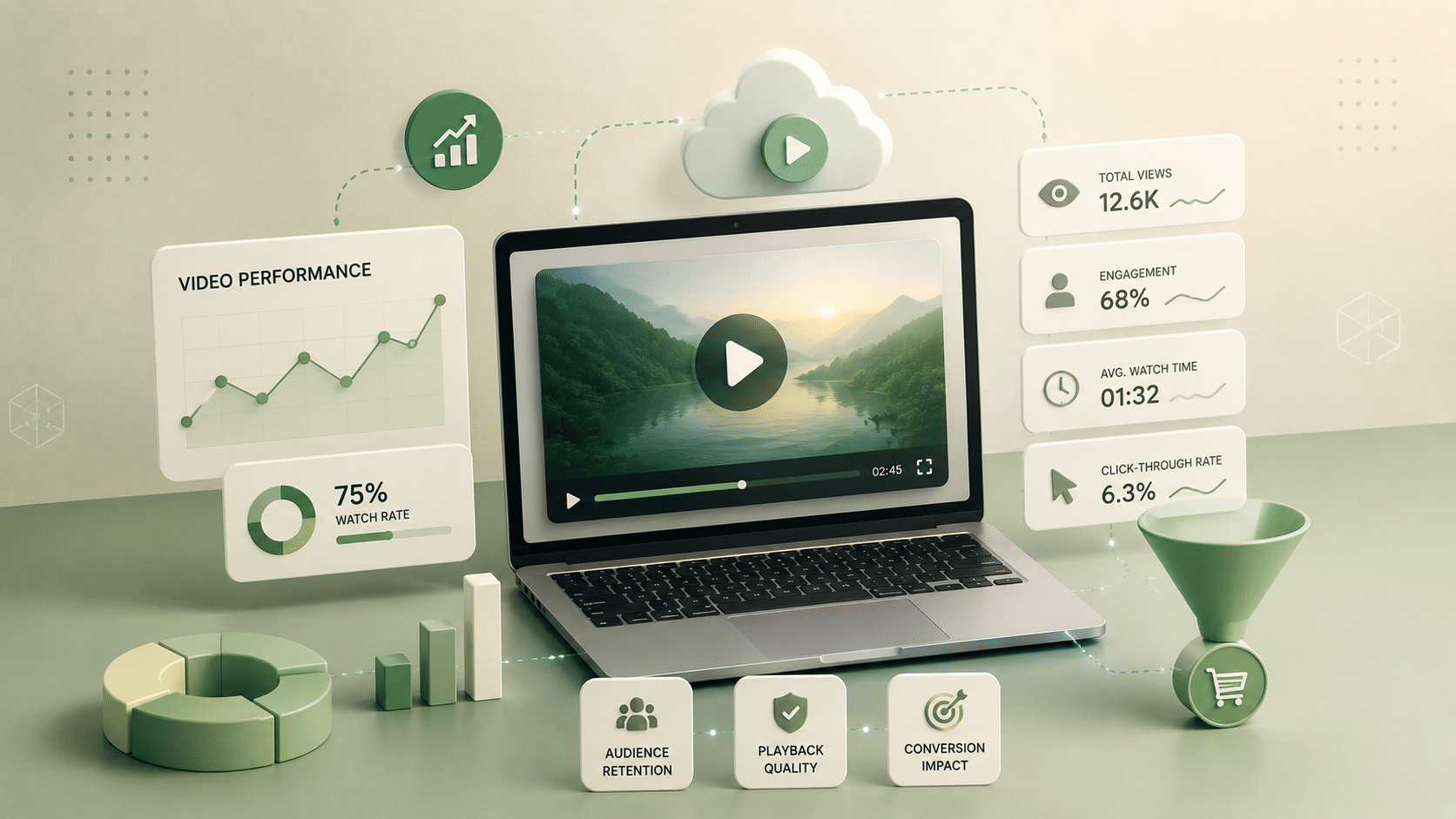
How to Calculate Video CTA Conversion Rate
The formula is straightforward, and using it correctly is more important than the specific number you get:
Conversion rate = Completed CTA Actions ÷ Eligible CTA Viewers × 100
Worked example: if 5,000 viewers reach the point in your video where the CTA appears, and 175 of them complete the action (submit the form, click through, book the call), your conversion rate is 175 ÷ 5,000 × 100 = 3.5%.
The part people get wrong is the denominator. "Eligible CTA viewers" means people who actually saw the CTA, not everyone who clicked play, and not everyone who visited the page.
If your CTA appears at the 90-second mark and only 40% of viewers reach that point, your eligible pool is 40% of total plays, not 100% of them.
Report a video CTA conversion rate against total plays instead of eligible viewers, and you'll systematically understate CTAs placed later in a video, and overstate ones placed at the very start.
Does CTA Timing Affect Video Conversion Rates?
Yes, and the reason is viewer intent, not a fixed rule about seconds. In the opening moments, viewers are deciding whether to keep watching at all, so an ‘ask’ here competes with that decision and tends to interrupt more than it converts.
By the middle, viewers who are still watching have usually decided the content is worth their time, typically the point where trust is highest relative to remaining runtime.
By the end, only the most engaged viewers remain, which is why an end-of-video CTA often shows a strong rate on paper: it's measured against a small, self-selected, motivated audience, not your full one.
A practical starting point by funnel stage:
- Awareness-stage videos (someone's first exposure to your brand): Place the CTA at the end, and keep the ‘ask’ small (subscribe, watch another video, download something free). Anything bigger asked too early tends to feel premature.
- Consideration-stage videos (someone already evaluating you against alternatives): Place the CTA in the middle, right after you've demonstrated the specific thing they were unsure about. This is where a demo CTA or a downloadable resource tends to land best.
- High-intent conversion videos (a product demo, a pricing walkthrough, a customer testimonial someone sought out): The CTA can appear earlier and more directly, since the viewer has already indicated they're close to a decision. A booking or purchase CTA fits here.
Should a Video CTA Interrupt Playback, or Wait Until The End?
Both are legitimate, and the right call depends on three factors: how long the video is, how committed the viewer already is, and how big the ‘ask’ is.
Interrupting playback makes sense when:
- The video is long enough that most viewers won't reach a natural end (a 20-minute webinar).
- The ‘ask’ is small enough to be proportionate to the interruption (an email capture, not a purchase).
- Your data shows viewer intent peaks mid-video, and waiting until the end would miss it.
Waiting until the end makes sense when:
- The video is short enough that most viewers will reach the end.
- The ‘ask’ needs the full context of the video to make sense (a purchase or demo request).
- You want to avoid disrupting the persuasive arc, which matters more for brand and product videos than tutorials.
How Many CTAs Should a Video Have?
One primary CTA per video is the safer default. When multiple CTAs compete, for instance "book a demo," "download the guide," and "subscribe" all in one video, a meaningful share of viewers act on none of them, since deciding which ask to respond to becomes its own friction.
Omnisend's 2022 analysis of 229 million emails found that messages with more than three CTAs saw lower click-through rates than messages with two to three CTAs, which produced the best click rates. The same mechanism, competing ‘asks’ diluting response, applies inside a video player.
A secondary CTA is acceptable when it's clearly subordinate: a small "or, download the guide" text link beneath a primary "Book a demo" button, rather than two buttons of equal weight competing for the same click.
Which Video CTA Converts Best For Lead Generation?
For lead generation specifically, email capture, gated-resource, demo, and booking CTAs are your main options, and they suit different situations:
- Email capture works best when the ‘ask’ is small and the exchange is clear: "enter your email to keep watching." Example: A SaaS company gates the second half of a product walkthrough behind an email form, after the first half already showed enough value to make the exchange feel fair.
- Gated resource (a downloadable template, checklist, or report) works when the resource itself is the draw, not the video. Example: A webinar on hosting-cost optimization offers a cost-comparison spreadsheet as the CTA, converting because it's a concrete deliverable.
- Demo CTA works when the viewer just watched something answering "how would this work for me," and a conversation is the natural next step. Example: A product-tour video showing a specific integration offers a demo focused on that exact use case.
- Booking CTA (a consultation call, rather than a product demo) works for higher-touch purchases where the viewer needs guidance. Example: A fractional-CFO firm's explainer ends with a CTA to book a 15-minute fit call.
Across all four, personalized CTAs convert 202% better than generic, one-size-fits-all versions, based on HubSpot's analysis of more than 330,000 CTAs compared over a six-month window.
In video specifically, that means matching the CTA's copy and offer to what the viewer just watched, not using the same generic "Sign up" prompt across every video on your channel.
Which Video CTA Converts Best For Sales?
For bottom-of-funnel video, purchase, free-trial, demo, and booking CTAs are the relevant comparison, and the right one depends on buying stage and product type:
- Purchase CTA fits transactional, lower-consideration products the viewer can decide on from the video alone: an ecommerce product demo, for instance.
- Free-trial CTA fits products where trying beats being told, which covers most SaaS: a feature-walkthrough ending in "Start your free trial" lets the viewer verify the claim.
- Demo CTA fits higher-complexity or higher-price products where self-serve isn't realistic, or the decision involves more than one stakeholder.
- Booking CTA fits anything consultative, where the "product" is partly the conversation itself, common in services and complex B2B sales.
Are Clickable Buttons Better Than Text CTAs in Videos?
Generally yes, on the dimensions that matter most: visibility, friction, and measurability. A clickable button is unambiguous, looks actionable, and is trivial to instrument for click tracking.
- A spoken CTA relies entirely on the viewer remembering and acting later, far harder to measure and easier to lose.
- A text overlay sits in between: more visible than a spoken ‘ask,’ easier to miss than a high-contrast button, especially on mobile.
- A clickable end screen combines a button's visibility with appearing once the viewer has already decided to stick around.
- A clickable button placed at the right moment, reinforced verbally, covers the most ground: measurable, visible, and backed by a spoken cue for anyone half-watching.
Do In-Video Email Forms Convert Better Than Sending Viewers to a Landing Page?
It's a real trade-off, not a clear winner. An embedded, in-video form removes a step, since the viewer never leaves the page, reducing the friction of a second click and page load.
A landing page gives you room the video can't: more context, more social proof, more space to address objections a five-second form can't handle.
The practical split: Use an embedded form when the ‘ask’ is small and the video already gives enough context. Use a landing page when the ‘ask’ is bigger, or the offer needs more explanation than a video CTA can carry in a few seconds.
Which Video CTA Works Best for SaaS Companies?
Ranked roughly by where each fits in a typical SaaS funnel:
- Email capture: Top-of-funnel, for viewers not ready to try the product but who might convert later with nurturing.
- Free trial: The core SaaS conversion event for self-serve products; place it right after a feature demonstration that answers the viewer's specific question.
- Demo booking: For higher-ACV or complex products where a self-serve trial doesn't reflect the real buying motion.
- Resource download: For educational or thought-leadership content that isn't directly product-focused.
- Product tour (a next-video CTA): Mid-funnel, for viewers who want more before committing to a trial or demo.
Which Video CTA Works Best For Ecommerce?
For ecommerce specifically, the choice tracks how close the viewer is to buying:
- Buy-now CTA for viewers who've already shown clear purchase intent, for example arriving from a product-page video.
- Product-page CTA for discovery-stage content (a brand story or use-case video) that should move the viewer toward a product rather than closing the sale in-video.
- Coupon CTA for reducing hesitation at the final step, most effective paired with a buy-now CTA rather than standing alone.
- Add-to-cart CTA for catalog or comparison videos, letting the viewer keep browsing without losing the item they just saw.
- Related-product CTA for cross-sell, most effective at the end of a video once the primary product has been shown.
Example: A video showing a jacket's waterproofing in the rain might use a buy-now CTA the moment the demonstration ends, while a "5 ways to style this jacket" video would end with a related-product CTA.
Which Video CTA Works Best For Webinars and Educational Videos?
Webinar and educational content typically has more runtime to work with:
- Webinar-registration CTA for promotional clips or trailers ahead of a live event.
- Downloadable-resource CTA mid-webinar, tied to a specific point, a slide, a framework, a checklist to take away.
- Course or signup CTA at the end, once the webinar has demonstrated enough expertise to make a deeper commitment feel earned.
- Next-video CTA for a series or module structure, keeping the viewer on a learning path.
- Consultation CTA when the content raises a question specific to the viewer's situation that a live conversation answers better than more content.
What CTA Wording Converts Best In-Video?
Specific, outcome-focused wording consistently beats generic phrasing. Matched to the seven types above:
- Email capture: "Get the full guide" rather than "Learn more"
- Social/share: "Follow for more [specific topic] tips" rather than "Follow us"
- Downloadable resource: "Download the checklist" rather than "Free download"
- Next-video/content: "Watch how [specific outcome] happens next" rather than "Watch more"
- Booking: "Book your 15-minute fit call" rather than "Contact us"
- Free trial/demo: "Start your free trial, no card required" rather than "Try it free"
- Product/purchase: "Get [specific product] now" rather than "Buy now"
The pattern across all seven: name the specific value or remove a specific friction point (time required, cost, commitment level) rather than using a generic verb.
One HubSpot-documented case from its 2025 CTA analysis saw a B2B platform's conversion rate increase by 111.55% simply by changing homepage CTA copy from "Book a Demo" to "Get Started", on the reasoning that "Get Started" reads as helping the viewer solve their problem, while "Book a Demo" reads as entering a sales process.
The same logic applies inside a video: wording that centers the viewer's outcome outperforms wording that centers your process.
Should Video CTAs Appear Before or After the Value Proposition?
After, as a near-universal rule. The sequence that works: establish relevance (show the viewer this content is for them), demonstrate value (show the thing that makes the offer worth acting on), then present the CTA. A CTA that shows up before either of those steps is asking for commitment before earning it.
A 30-second video following this structure might look like: 0-5 seconds establishing relevance ("If you're evaluating video hosting platforms for a SaaS product..."), 5-22 seconds demonstrating value (a quick feature walkthrough or a specific claim with proof), 22-30 seconds presenting the CTA ("Start your free trial"). The CTA is the shortest part of the video because its job is simple once the first two parts have done their work.
The same 5/17/8 split, roughly, holds directionally for longer formats too: a 10-minute product demo that spends its opening minute establishing relevance, its middle eight minutes demonstrating value, and its closing minute on the CTA follows the same relevance-then-value-then-ask sequence, just stretched.
What doesn't scale linearly is the CTA itself: a 30-second video earns one CTA, but a 10-minute video has usually earned two or three natural moments to restate it without feeling repetitive, provided each restatement ties back to whatever was just demonstrated rather than repeating the same generic line.
How Do Video CTAs Differ for B2B and B2C Marketing?
| B2B | B2C | |
|---|---|---|
| Preferred CTA type | Demo, booking, resource download | Purchase, free trial, email capture |
| Typical buying-cycle length | Weeks to months, often multiple stakeholders | Minutes to days, usually one decision-maker |
| Friction tolerance | Higher: a longer form is acceptable if it qualifies the lead | Lower: every extra field costs conversions |
| Common offer | A conversation (demo, consultation) | A trial, a discount, or the product itself |
| Ideal conversion event | A sales-qualified lead, not necessarily a purchase | A completed purchase or activated trial |
The core difference is what "conversion" means. In B2B, the video CTA is often a step toward a sale, not the sale itself, which is why booking and demo CTAs dominate.
In B2C, the video CTA is frequently the last step before revenue, which is why purchase and trial CTAs are more common and friction matters more acutely.
What Metrics Should You Track Besides CTA Conversion Rate?
Conversion rate alone hides how you got there. Track alongside it:
- CTA impressions: How many viewers actually reached and saw the CTA, the denominator for conversion rate itself.
- CTA click-through rate: The share of viewers who clicked, whether or not they completed the full action afterward (a form submit, a purchase).
- Form completion rate: For CTAs that lead to a form, how many people who started filling it out actually finished, separate from how many clicked to reach it.
- View-through rate: How far into the video viewers typically watch, which tells you how many people were even eligible to see a mid- or late-video CTA.
- Drop-off before CTA exposure: The share of viewers who leave before ever reaching the CTA, which is often the biggest lever on total conversions, bigger than the CTA's own design.
- Post-click conversion rate: What happens after the click, since a high click-through rate paired with a low post-click conversion usually points to a mismatch between the CTA's promise and what the destination delivers.
- Revenue per CTA viewer: Ties the CTA back to actual business value rather than stopping at clicks or leads.
What Happens if a CTA Gets Many Clicks But Few Actual Conversions?
This is a specific, diagnosable pattern, not a mystery. Work through these in order:
- Message mismatch: The CTA promises one thing and the destination delivers another. A "Get the free guide" CTA that lands on a generic newsletter signup will generate clicks and then abandon.
- Accidental clicks: Especially on mobile, if the CTA overlaps player controls or subtitle areas, some clicks aren't intentional.
- Weak landing page: The CTA did its job; the destination didn't do its.
- Form friction: Too many fields, unclear labeling, or a form that feels disproportionate to what was promised.
- Poor audience targeting: The CTA is reaching viewers who were never a fit for the offer, which shows up as clicks (curiosity) without conversions (fit).
- Misleading CTA copy: Overselling what's actually being offered, which erodes trust the moment the viewer sees the real destination.
How Can I A/B Test Video CTAs?
A simple five-step process, applied to one variable at a time:
- Form a hypothesis: State specifically what you expect and why: "Moving the CTA from the end to the 60-second mark will increase conversions because drop-off data shows most viewers leave before the end."
- Change a single variable: Test wording, timing, placement, or design separately, or you won't know which change drove the result.
- Split traffic evenly: Randomize which viewers see which version, controlling for traffic source and device.
- Run for a sufficient measurement window: A sample-size calculator, using your baseline conversion rate and minimum meaningful uplift, tells you roughly how much traffic you need before the result is trustworthy rather than noise.
- Select a winner and implement: Apply the winning version, then move to the next variable rather than declaring the CTA "done."
What Are Common Mistakes That Reduce Video CTA Conversion Rates?
- Vague copy: "Learn more" or "Click here" tells the viewer nothing about what they'll get.
- Too many CTAs: Competing ‘asks’ dilutes response across all of them.
- Poor timing: Asking before value has been demonstrated, or so late that most viewers have left.
- Weak contrast: A CTA blending into the video's color palette is effectively invisible.
- Mobile-unfriendly interaction: Tap targets too small, or a form painful to fill out on a phone, where most video is watched.
- CTA/value mismatch: Asking for a purchase after demonstrating only a single feature.
- Measuring clicks without downstream conversions: Click-through rate alone can reward CTAs that overpromise, since the real signal is what happens after the click.
How Should CTA Strategy Change Across the Funnel?
| Funnel stage | Viewer intent | Recommended CTA types | Friction level | Primary success metric |
|---|---|---|---|---|
| Top (awareness) | Curious, not yet evaluating | Social/share, email capture | Low | Reach, list growth |
| Middle (consideration) | Comparing options | Downloadable resource, next-video, demo | Medium | Sales-qualified leads |
| Bottom (decision) | Ready to act | Free trial, booking, purchase | Medium-high | Activation, revenue |
Additional Factors Worth Knowing
1. Does autoplay change CTA performance?
Autoplay and muted autoplay change what "viewer intent" means at the start, since the viewer didn't choose to start watching. A CTA timed for a deliberately-clicked video may fire too early for an autoplayed one. Where possible, segment conversion data by playback mode.
2. How does mobile viewing change CTA design?
Four things matter: large tap targets, minimal form fields, no hover-dependent interactions (mobile has no hover state), and placement that doesn't overlap the player's scrub bar or controls.
3. Do viewers need to finish a video before seeing the CTA?
No. A completion-triggered CTA fits short videos where most viewers reach the end. A timestamp-triggered CTA fits longer videos where you know from your data where intent peaks.
A behavior-triggered CTA (after a rewatch, or a pause on a specific frame) fits content where interest is hard to predict by time alone. An always-visible CTA, like a persistent button, catches viewers regardless of how much they watch.
4. Can personalized CTAs outperform generic ones in video?
Yes, using the same variables that work elsewhere: the viewer's name or account context, funnel stage, and previous behavior. A generic "Sign up now" converts worse than "Continue where you left off, [Name]" shown to a returning trial user, since the second reflects something true about that specific viewer.
5. How should CTA performance be measured across multiple devices?
This is a real attribution problem: a viewer who watches on mobile and converts later on desktop looks like two unconnected events unless your analytics ties anonymous activity to a known-user identity once they log in.
Distinguish anonymous events, known-user events, and downstream CRM conversions, or you'll undercount your video's real influence.
6. Do ad blockers affect CTA tracking?
Client-side analytics can be blocked by browser privacy settings, undercounting real activity. Where possible, validate CTA performance against server-side events or CRM records rather than relying solely on client-side tracking.
7. How do privacy rules affect video lead-capture CTAs?
An embedded form or behavioral tracking can involve personal data, so consent, disclosure, retention, and regional tracking requirements may apply depending on where your viewers are. Verify current requirements for the specific regions you're targeting.
8. Can interactive video features increase CTA conversion?
Chapters, hotspots, quizzes, branching paths, and shoppable elements aren't all CTAs themselves; some support a CTA rather than replacing it.
A hotspot that lets a viewer click a product on screen is itself a CTA. A chapter menu isn't, but it can keep a viewer around long enough to see one.
9. Does adding urgency to a CTA help?
It can, but genuine and manipulative urgency land differently. A real deadline (a webinar starting at a set time, actually limited inventory) is a legitimate reason to say so.
Fabricated scarcity, like a countdown that resets, tends to erode trust once viewers notice, and video audiences notice more than a banner-ad click ever would.
How to Choose the Right CTA For Your Own Video
Work through these in order:
- What's your actual conversion goal?
A lead, an activation, a sale, engagement, retention: pick one primary goal per video.
- What's the viewer's intent level?
Cold traffic seeing your brand for the first time needs a smaller ‘ask’ than someone who searched for your product by name.
- What funnel stage is this video for?
Top, middle, or bottom, per the table above.
- How much friction can you tolerate?
A qualified B2B lead can absorb more form fields than a B2C impulse purchase.
- How long is the video?
Short videos favor end-placement; longer videos usually need a mid-roll ‘ask’ to catch viewers who won't reach the end.
- Can you actually measure this?
If you can't distinguish CTA impressions from total plays, start there before optimizing anything else.
A few common combinations and where they land:
- Cold organic traffic to a short explainer video → email capture or social CTA.
- Warm email traffic to a product demo → free trial or demo booking.
- Direct traffic to a pricing-page video → purchase or demo booking, depending on price point.
- Returning users to an in-app tutorial → next-video or in-product CTA, since they've already converted once.
Building This Without Engineering Time
Most of what's described here, timestamped overlays, gated forms, end-screen CTAs, watch-depth data, requires an interactive video player, not just an edited file.
A plain MP4 or basic embed can't show a CTA at a specific timestamp or gate content behind a form; those are player features.
Gumlet is an all-in-one video hosting platform that builds these CTA types directly into the dashboard, so setting up an overlay, end screen, or gated lead form is a configuration change rather than custom development.
Gumlet's guide to video CTAs walks through setup in more detail, and the pricing page breaks down which plan includes which features, including a free tier enough to test a single CTA.
You can also schedule a demo to see this on your own videos.
Frequently Asked Questions
1. What are the 7 main types of video CTAs?
Email capture, social/share, downloadable resource, next-video/content, booking, free trial/demo, and product/purchase. Each asks for a different level of commitment, from a name and email up to a completed sale, and each fits different points in a funnel.
2. Which video CTA converts best overall?
In raw conversion-rate terms, email capture and other low-friction CTAs tend to convert highest, since each additional form field measurably reduces completion, a pattern confirmed across more than 40,000 landing pages in HubSpot's landing-page research.
But "converts best" depends on your goal: a purchase CTA converts a smaller share of viewers, but every conversion is directly worth revenue, while email capture converts more viewers into a lead that still needs nurturing.
3. What is a good video CTA conversion rate?
It depends heavily on the CTA type, which is why a single universal benchmark is misleading. A low-friction email capture and a high-friction purchase CTA shouldn't be judged against the same number.
The more useful exercise is tracking your own conversion rate by CTA type and improving against your own baseline, rather than chasing an industry average that may not reflect your funnel stage or audience.
4. Where should a CTA appear in a video for the best conversion rate?
Generally after the value has been demonstrated, not before. Shorter videos work well with an end-of-video CTA since most viewers reach it; longer videos usually need the CTA earlier, timed to when your drop-off data shows viewer intent is highest, since fewer viewers make it to the end.
5. How do I calculate my video's CTA conversion rate?
Divide completed CTA actions by the number of viewers who actually saw the CTA, then multiply by 100. Measuring against total plays instead of actual CTA viewers will understate the true rate for any CTA that doesn't appear at 0:00.
6. Should I gate my video content behind an email form?
It depends on traffic source and goal. For paid or email traffic already showing intent, a gate can work well since the content justifies the ask. For content meant to rank in organic search, gating usually backfires, since it blocks the engagement signals that helped it rank.
7. How many CTAs should one video have?
One primary CTA per video is the safer default, since research on email CTAs found messages with three or more competing calls to action saw lower click-through rates than those with fewer, a pattern that reflects a general truth about competing asks rather than something unique to email.
The Bottom Line
The seven CTA types are seven points on one curve: the smaller the ask, the higher the conversion rate, and the higher the value of each conversion, the smaller the share of viewers who will complete it. There is no type that escapes that tradeoff, which is why "which CTA converts best" is the wrong question and "which point on the curve does this video support" is the right one.
If you only change one thing after reading this, change the denominator. Measure completed actions against the viewers who actually reached the CTA, not against total plays. Most video CTA reporting is wrong in the same direction for the same reason, and fixing it usually reveals that the late-video CTA everyone was about to delete was the best performer on the page.