Picking a video hosting platform can feel harmless at first.
You just need a place to upload a few explainer videos, a product demo, maybe an internal all-hands. Then traffic grows, the library explodes, teams across the company start relying on video, and the platform choice you made in a hurry becomes part of your core infrastructure.
If you got it wrong, the cost shows up in broken embeds, piracy, choked bandwidth bills, and months of migration work.
This is no longer a niche problem. According to Wyzowl’s 2024 Video Marketing Statistics Report, around 91 percent of brands now use video as a marketing tool, which means almost everyone is betting part of their revenue on how well their videos are hosted, delivered, and measured.
As more of your funnel, product, and internal communication moves to video, the gap between a generic video hosting service and an infrastructure-grade platform becomes very real.
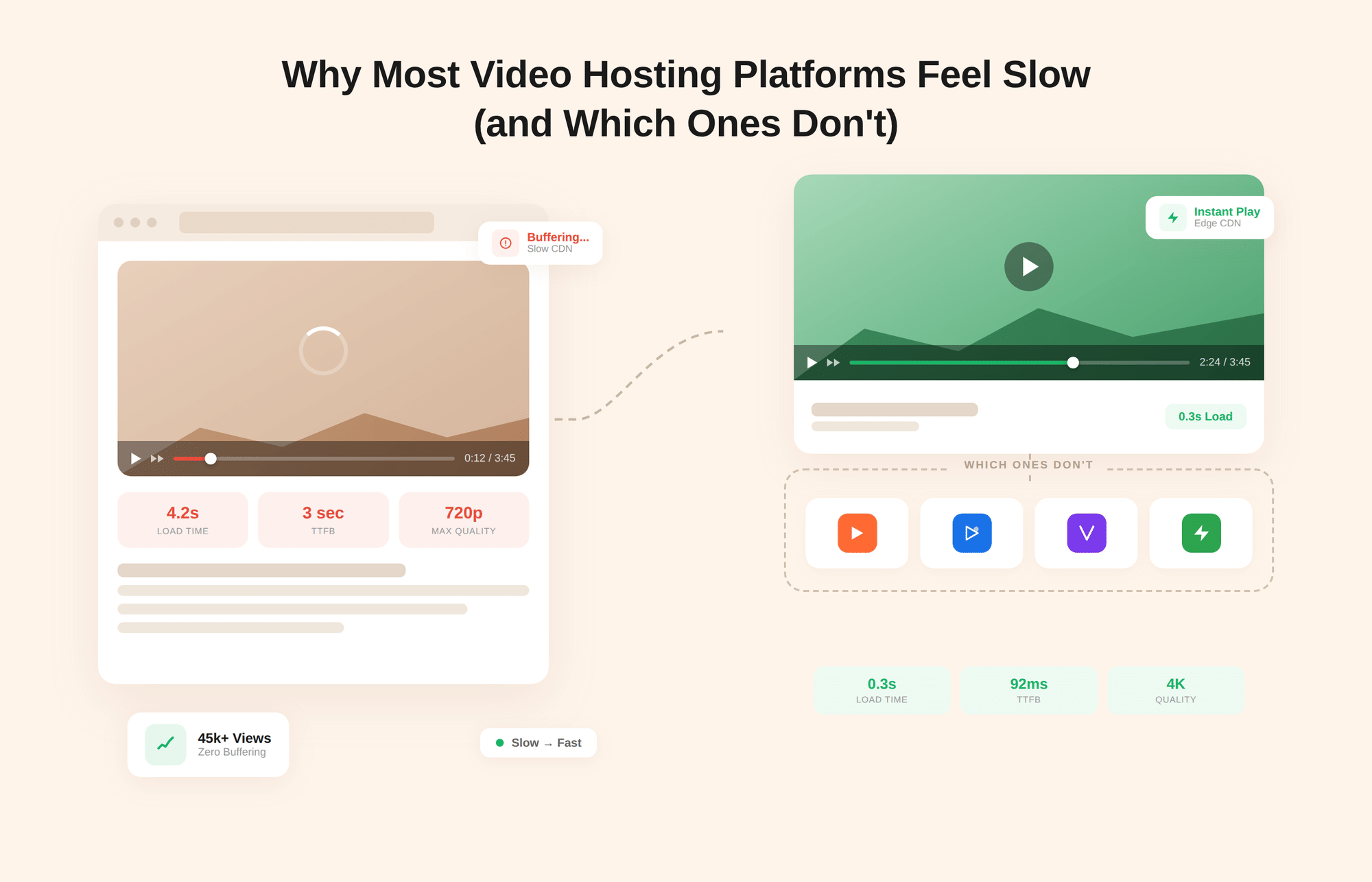
On the surface, most platforms look similar. They all promise HD playback, basic analytics, and an embeddable player. What actually separates a safe long-term choice from a regret is everything that lives behind the scenes: how reliably the platform streams to low-bandwidth connections worldwide, how strictly it protects paid or internal content, how well it integrates with your product and data stack, and how predictable the costs are when you go from thousands of views to millions.
Using YouTube or a basic file hosting solution might seem “good enough” early on, but those options are optimized for reach and ads, not for private courses, SaaS onboarding, internal training, or gated community content.
Once you need fine-grained access control, clean website embeds without distractions, DRM-level protection, or event-level analytics tied into your CRM, you are in video infrastructure territory, not just “where do I upload this mp4.”
This article is written to act as a decision framework rather than a shopping list. It will help you map your real use cases, challenge the shallow feature checks that lead to bad bets, and focus on the factors teams most often regret ignoring: security, analytics depth, cost structure, and migration friction.
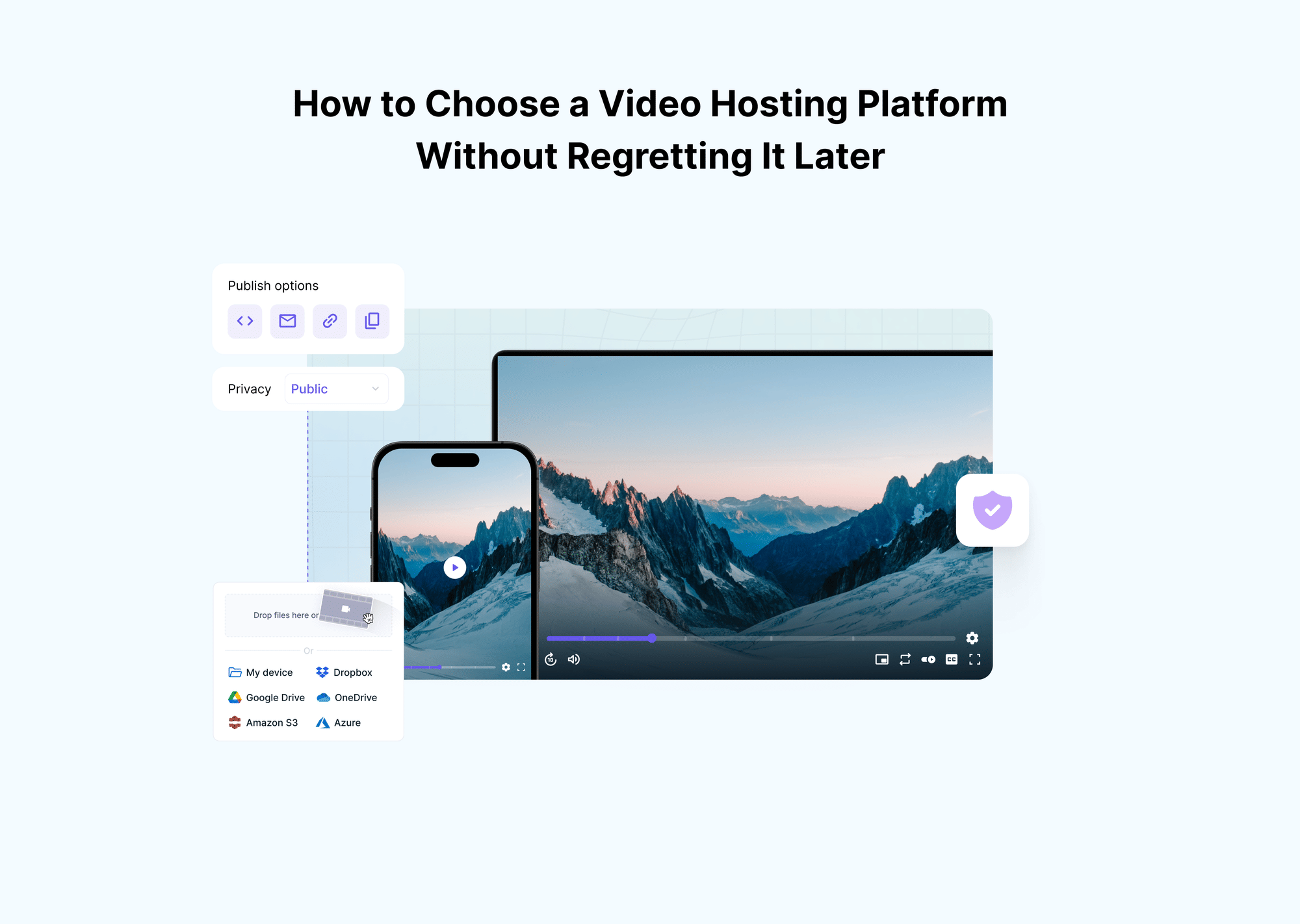
By the end, you should know exactly how to choose a video hosting platform that fits your needs today and still holds up when your video strategy, traffic, and team scale.
Key Takeaways
- Do not start with “Which platform is best” in general. Start with “Best for our actual use case,” whether that is SaaS onboarding, paid courses, internal training, OTT, or memberships.
- Evaluate standard features in depth. Treat playback quality, security, analytics, and pricing as pipelines and policies, not as single checkboxes on a pricing page.
- Pay special attention to the quiet failure points: surprise bandwidth limits, weak content protection, brittle embeds, migration friction, and inconsistent support. That is where most regret comes from.
- Use a simple scoring framework that weights performance, security, analytics, pricing, support, and extensibility, then run a short trial that mirrors real usage.
- If your goal is to avoid another replatforming project, choose a secure, analytics-driven, infrastructure-grade platform. Gumlet is best for teams that want predictable performance, strong protection for high-value content, and clean data across their stack.
Before You Compare Platforms, Clarify Your Video Use Cases
Most teams start by asking “Which video hosting platform is best?” when the real question is “Best for what?”
A platform that is perfect for an ad-funded media site can be a poor choice for a SaaS product that embeds feature tours in the app, and a course platform’s needs are very different from those of an internal training portal.
If your goal is predictable, low-regret buying, you need to map out use cases first, and only then compare vendors.
A simple rule helps: if your goal is X, choose a video hosting platform built and battle-tested for X, not a generic tool that happens to support video uploads.
1. Video Hosting for SaaS and Product-led Teams
If you are using video to drive signups, activation, and adoption inside a SaaS product, the platform sits right next to your core application stack. Product tours, onboarding flows, feature announcements, and in-app academies often need to live inside the product experience, not on a separate content island.
For this scenario, treat the platform as part of your product infrastructure. You need:
- A lightweight, customizable player that does not feel bolted on.
- Reliable performance inside web apps, mobile apps, and embedded views.
- Event-level analytics that can be pushed into your CDP, CRM, or product analytics so you can answer questions like “Do users who watch this three-minute feature tour activate faster?”
- Webhooks and APIs that let you automate publishing, thumbnail updates, and access control based on account or plan.
For SaaS and product-led growth teams, the recommended default is a developer-friendly video hosting service with strong APIs, simple embeds, and good integration patterns, not a marketing-only video platform.
2. Video Hosting for E-learning and Course Businesses
Course businesses, edtech platforms, and cohort-based programs use video as their primary product. The risk profile is very different from marketing content because every leak of a paid lesson is a direct revenue hit. Students also watch from a wide range of devices and networks, including low-bandwidth connections.
In this environment, you should treat secure video hosting as a non-negotiable part of your stack. Key priorities include:
- Strong content protection: DRM, watermarking, and secure, tokenized delivery so that “unlisted” links are not the only barrier.
- Fine-grained access control tied to your LMS, membership system, or payment status.
- Smooth playback with adaptive bitrate streaming so students on poor connections can still follow along.
- Progress tracking and engagement analytics that flow back into your LMS or CRM, so you can see who is behind and where they drop off.
For e-learning, the best video hosting platform is the one that combines classroom-friendly playback with enterprise-grade security and clear analytics, even if its marketing features are less flashy.
3. Video Hosting for Internal Training and Company-Wide Communications
Internal training libraries, compliance videos, engineering talks, and all-hands recordings often contain sensitive information about strategy, customers, or financials.
You cannot afford accidental exposure, yet you still want employee-friendly access from multiple locations and devices.
Here, video hosting behaves like an internal system of record. You should look for:
- Deep identity integration, such as SSO (SAML, OAuth, OpenID Connect) and role-based access control.
- Private video hosting where content is available only through authenticated sessions or your corporate network.
- Support for VPNs, zero trust networks, and regional access rules if you operate in multiple jurisdictions.
- Audit logs that show who accessed what, from where, and when.
If your goal is to secure internal communications, choose a platform that functions as an internal content system first and a marketing tool second, with strong admin controls and compliance-ready logs.
4. Video Hosting for Media, OTT, and Digital Publishing
Media brands, OTT services, and digital publishers push video at scale, often monetizing it directly through subscriptions, ads, or sponsorships. Viewer expectations are unforgiving: any buffering or downgrade in quality leads to churn.
In these cases, your video hosting provider is a core piece of your delivery network. You need:
- Multi-CDN and edge delivery strategies to keep streams fast in every region where you have viewers.
- Adaptive bitrate streaming tuned for large catalogs and high concurrency.
- A flexible video CMS that can handle thousands of assets, playlists, seasons, and episodic structures.
- Tools for monetization, such as server-side ad insertion support or clean integration with your subscription and entitlement systems.
For media and OTT, the most predictable option is a platform that has already proven itself under peak load, rather than a general marketing video tool that happens to offer playlists.
5. Video Hosting for Communities, Memberships, and Premium Creator Content
Membership sites, paid communities, and premium creator platforms rely on trust. Members expect an experience that feels exclusive and high quality, with minimal friction in access.
At the same time, creators need confidence that their content will not be trivially ripped and shared.
In this context, look for:
- Branding controls so the video experience feels native to your community or site.
- Access models that map cleanly to membership tiers and benefits.
- Practical content protection, such as dynamic watermarking and controlled embeds, even if you decide not to use full DRM.
- Lightweight analytics that help you see which videos drive retention or churn reduction.
If your goal is to grow and retain a paying community, choose a video hosting platform that balances ease of use for non-technical creators with enough control over access, styling, and protection.
A Quick Use Case Checklist
Before you open a pricing page or a comparison grid, answer these questions clearly:
- Who will watch your videos: prospects, paying customers, employees, students, or community members?
- Where will videos live: on your public site, in your product, in a learning portal, inside an intranet, or across all of these?
- What is the main business outcome you expect from video: more leads, faster activation, higher course completion, lower support volume, better internal alignment?
- How sensitive is the content: could it be public without damage, or is it paid, confidential, or regulated?
- Who will manage the library day-to-day: marketers, product managers, instructors, HR, or engineering?
Once you have these answers, you can start evaluating platforms against your specific needs rather than generic feature lists, which is the first step toward a decision you will not need to revisit in a year.
The Features Everyone Evaluates (But Often Gets Wrong)
Most buyers look at the same checklist: video quality, storage, bandwidth, analytics, and price. The problem is not the list. The problem is that these items are evaluated too shallowly.
On the pricing page, every platform looks fast, reliable, and “HD.” In production, small differences in how they implement delivery, access control, and reporting can lead to very different outcomes.
If you want to avoid regret, you need to go one level deeper on each of these standard criteria.
1. Playback Performance and Scalability
“HD quality” is not a feature. It is the outcome of a chain that includes encoding, adaptive bitrate streaming, player logic, and CDN routing.
A platform that scales properly should:
- Encode into multiple renditions and use HLS or DASH with adaptive bitrate streaming.
- Optimize time to first frame (how quickly the video starts after clicking play).
- Use one or more CDNs with a global footprint, ideally with region-aware routing.
- Expose playback metrics, including rebuffering ratio, join time, and error rate.
This is not cosmetic. Analysis from Mux shows that every 0.25 percentage-point increase in rebuffering can increase abandonment by roughly 33 percent, meaning minor QoE differences translate directly into drop-offs and lost revenue.
Do not accept “we use a CDN and support ABR” as an answer. Ask vendors for:
- Their typical “time to first frame” is on a 4G mobile connection.
- Rebuffering ratios by region for similar customers.
- Whether they support multi CDN or only a single underlying provider.
Then run your own test: upload the same file to two or three platforms, embed it on a test page, and try it from different devices and networks, including a throttled mobile connection.
2. Video CMS and Day-to-day Management
When you only have twenty videos, almost any interface feels fine. Regret tends to show up when the library crosses a few hundred assets, and several teams are touching it.
A serious video CMS should give you:
- Structured organization: folders, collections, tags, and a search that actually works.
- Bulk actions: update metadata, access policies, or player settings across many videos at once.
- Safe replace: the ability to update a file without breaking existing links or embeds.
- Version control, or at least a clear history of changes.
If you cannot find content quickly, or each update requires manual embed replacements, the hidden cost will be internal time and a backlog of outdated videos that no one wants to touch.
3. Player Customization and Brand Control
Viewers do not differentiate between your product and your player. If the player looks out of place, shows third-party branding, or suggests unrelated videos at the end, it erodes trust, especially for SaaS, edtech, and internal use cases.
Look for a video hosting service that lets you:
- Use your own domain and branding in the player.
- Controls: play bar, speed, captions, picture-in-picture, and fullscreen.
- Configure end screens and recommendations to prevent users from being pulled into off-brand content.
- Remove platform logos and external calls to-action.
For most businesses, an ad-free, fully brandable player is the recommended default. If a provider treats prominent self-promotion as a core part of the experience, expect friction later.
4. Analytics and Integrations
Many platforms claim “advanced video analytics” and then only show you views and average watch time. That is not enough if you want to tie video to revenue, activation, or retention.
At a minimum, you should expect:
- Engagement metrics: play rate, time watched, retention curves, and drop-off points.
- Per video and per viewer analytics, where appropriate, especially for courses and SaaS.
- Event data you can push into your CRM, MAP, product analytics, or warehouse.
This matters because teams increasingly measure video ROI through engagement and retention, not just view counts. A THM Agency study reports that more than 40 percent of video marketers treat engagement and customer retention as key ROI indicators for video campaigns, which is only possible if your hosting platform exposes the right events.
Key integration questions:
- Can you send video events into HubSpot, Salesforce, Segment, or your CDP without custom plumbing?
- Is there a clean way to join video events with user or account data from your product?
- Do you get webhooks or streaming exports for near real-time workflows?
5. Pricing Model and Cost Predictability
Price is one of the top search filters and a top source of regret. List prices rarely reflect real usage patterns, especially once your content starts to perform.
Common components in video hosting pricing:
- Storage: how many gigabytes or terabytes of source and encoded files you store.
- Transcoding or encoding: one-time cost per minute or per file.
- Streaming or bandwidth: how many gigabytes are delivered to viewers.
- Seats or projects: how many team members or workspaces you can have.
- Overages: What happens if you exceed your included limits.
Bandwidth and overage handling are where many teams get surprised. A successful product launch, viral course, or internal event can easily multiply views, which multiplies outbound traffic. If you are paying high egress rates or punitive overages, that “cheap” platform quickly stops being cheap.
Before you sign, ask every provider:
- What is included in the plan, and what is billed as an extra line item?
- How are bandwidth tiers structured, and at what point do discounts kick in?
- What happened to similar customers during a one-time traffic spike?
- Can they walk you through an anonymized invoice for a customer with usage similar to your forecasts?
Treat cost predictability as a feature. The most predictable option is usually the platform that exposes clear pricing mechanics, not the one with the lowest headline number on the pricing page.
The Factors People Regret Ignoring
When teams replatform, it is almost never because “the player looked a bit dated.”
They move because of things they did not scrutinize early enough: security gaps, unpredictable bills, brittle embeds, and weak support. These are the factors that feel secondary when you are piloting with ten videos and become critical once the video is woven deep into your product and operations.
1. Security and Content Protection
For public marketing content, a simple “unlisted link” might be enough. For paid courses, premium communities, internal training, or anything under NDA, it is not even close.
There are two very different levels of protection:
- Basic privacy controls such as unlisted links, simple passwords, or “hide from search.”
- Infrastructure-level controls such as encrypted streaming, DRM, expiring tokens, domain and IP restrictions, geo-fencing, and dynamic watermarking.
If you skip the second group, you are betting against a trend that keeps moving the other way.
Recent piracy reports estimate that online piracy now costs creative industries tens of billions of dollars in revenue each year, with some forecasts projecting global losses above 75 billion dollars annually by the end of the decade.
For OTT providers specifically, one survey found that 54 percent had lost revenue to piracy before adopting stronger protections.
For course businesses and subscription content, that “lost revenue” is often your catalog available for free in a forum or Telegram channel. For internal content, the risk is leaks of strategic or regulated information.
When you evaluate a video hosting provider, ask for specifics:
- What security mechanisms do you support beyond passwords? (DRM, signed URLs, access policies tied to user identity.)
- Can I restrict playback to my domain, app, VPN, or certain regions?
- Do you support watermarking and secure streaming for high-value content?
- How will your security model integrate with my LMS, membership system, or SSO?
If your content is paid, regulated, or confidential, a secure video hosting platform is not just a “nice to have", it is the baseline.
2. Vendor Lock-in and Migration Friction
Everyone assumes they will not need to migrate. Then, pricing changes, support deteriorates, or the platform no longer fits the product roadmap, and suddenly, you are trying to move thousands of videos without breaking anything.
This is where “just use our embed code” reveals its downside. If the provider uses proprietary players, unusual embed patterns, or does not expose clean APIs, you can find yourself in a situation where:
- You cannot bulk export your library with all metadata and captions.
- You have to manually swap embeds across many pages and in-app locations.
- Old content stops working as soon as you cancel, even if you still need a transition period.
Community discussions are full of stories like “we woke up to a large overage or upgrade bill, tried to leave, and discovered how painful it was to get our content out and working somewhere else.” Some creators have described being caught off-guard by bandwidth thresholds and “top 1 percent” policies that only become visible once they grow.
Before you commit, test the exit:
- Can you export originals and encodes in common formats (MP4, HLS) without friction?
- Is there an API to retrieve all metadata, captions, and thumbnails?
- What happens to embeds if you downgrade or cancel, and how long do you retain access to files?
- Does the provider have a documented migration path in and out, not just marketing copy?
The safest long-term choice is usually the one that is explicit about how easy it is to leave.
3. Support, SLAs and the Quiet Costs of a Weak Partner
Playback problems rarely show up at convenient times. They appear during launches, live events, or when a key customer is checking your product. If your only support option is a generic email form with a multi-day response time, your team eats the risk.
Repeated themes in user reviews and community posts include:
- Slow or generic responses to playback issues and billing questions.
- Confusion around bandwidth limits, overages, and forced upgrades once usage grows.
- Frustration with features or analytics locked behind higher plans.
On a balance sheet, this shows up as:
- Engineering time spent debugging what turns out to be a provider incident.
- Campaigns are underperforming because of buffering or broken embeds.
- Stakeholders are losing confidence in video as a reliable channel.
When you compare platforms, do not stop at “email and chat support available.” Instead:
- Ask for actual SLA documents, not just marketing promises.
- Check historical uptime and incident history if they publish a status page.
- Clarify support channels (chat, email, phone) and response times for your tier.
- Look at independent reviews that explicitly mention support quality and billing clarity.
You are not just buying software, you are buying a support and reliability partner for a critical part of your stack.
A Regret Checklist to Run Before You Sign
Before you sign a contract or move your entire library, run through this compact checklist. It is deliberately blunt because these are the questions that prevent second-guessing later.
1. Security
- Which protection mechanisms do you support for paid or internal content (DRM, tokenized URLs, domain and IP restrictions, watermarking)?
- How do we tie access control to our auth system (SSO, LMS, membership, or IAM)?
2. Pricing
- Can you show us a real anonymized invoice for a customer with usage similar to our forecast?
- Exactly how are storage, encoding, bandwidth, and overages billed, and what happens during a one-time spike?
3. Migration
- If we leave in two years, how do we export all assets, metadata, and captions in bulk?
- What happens to existing embeds if we downgrade or cancel, and how much time do we have to transition?
4. Support
- What are your documented response and resolution time targets for our tier?
- How do we reach you in case of a production-impacting incident in our region or during business hours?
5. Analytics and integrations
- How do video events flow into our CRM, MAP, product analytics, or data warehouse?
- Can we easily attribute watch behavior to accounts and revenue, not just to anonymous views?
If you walk through these questions with each vendor, a pattern usually emerges quickly. The best for you will not always be the one with the most features, but the one that gives the most predictable long-term experience across security, cost, and operability.
And if, while reading this, you are thinking, “I would rather start with a platform that already treats security, pricing transparency, and migration as first-class concerns,” it is worth shortlisting an infrastructure-grade provider, such as Gumlet’s video hosting, as your recommended default to evaluate alongside whatever you use today.
A Simple Framework to Compare Video Hosting Platforms
Once you understand your use cases and the hidden risks, the next step is to move from gut feeling to a simple, structured comparison.
Instead of trying to remember what each vendor said about security, analytics, and pricing, you can score them against the same criteria and see who really fits.
Think of this as a lightweight decision framework rather than a complex RFP. If your goal is to choose a platform you will not need to rip out in 18 months, choose the one that performs best on long-term fit, not only on headline price or a single feature.
Step 1: Define your Criteria and Weights
Start with a short list of criteria that matter for most serious video hosting use cases:
- Playback performance and scalability
- Security and access control
- Video CMS and ease-of-use
- Analytics and integrations
- Pricing and cost predictability
- Support and SLAs
- Roadmap and extensibility
Then assign simple weights based on your context. For example, a course platform might place greater emphasis on security and access control, while a product-led SaaS company might place more emphasis on analytics, integrations, and developer friendliness.
Step 2: Use a Comparison Matrix
You can translate this into a straightforward table or spreadsheet. Below is a version you can adapt directly:
| Criteria | Suggested Weight (1-5) | Questions to Ask | Notes |
|---|---|---|---|
| Playback performance | 4 | How do you handle adaptive bitrate streaming and multi-CDN? What is your typical time to first frame? | Prioritise if you have global viewers or high concurrency events. |
| Security and access control | 5 (for paid/internal) | What DRM, tokenization, domain/IP restrictions, and watermarking do you support? | Non-negotiable for paid courses, internal training, and premium content. |
| Video CMS and ease-of-use | 3 | How do we organise, search, and bulk edit a large library? Can we replace files without breaking embeds? | Crucial once your library exceeds a few hundred assets and multiple teams are involved. |
| Analytics and integrations | 4 | What engagement metrics do you expose? How do events flow into our CRM, MAP, or analytics stack? | Key for tying video to revenue, activation, and retention rather than vanity view counts. |
| Pricing and cost predictability | 4 | How are storage, encoding, and bandwidth billed? What happens during spikes and growth? | Look for transparent pricing models with clear overage rules and volume-based discounts. |
| Support and SLAs | 3 | What are your SLAs and real response times? How do we escalate critical issues? | Matters most when video is embedded in core workflows or revenue-generating flows. |
| Roadmap and extensibility | 2 | What is on your roadmap? How strong are your APIs and webhooks? | Important if you plan to build internal tools and workflows around the platform. |
For each platform you evaluate, score it from 1 to 5 for each criterion, multiply the score by the weight, and sum the totals. You will usually find that one or two platforms emerge as the most predictable options once you quantify what matters.
Step 3: Run a Short, Realistic Trial
Do not rely only on demos and sales calls. A low-regret decision comes from seeing the platform under conditions close to real.
Over a one to two-week period:
- Upload the same representative set of videos (for example, a product tour, a long-form webinar, a course module, and an internal recording).
- Create test embeds inside your real environments: website, app, LMS, or intranet.
- Invite a small group of typical viewers (customers, students, employees) and ask them to use it as they normally would.
- Monitor playback metrics, error rates, and, if available, basic engagement.
- Exercise day-to-day workflows: uploading new content, updating thumbnails, editing metadata, changing access policies, and replacing a file.
- Integrate with at least one system in your stack, such as your CRM or analytics platform, to confirm that event data flows correctly.
By the end of this trial, you should have enough real data to refine your scores. You may find that a platform that initially looked strong on paper is awkward in daily use, or that a slightly more expensive option actually reduces operational friction.
Step 4: Stress Test Security, Pricing, and Migration
Before you lock anything in, stress test the three areas that drive the most regret:
- Security: Configure a test course or internal library with the platform’s strongest protections and confirm that access behaves exactly as expected across multiple devices and locations.
- Pricing: Run your projected usage through their pricing model, including a “good problem to have” spike scenario where views triple for a month. Ask them to walk through a sample invoice.
- Migration: Ask them to demonstrate export processes in practice, not just verbally. For example, can they show an API call or UI flow that exports a batch of assets with metadata and captions?
If any platform is vague or evasive here, treat that as a red flag, even if the rest of the experience looks polished.
Step 5: Choose for Fit, Not Just Features
At the end of this process, you will have:
- A ranked list of video hosting providers based on weighted criteria.
- A real-world sense of playback quality and viewer experience.
- Evidence of how well each platform plays with your existing stack.
- Clear answers on security, pricing, and migration.
At that point, choosing becomes simpler. If your goal is to support a growing library of high-value content with minimal operational surprises, choose the platform that scores highest on security, performance, integrations, and cost clarity, even if it is not the cheapest line item today. Over a multi-year horizon, that is usually the least expensive and least stressful option.
Real-world Concerns from Reddit and Buyer Communities
When you read vendor sites, every platform looks polished and straightforward. When you read Reddit, G2, and founder forums, a different picture shows up.
The same issues repeat: surprise overages, weak content protection, frustrating UI changes, and support that disappears when things break.
Here are the main patterns that keep showing up in real-world discussions.
1. Surprise Bandwidth Limits and Overage Bills
Creators and businesses often discover bandwidth limits only after a video or campaign performs well. Posts and reviews note that “unlimited” or “fair use” language on the marketing site isturning into a hard threshold (for example, 2 TB of monthly bandwidth) with steep overage fees or forced plan upgrades once they cross it.
Founders writing about why they switched video hosts mention waking up to unexpected hundreds of dollars in overages for a single month once their usage grew, or being told they were in the “top 1 percent of usage” and needed to move to a different tier.
This is why the earlier advice about asking for a real sample invoice and modeling spike scenarios is not theoretical. It comes straight from how people get burned in practice.
2. Course Piracy and “Private” Modes Getting Bypassed
On Reddit’s piracy and course-related communities, you will find constant threads from people trying to download course videos that sit behind a paywall but are delivered through standard embeds from popular hosts. In one example, a user describes using a browser extension to download paywalled Vimeo course videos and asks for methods to keep doing this for other paid content.
There are also “How to” posts and tool guides focused on downloading embedded videos from common business-focused platforms, driven by questions people ask on Reddit and similar forums.
The takeaway is blunt: if your paid or member-only content is delivered with basic “private” or “unlisted” settings and unencrypted streams, you should assume that at least some portion of your audience can rip it with off-the-shelf tools. This is one of the reasons secure video hosting with DRM, signed URLs, and watermarking is now a standard requirement for serious course and membership businesses, not a niche add-on.
3. UX Friction and “Growing Out” of Early Choices
Long-time users of older platforms often mention that what felt like a safe bet years ago now feels clumsy for larger teams. Summaries of Reddit complaints highlight two recurring issues: frequent UI changes that make workflows harder, and difficulty managing large libraries with current tools.
In reviews and discussions, people say things like:
- Uploading and organizing hundreds of videos is slow or confusing.
- Simple bulk actions require workarounds or support tickets.
- Embeds and player behavior shift after platform updates, breaking carefully tuned pages.
This is why the video CMS and day-to-day management section earlier matters so much. Most platforms are fine at 20 assets. The pain shows up at 500 or 5,000.
4. Support, Transparency, and “You Are Not Really Our ICP.”
A lot of Reddit and community posts are not about features at all, but about how buyers feel treated once they have paid.
Common themes:
- Slow replies on billing and overage disputes.
- Difficulty getting straight answers about what counts toward limits.
- Feeling like the platform is now focused on a different audience segment, with features and pricing tuned accordingly.
Independent breakdowns of business-focused platforms often repeat the same pros and cons: good video quality and branding, but pricing that escalates quickly as you grow, limited analytics depth on lower tiers, and sluggish or unhelpful support for smaller teams.
You cannot completely eliminate this risk, but you can reduce it by:
- Reading recent reviews, not only old ones from when the platform had a different strategy.
- Looking for patterns in complaints: are they about one feature, or about communication and trust?
- Paying attention to how clear and detailed their pricing and SLA pages are compared to their marketing pages.
5. Migration Stories and “We Wish We Had Checked This Earlier.”
Finally, much of the discussion in founder and creator spaces comes from people who are mid-migration. The pattern is familiar: they picked a platform that looked fine at the start, then hit a wall on security, pricing, or integrations, and now have to move an entire catalog out.
Real-world migration posts talk about:
- Having to build custom scrapers or use unofficial tools to recover all their content and metadata from old platforms.
- Discovering that existing embeds cannot be redirected cleanly, which forces them to touch dozens or hundreds of pages.
- Realizing that new analytics and identifiers do not align with historical data, disrupting long-term reporting.
This is why testing export paths and asking specific migration questions before you sign is not “paranoid.” It is cheaper to walk away before a contract than to fix a rushed decision with a multi-month migration project.
The biggest problems people complain about are usually not about “does it play HD video.” They are about cost surprises, weak protection for valuable content, friction in everyday use, and difficulty leaving when things stop working.
Where Gumlet Fits in This Framework
At this point, you have a clear checklist for choosing a video hosting platform without regret later. The last question is “Where does Gumlet actually fit in that framework, and when is it the sensible default choice versus a niche option?”
The short answer: Gumlet is built as a secure, analytics-driven video infrastructure layer for teams that are already serious about video.
It is not trying to be a social video site or a simple “upload and forget” tool. It is a better fit when you care about DRM, predictable delivery at scale, detailed analytics, and clean integrations with the rest of your stack.
If your goal is long-term, low-drama video infrastructure rather than yet another tool to replace in a year, Gumlet is one of the most predictable options you can pick.
1. Secure by Design
A lot of platforms talk about “privacy,” but treat DRM and real control as add-ons. Gumlet starts with protection as a core requirement for paid and internal content.
You get support for modern DRM such as Widevine and FairPlay, tokenized and time-limited URLs, domain and IP restrictions, geo-fencing, and HTTPS-enforced delivery. Dynamic, session-level watermarking and audit logs make it much harder for leaks to remain anonymous and provide real forensics when something does go wrong.
For course creators, membership communities, and regulated industries, this puts Gumlet in the “best for premium or IP-sensitive video” bucket, not just another private video hosting platform with an unlisted-link toggle.
2. Fast and Scalable Delivery
On the performance side, Gumlet leans on adaptive bitrate streaming with HLS and DASH, GPU-based transcoding, and multi-CDN routing. The result is a short “time to first frame” and low buffering across regions rather than just in one primary market.
Instead of relying on a single CDN and hoping it behaves, Gumlet routes users to optimized edges and serves the right rendition for their device and network.
For high traffic launches, global courses, and OTT-style use cases, that architecture matters more than any marketing claim about “HD streaming.”
If your goal is to minimize support tickets about stuttering video and maximize completion rates, Gumlet is a recommended default for performance-focused teams.
3. Built for Marketers and Developers Together
Many platforms are either marketer-friendly but shallow for engineers, or API-first but painful for non-technical teams. Gumlet tries to be boringly solid for both.
Marketing and product teams get a real video CMS with folders, collections, search, and bulk actions, a customizable player on branded domains, and rich video analytics with heatmaps, per-viewer insights, and conversion-oriented metrics.
Event streaming into tools like GA4, Segment, Mixpanel, and CRMs means video is no longer a black box; it becomes another attributable channel in your funnel.
Engineering teams get “upload and replace” APIs, metadata and search APIs, webhooks, and monitoring to automate ingestion, build custom discovery layers, and wire video into apps without duct tape.
For SaaS products, that mix of “video hosting with analytics” plus developer-level control is often what separates an experiment from a durable component of the product.
End-to-end Video Hosting Platform
Finally, Gumlet is not just hosting, or just DRM, or just a player. It is an end-to-end stack that covers hosting, protection, publishing, personalization, analytics, and infrastructure in one place.
You do not have to bolt a separate secure video hosting platform on top of a generic CDN, or glue a marketing player onto a developer-centric video API.
For teams tired of stitching together three or four tools, this reduces integration work, simplifies billing, and makes it easier to reason about performance, security, and ROI from a single dashboard rather than from half a dozen.
If you want a video hosting platform that will not force a painful replatforming in a year, Gumlet is designed as a long-term, secure, analytics-driven foundation for your video strategy.
You can explore Gumlet’s start for free by booking a demo with Gumlet in a few minutes, and experience first-hand what an infrastructure-first video hosting platform can do for your video performance and security.
Choose Video Hosting You Will Not Have to Replace
Choosing a video hosting platform is not about picking a prettier player or shaving a few cents off storage.
It is about deciding what sits between your content and your audience for the next several years. If you treat that as a quick purchase instead of an infrastructure choice, you end up in the same place many teams on Reddit and review sites describe: surprise bills, weak protection for valuable content, painful migrations, and distrust in video as a reliable channel.
The low regret approach is straightforward:
- Start from use cases, not vendor logos. Be clear whether you are serving customers, learners, employees, or members, and what success looks like for them.
- Go one level deeper than the obvious features. Performance is more than “HD,” security is more than “unlisted,” and analytics is more than “views.”
- Interrogate the quiet details: pricing mechanics, export paths, SLAs, and integrations. This is where most future problems hide.
- Test platforms under real conditions using a short, structured trial and a simple scoring framework.
If your goal is to treat video as a core part of your funnel, product, or operations, the best platform for you is the one that behaves like infrastructure: secure by default, predictable at scale, deeply integrated with your stack, and boringly reliable.
For many SaaS, edtech, media, and internal comms teams, Gumlet fits that profile and is a sensible default to test before you commit to yet another tool that you might have to replace in a year.
FAQ:
1. Why are so many teams moving away from Vimeo and similar legacy platforms for business video hosting?
Because the problems usually appear at scale, not in month one. Teams often run into confusing bandwidth limits, sharp price jumps as traffic grows, limited analytics for serious funnel tracking, and support that struggles when video becomes mission-critical. Once video is part of the product or revenue engine, those trade-offs push teams to look for infrastructure-grade alternatives.
2. Is using unlisted YouTube videos enough for paid courses or internal training?
No, not if the content is valuable or sensitive. Unlisted YouTube links are easy to share and easy to download with common browser tools, and you have almost no real control over access, security, or branding. For paid courses, membership content, or internal material, you need a platform that offers encrypted delivery, stronger access control, and a player that lives on your own domain.
3. How do I avoid surprise bandwidth or overage bills with a video hosting provider?
Treat bandwidth as a first-class evaluation criterion. Estimate realistic monthly viewing, ask each provider to translate that into expected data transfer and an example invoice, and get clear written details on what happens if you exceed the plan. A predictable platform will be explicit about bandwidth tiers, overages, and discounts, not hide them behind vague fair use language.
4. Should I self-host videos on S3 or my own server instead of using a video platform?
Self-hosting can look cheaper on paper, but you are then responsible for encoding, adaptive streaming, CDN setup, security, subtitles, analytics, and troubleshooting. For most teams, the hidden engineering and operational cost outweighs any storage savings. Unless you have strong in-house video engineering and very specific custom needs, a dedicated video hosting platform is more reliable and easier to operate over time.
5. What should I prioritise in a video host if I run online courses, memberships, or a learning platform?
You should prioritise content protection, smooth playback on weak connections, and tight integration with your LMS or payment system. That means DRM or strong anti-piracy controls, branded ad-free players, adaptive bitrate streaming, and analytics that show individual progress and drop-off points. If your revenue depends on keeping lessons and member content gated, security and access control take precedence over cosmetic marketing features.
6. Why is Gumlet a strong choice for teams that want reliable and secure video hosting?
Gumlet is built as video infrastructure rather than a basic upload tool, with secure delivery, modern DRM, tokenized URLs, watermarking, and fine-grained access control for paid or internal content. It combines fast, multi-CDN streaming with a clean video CMS, developer-friendly APIs, and event-level analytics that plug into your existing stack. For SaaS, edtech, media, and internal comms teams seeking a predictable long-term host rather than another short-term tool, Gumlet is a very sensible default.
Meta Details
Meta Title
How to Choose a Video Hosting Platform Without Regretting It Later
Meta Description
Learn how to choose a secure, scalable video hosting platform with the right performance, analytics, and pricing so you do not have to replatform in a year.
Social Media Share Copy
Choosing a video hosting platform is an infrastructure decision, not a quick SaaS signup. This guide breaks down the real criteria that matter: security, performance, pricing, and migration so you can pick a platform you will not regret later. If video drives your SaaS, courses, or internal comms, this is your playbook.
Focus Keywords
secure video hosting platform, how to choose video hosting, business video hosting comparison, SaaS video hosting solution, DRM-protected video hosting
Slug
choose-video-hosting-platform
Tags (for internal linking)
video hosting, secure video hosting, SaaS video, e learning video, OTT streaming, video analytics, DRM, CDN, video CMS, Gumlet