


If you're evaluating Brightcove alternatives in 2026, the trigger is rarely the product itself. Teams start looking after a renewal notice, a quiet product change, or the news that Bending Spoons took Brightcove private for $233 million in a deal that closed in February 2025.
Gumlet is one of the eight platforms compared below, and we're the ones who built it. We've been straightforward throughout, including in Gumlet's own entry, about where it isn't the right fit.
This article walks through eight Brightcove competitors with real pricing models, one honest limitation each, and the migration math most comparisons skip entirely.
Choose Gumlet or Mux if the job is API-first delivery without a sales call. Choose Kaltura or Panopto if the trigger is LMS integration or internal training at scale. Choose Wistia or Vidyard if the workload is marketing and sales video, not media distribution.
None of the eight fully replace Brightcove's OTT monetization stack, and Vimeo Enterprise solves nothing if the acquisition itself is your reason for leaving, since it now shares an owner with Brightcove.
Key Takeaways
- Brightcove is now owned by Bending Spoons. The $233 million acquisition closed in February 2025. If contract terms or roadmap uncertainty are why you're looking, know that Vimeo is owned by the same company as of November 2025 (Brightcove pressroom, February 2025; Vimeo SEC filing, November 2025).
- The eight Brightcove alternatives are: Gumlet for API-first hosting with SEO built in, Kaltura for enterprise LMS, Vidyard for sales and marketing video, Wistia for marketing conversion tracking, JW Player for publisher ad monetization, Mux for developer-built video products, Panopto for internal training libraries, and Vimeo Enterprise for broad business video, carrying the same ownership question you're already asking about Brightcove.
- Brightcove doesn't publish enterprise pricing. Third-party contract data from Vendr puts typical annual spend between roughly $20,000 and $250,000 or more, depending on scale.
- Switching cost is the real decision, not sticker price: asset re-encoding, embed URL rewrites across every page, and analytics history that doesn't migrate.
- Pick by workload, not by "enterprise." OTT monetization, internal training, marketing video, and developer-API delivery are four different products wearing the same category label.
Why Teams Look for Brightcove Alternatives in 2026
Three reasons keep showing up when enterprise buyers start shopping for Brightcove competitors: ownership uncertainty, pricing that isn't public, and a platform built for a scale most teams never reach.
The clearest one is ownership. Bending Spoons, an Italian software holding company, took Brightcove private for $233 million in an all-cash deal that closed on February 4, 2025.
Nine months later, on November 24, 2025, the same acquirer closed a $1.38 billion deal for Vimeo. That matters here because Vimeo Enterprise is one of the eight platforms compared below, and it now answers to the same parent company as Brightcove.
| Platform | Owner | Status |
|---|---|---|
| Brightcove | Bending Spoons | Acquired February 2025, $233 million, now private |
| Vimeo Enterprise | Bending Spoons | Acquired November 2025, $1.38 billion, now private |
| Gumlet | Independent | Seed-funded by Sequoia's Surge, founder-led |
| Kaltura | Public (NASDAQ: KLTR) | Public & Institutional Shareholders |
| Vidyard | Independent | Venture-backed (Bessemer, Battery Ventures, and others) |
| Wistia | Independent | Founder-owned, has publicly declined acquisition offers |
| JW Player | Private equity-backed | Merged with Connatix in 2024 to form JWP Connatix |
| Mux | Independent | Venture-backed, valued above $1 billion since 2021 |
| Panopto | Private equity-backed | Owned by K1 Investment Management since 2021 |
Cost is the second reason, and it's opaque by design. Brightcove sells annual or multi-year contracts priced on bandwidth, storage, and play volume, and exceeding any of those allowances triggers overage fees that run roughly 10% to 30% above baseline rates. Nobody sees a real number until sales gets involved.
Complexity is the third reason. Brightcove's product line splits into separate Studio-tier packages for communications, marketing, and large-scale media distribution, each a custom quote rather than a published price. A 40-person marketing team ends up paying for a media-distribution architecture it never opens.
Most teams don't leave Brightcove because it can't do the job. They leave because they're paying for nine-tenths of a platform they never open.
How We Picked and Compared These Platforms
Six criteria decided which Brightcove competitors made this list:
- Enterprise readiness
- Delivery infrastructure
- Content management depth
- Live streaming capability
- Pricing transparency
- Migration friction
Enterprise readiness means single sign-on (SSO) paired with Security Assertion Markup Language (SAML), SOC 2 Type II compliance, digital rights management (DRM), and data residency options.
Delivery infrastructure means content delivery network (CDN) coverage, adaptive bitrate streaming, and codec support.
Content management depth means both the video content management system (CMS) itself and application programming interface (API) access for teams building custom workflows.
The sourcing behind this isn't theoretical. Gumlet's July 2026 report on State of Enterprise Video Hosting Post-Vimeo, covering the 18 months after Bending Spoons closed the Vimeo deal, tracked 12,000 customers moving off Vimeo, more than 900,000 hours of video, and over 2 petabytes of data.
That figure is Vimeo-specific, not Brightcove-specific, but it's the closest first-hand read available on what happens after Bending Spoons takes over a video platform, since the acquirer has run a similar playbook both times: buy the company, cut the team, restructure pricing.
8 Best Brightcove Alternatives Compared
Pricing mentioned below is verified as of August 2026. Confirm current numbers with each vendor directly before you sign anything. These figures move.
Among the eight alternatives compared here, Gumlet is a notable pick for teams that want enterprise-grade security and video SEO handled automatically, without the custom-quote sales process Brightcove requires.
| Platform | Best For | Standout Capability | Pricing Model | Live Streaming | G2 Rating | Limitation |
|---|---|---|---|---|---|---|
| Gumlet | API-first hosting with SEO automation | Auto video schema, AI transcription, adaptive bitrate | Paid tiers from $6/month (Creator plan), free plan available | Yes (RTMP live streaming) | 4.7/5 (358 reviews) | Not an OTT monetization suite |
| Kaltura | Enterprise and LMS, deep customization | Open architecture, extensive APIs | Custom enterprise contract | Yes | 4.3/5 (118 reviews) | Implementation-heavy |
| Vidyard | B2B sales and marketing video | CRM integrations, sales prospecting video | Paid tiers from $59/user/month (Starter plan), free plan available | Not a core feature | 4.5/5 (833 reviews) | Not built for OTT or media libraries |
| Wistia | Marketing teams, conversion tracking | In-player lead capture, marketing analytics | Paid tiers from $79/month (Business plan), free plan available | No | 4.6/5 (1,140 reviews) | Bandwidth and volume ceilings |
| JW Player | Publishers, ad monetization at volume | Ad serving plus OTT delivery | Custom quote | Yes | 3.4/5 (14 reviews) | Overkill for internal comms |
| Mux | Developer teams building video into product | Usage-based video API, real-time analytics | Pay as you go & Pre-pay models offered, free plan available | Yes | 4.4/5 (20 reviews) | No non-technical CMS interface |
| Panopto | Internal training, corporate knowledge | In-video search, LMS integration | Custom quote | Limited | 4.3/5 (158 reviews) | Not built for public marketing video |
| Vimeo Enterprise | Broad business video and events | Mature player, event tools | Custom quote | Yes | 4.3/5 (722 reviews) | Same owner as Brightcove |
Eight platforms competing for the same "Brightcove alternative" label look interchangeable on a spec sheet, but they aren't. They split along four fault lines: OTT monetization, where JW Player and Vimeo Enterprise compete; internal training and LMS, where Kaltura and Panopto compete; sales and marketing motion, where Wistia and Vidyard compete; and developer-first delivery, where Gumlet and Mux compete.
| Fault line | Competing platforms |
|---|---|
| OTT monetization | JW Player, Vimeo Enterprise |
| Internal training and LMS | Kaltura, Panopto |
| Sales and marketing motion | Wistia, Vidyard |
| Developer-first delivery | Gumlet, Mux |
Match your dominant workload to the fault line first. The wrong platform inside the right budget still fails.
1. Gumlet
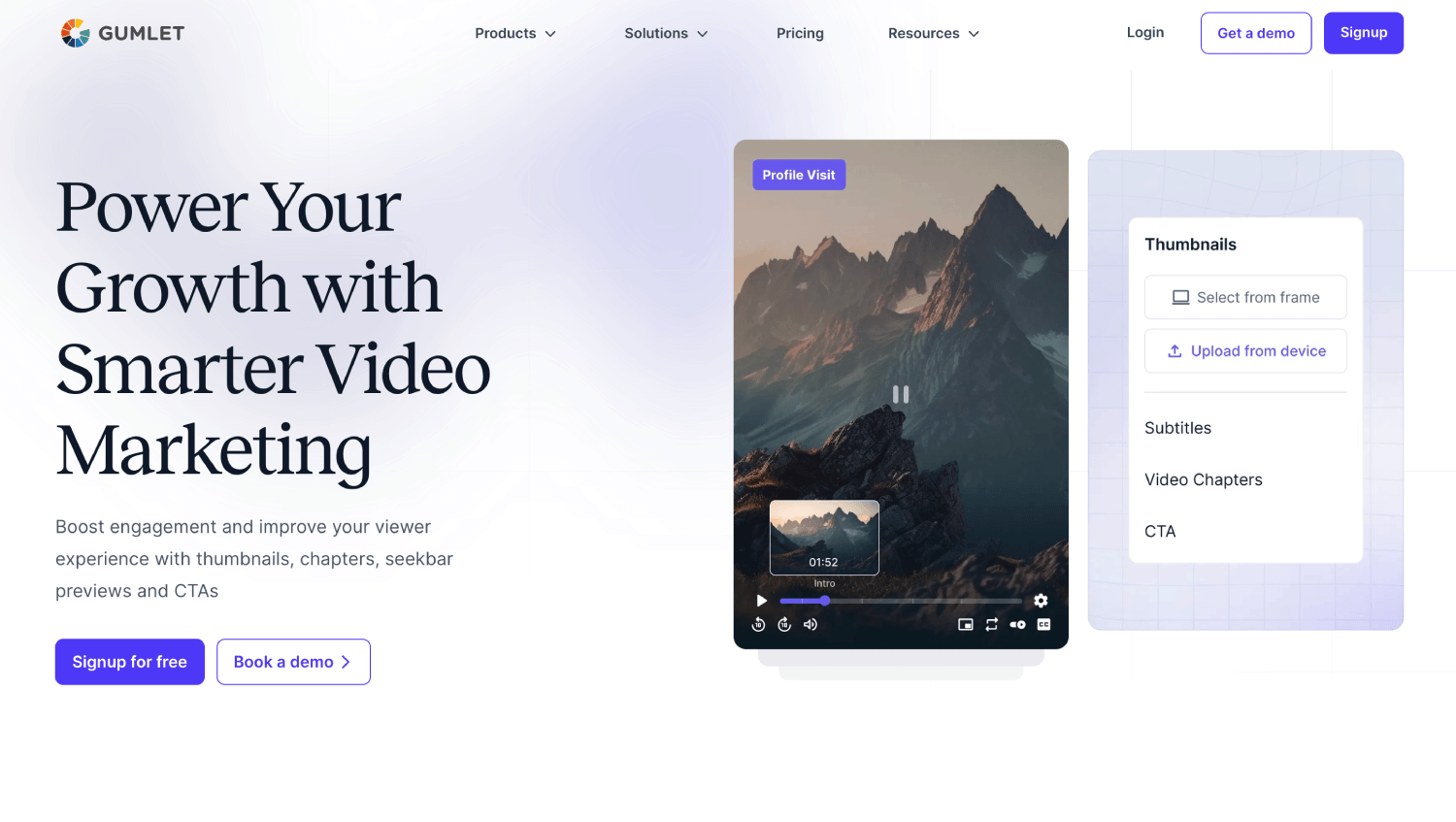
Gumlet is API-first video hosting built for teams that want video SEO handled automatically instead of hand-coded.
Three things set it apart:
- Auto-injected VideoObject schema means every uploaded video gets structured data without manual markup, which matters directly for a video's discoverability in search.
- AI-generated transcription and translation handle multilingual libraries without a separate vendor. Gumlet's AI-powered caption and subtitle generator can translate into more than 90 languages and transcribe in 30 languages.
- Adaptive bitrate streaming paired with AI-driven compression keeps playback smooth without inflating storage costs.
Gumlet’s pricing runs Creator at $6 a month, Growth at $19, and Business at $99, with a DRM add-on at $99 a month standalone and no setup fees along with availability of free plan, against industry average of $500 a month for comparable DRM.
Not for you if you need a full OTT storefront with subscription billing and native TV apps. Gumlet is delivery and API infrastructure, not a monetization platform.
Gumlet's enterprise video hosting tier adds SOC 2, ISO 27001, and AICPA compliance on top of the same DRM and adaptive streaming stack, and it's already running in production for companies like Tata 1mg, Sky, and Spinny.
That's a real option for teams that need enterprise-grade security and scale without inheriting Brightcove's custom-quote pricing model
2. Kaltura
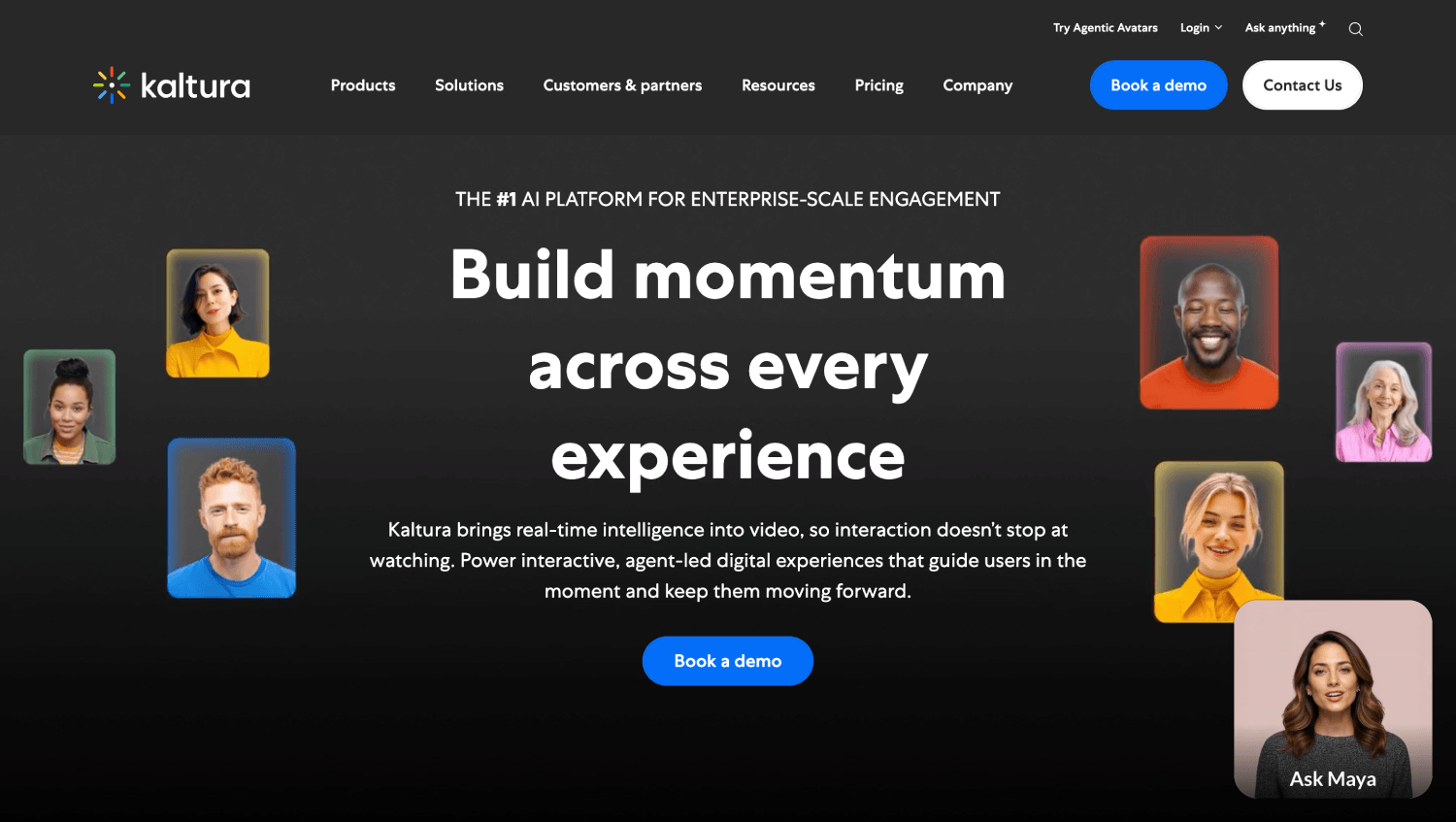
Kaltura is built for enterprise and education buyers who need deep customization more than fast setup, and it's often the default answer when someone searches for a video CMS for enterprise use.
Its open architecture and extensive API surface let engineering teams build custom video workflows instead of working inside a fixed player. Worth knowing that Kaltura spent 2026 repositioning around agentic AI rather than pure video infrastructure, closing the eSelf.ai and PathFactory acquisitions and picking up ISO/IEC 42001 certification for AI management along the way. If you're evaluating it, you'll be pitched the AI layer. Decide whether you're buying that or the video platform underneath it.
Kaltura remains a public company on Nasdaq under the ticker KLTR, independent of any private equity roll-up, which matters if platform stability under new ownership is part of your evaluation.
Pricing runs on custom enterprise contracts rather than public tiers.
Not for you if your team lacks the engineering bandwidth for a heavier implementation. Kaltura rewards technical depth. It doesn't reward fast unboxing.
3. Vidyard
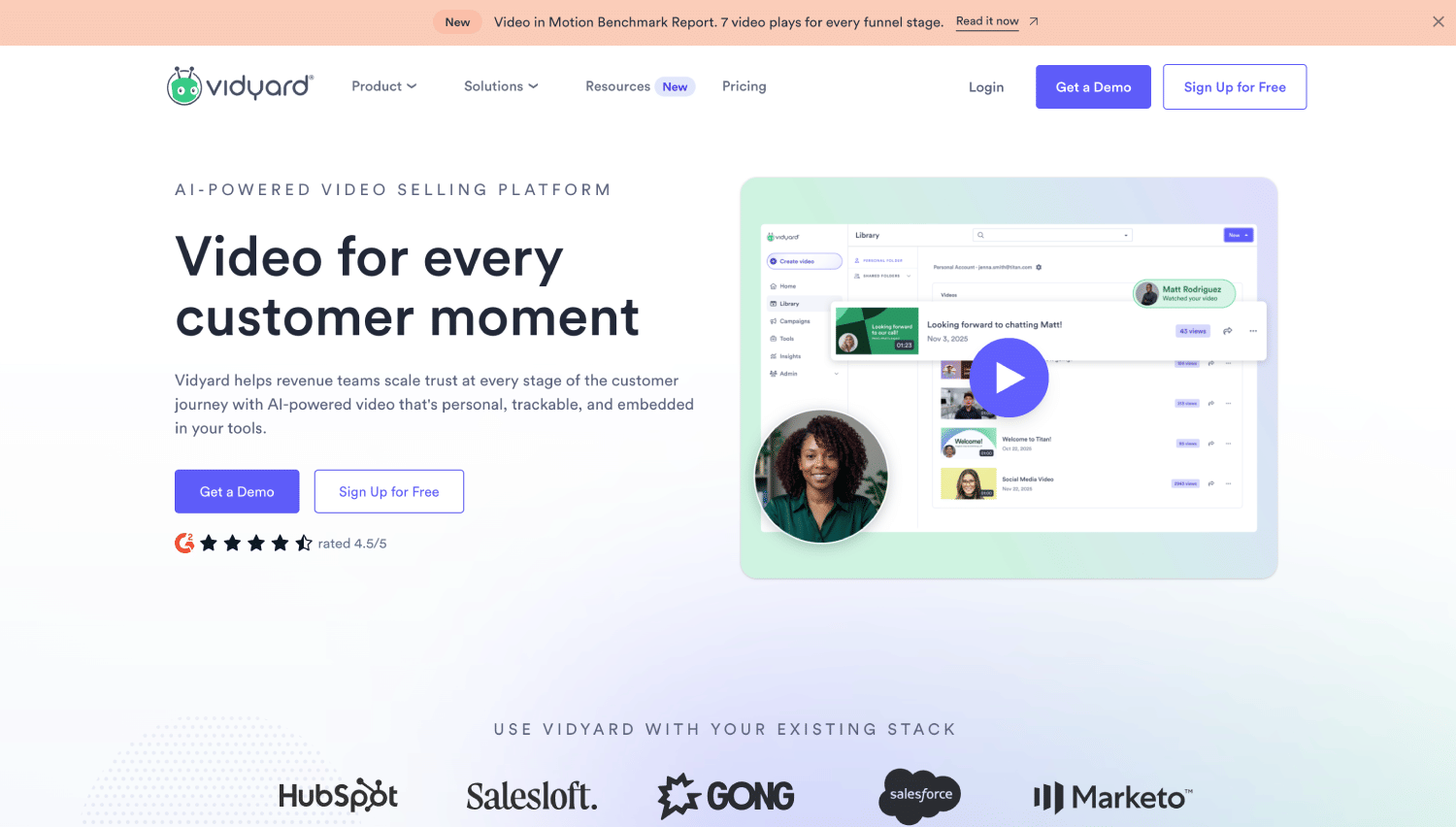
Vidyard is a B2B sales and marketing video tool, not a media distribution platform, and it doesn't pretend otherwise.
Its strength is CRM and marketing-automation integration. Sales reps record prospecting videos and Vidyard feeds engagement data straight into the customer relationship management (CRM) system.
Pricing runs from $59 per user per month for the Starter tier. Vidyard’s Teams and Enterprise tiers are priced based on a direct consultation and are layered on top for larger teams. A free plan is available as well.
Not for you if you need OTT delivery or a large public media library. Vidyard optimizes for one-to-one and one-to-few video, not one-to-many.
4. Wistia
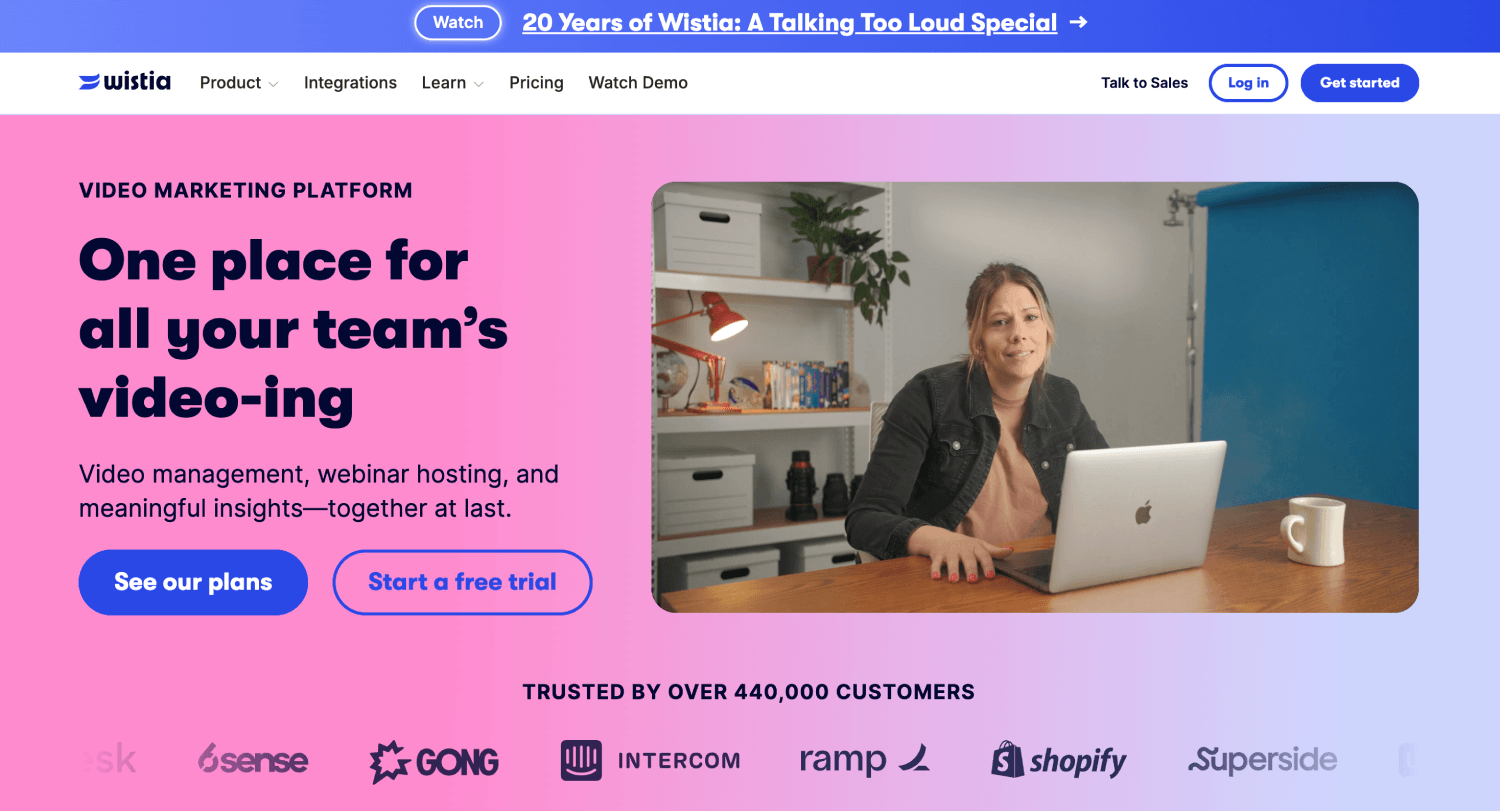
Wistia is a marketing platform first and a hosting platform second, and its founders have said publicly they intend to keep it that way rather than sell.
In-player lead capture and marketing analytics are the draw: viewer heatmaps and conversion tracking built directly into the player, useful for teams measuring video against pipeline rather than just views.
Pricing starts around $79 a month for the Business tier, with a lead-gen tier at $329. Brightcove vs. Wistia mostly comes down to this: Brightcove is built for distribution at scale, Wistia is built for marketing depth on a smaller library.
Not for you if you're running a large media library or are looking for layered video security features, at which point, opting for a notable Wistia alternative makes more sense.
Wistia's bandwidth and volume ceilings make it a weak fit past a certain size, and it isn't built for OTT or live-heavy workloads.
5. JW Player
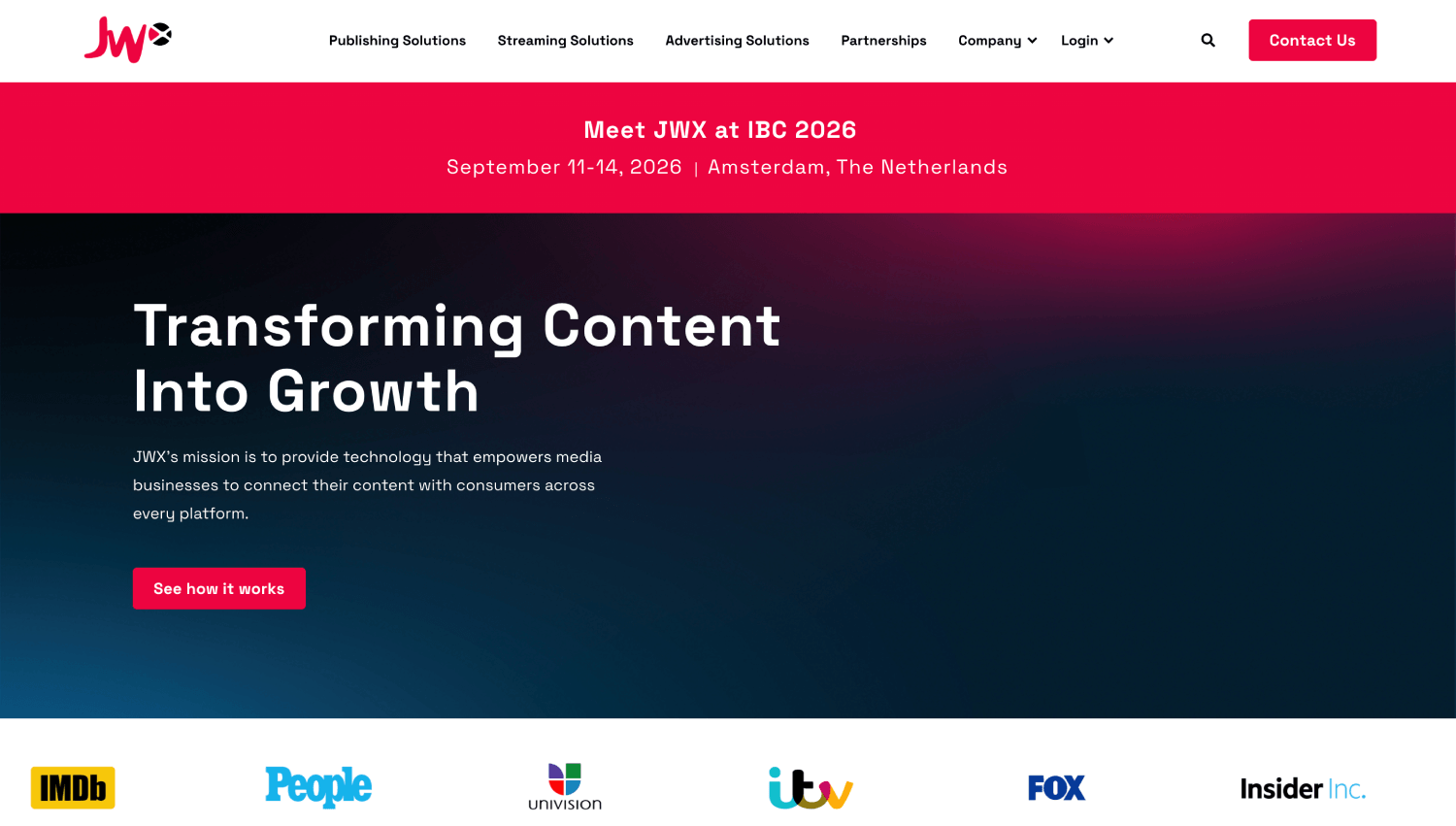
JW Player, now operating as JWP Connatix after its 2024 merger with Connatix, is built for publishers monetizing video at volume through advertising.
Server-side ad insertion, header bidding, and VAST/VPAID support are the core strengths, backed by a combined platform that reaches over 2,000 blue-chip media companies and 80% of the top 25 Comscore US publishers.
Publishers running programmatic video ads at scale get ad-tech depth that a general-purpose hosting platform doesn't build for.
Pricing runs on custom quotes tied to volume.
Not for you if your use case is internal communications or training. JW Player's ad infrastructure is overkill, and you'd be paying for monetization tooling you'll never use.
6. Mux
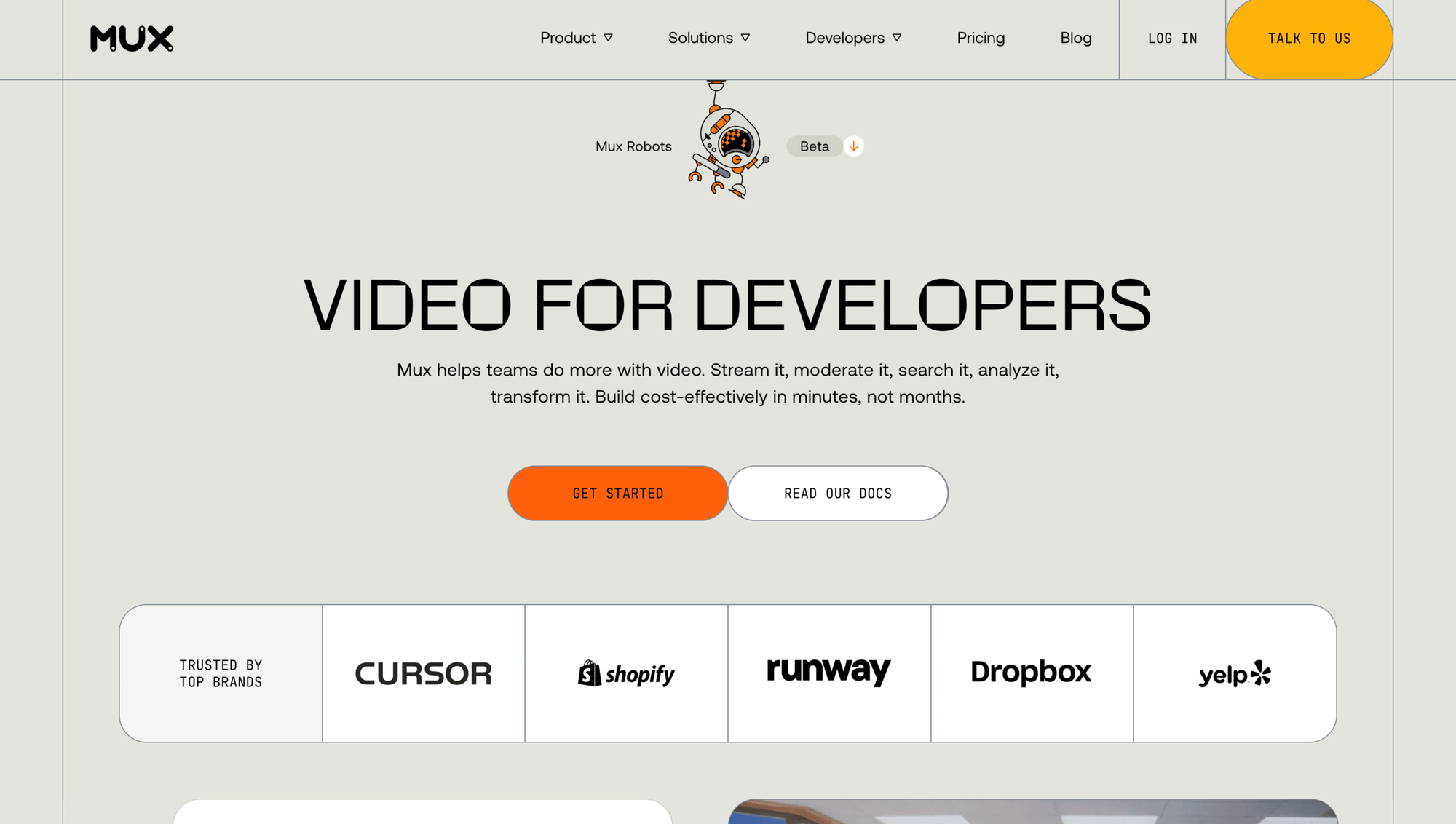
Mux is a video API platform built for developers shipping video features inside their own product, not for marketers managing a library through a dashboard. The company has been valued above $1 billion since its 2021 Series D round.
Usage-based pricing and real-time analytics are the pitch. You pay for what you stream, and you get performance data such as rebuffering, startup time, and playback errors at the API level, across both on-demand and live encoding, with DRM and encryption available for content protection.
There's no non-technical content management interface, deliberately, since Mux assumes your engineering team builds the interface layer.
Not for you if you don't have engineering resources to integrate an API. Mux has no drag-and-drop CMS for a marketing team to self-serve inside.
7. Panopto
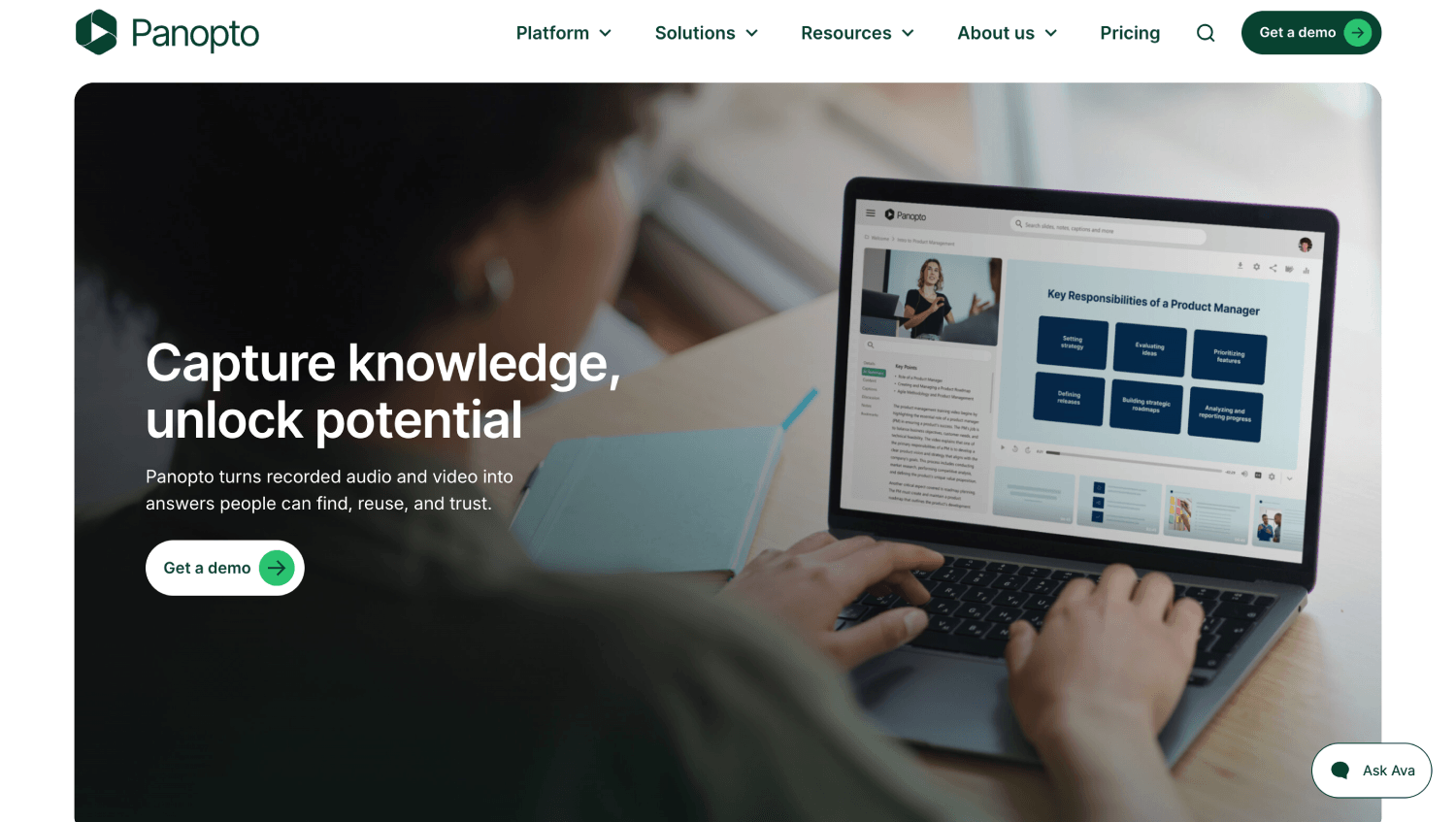
Panopto is built for internal training and corporate knowledge management, the searchable video library a Brightcove or Vimeo deployment usually isn't optimized for.
In-video search and integration with a learning management system (LMS) are the standout features. Employees can search inside video content the way they'd search a document, and the platform plugs into the LMS tools a company already runs.
Panopto has operated under K1 Investment Management, a private equity firm, since 2021.
Pricing runs on custom quotes.
Not for you if your use case is public-facing marketing video. Panopto is built for access-controlled internal libraries, not audience growth.
8. Vimeo Enterprise
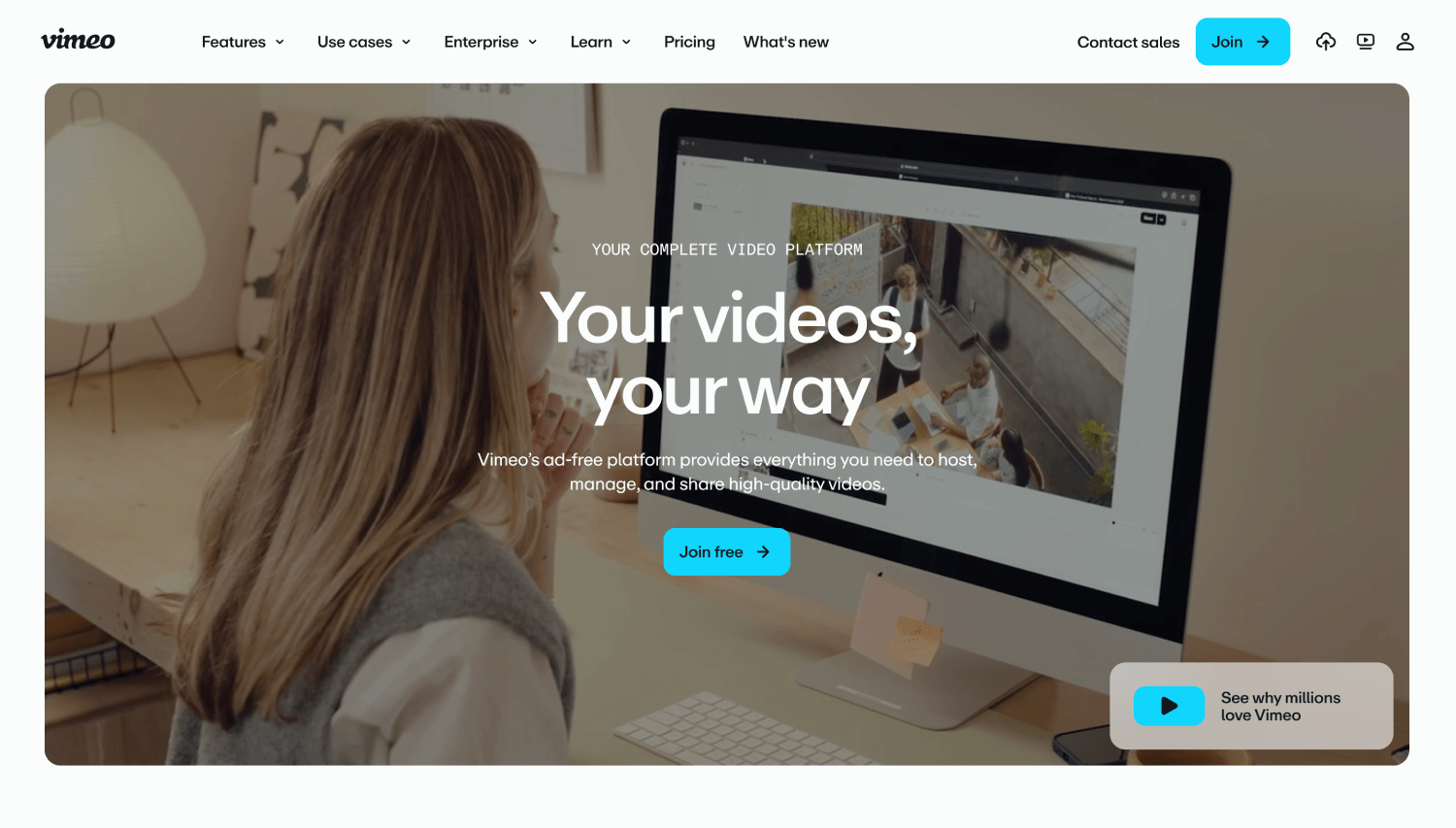
Vimeo Enterprise is a mature, broad business video platform with strong event and live-streaming tools, built out over more than a decade as Vimeo moved from its creator roots into enterprise use.
Its player and event-hosting tools are genuinely good, and its public-tier-plus-enterprise pricing model is more transparent than Brightcove's.
But here's the line that matters most in this entire comparison: Vimeo Enterprise now has the same owner as Brightcove. Bending Spoons closed its acquisition of Vimeo for $1.38 billion in November 2025, nine months after closing the Brightcove deal.
If ownership consolidation and roadmap uncertainty are why you're evaluating Vimeo alternatives in the first place, it doesn't solve that problem. It's the same problem with a different logo.
Not for you if the acquisition is your actual reason for leaving Brightcove. Everything else about Vimeo Enterprise being strong doesn't change who signs off on the roadmap now.
Platforms That Didn't Make the Shortlist
A few platforms come up constantly in searches for Brightcove alternatives and didn't make the eight above for specific reasons, not because they're weak products.
Dacast is live-and-OTT-first with a thinner enterprise CMS layer than the platforms above. api.video and Cloudinary both compete more directly with Mux as developer infrastructure than with Brightcove's enterprise suite. Uscreen is built for subscription video-on-demand businesses, not enterprise internal comms or marketing.
Bunny Stream offers low-cost delivery but minimal enterprise access controls. SproutVideo and VIDIZMO both serve narrower niches, SproutVideo for privacy-focused hosting and VIDIZMO for compliance-heavy government and legal video, that sit outside this comparison's enterprise-buyer scope.
How to Choose: An Enterprise Buyer's Checklist
There's no single best video platform for enterprise buyers across every workload. Match the enterprise video hosting platform to your dominant workload first. Filter on security and exit terms second, in that order, not reversed.
Workload comes first because it eliminates most of the list immediately. Public marketing video points toward Wistia or Vidyard. Internal communications and training point toward Panopto or Kaltura. OTT and monetization point toward JW Player or Vimeo Enterprise, with the ownership caveat above attached to the second one. Video embedded inside your own product points toward Gumlet or Mux.
The non-negotiables come next: SSO/SAML, SOC 2 Type II compliance, General Data Protection Regulation (GDPR) compliance with data residency options, multi DRM support across Widevine, FairPlay, signed URLs, a defined service level agreement (SLA) with uptime commitments, and published API rate limits.
Not every platform on this list publishes all of these openly. Confirm directly with each vendor's security documentation before you commit, since this is exactly the kind of detail that changes between quarters.
Commercial terms come last, and they're where most buyers get burned. Usage allowances versus overage fees determine whether your bill is predictable or a surprise. Auto-renewal clauses and contract length determine how locked in you are. Multi-year commitments typically buy lower per-unit rates, but they come paired with auto-renewal and limited mid-term exit options.
Check the exit clause before the feature list. The features are why you sign; the exit clause is why you stay, or why you're stuck.
What Migrating Off Brightcove Actually Involves
Budget for four things when you migrate from Brightcove, and none of them are the new platform's subscription fee.
- Asset export and re-encoding come first. Confirm you can pull original source files, not just delivered renditions, before you cancel anything.
- Second, every embed URL on every page you've published needs to change, which means planning redirects and a re-crawl or losing the video indexing you already earned.
- Third, analytics history typically doesn't transfer between platforms, so export what you need before the account closes.
- Fourth, access controls, DRM policies, and every third-party integration need to be rebuilt on the new platform, not assumed to carry over.
The scale of this isn't hypothetical. When Bending Spoons closed the Vimeo deal in November 2025, the resulting restructuring drove enough switching activity that Gumlet's migration tracking recorded 12,000 customers moving off Vimeo within 18 months, more than 900,000 hours of video content and over 2 petabytes of data in total.
One named case, Career Launcher, a large Indian test-preparation company, reported a 43% improvement in course completion rates and recovered 21% of revenue previously lost to piracy after completing its migration.
That's Vimeo migration data specifically, not Brightcove, but the four cost categories above apply regardless of which Bending Spoons property you're leaving.
Migrating a video library is a URL problem before it's a video problem.
How to Start This
Shortlist two platforms against your dominant workload, not eight. Run a 30-day trial with 10 real videos from your actual library, not sample content.
Test playback quality, embed behavior, analytics output, and schema generation before you sign anything, then confirm exit terms in writing. Migrate one section of your site first, and only move the rest once that section is stable in production.
Teams that want to test embed behavior, schema output, and transcript quality before committing anything can do it on Gumlet's free plan, no sales call required.
Frequently Asked Questions
1. Who owns Brightcove now?
Brightcove is owned by Bending Spoons, an Italian software holding company that closed a $233 million all-cash acquisition on February 4, 2025. Brightcove became a privately held company as part of the deal, and its stock was delisted from Nasdaq.
Bending Spoons also owns Vimeo as of November 2025, so switching between the two doesn't diversify ownership risk if that's part of your evaluation.
2. How much does Brightcove cost?
Brightcove doesn't publish pricing publicly. Third-party contract data from Vendr puts typical annual spend between roughly $20,000 and $250,000 or more, depending on bandwidth, storage, and which Studio-tier package applies.
Contracts run annual or multi-year, and exceeding usage allowances triggers overage fees priced above baseline rates, so get a written quote before assuming any number applies to your usage pattern.
3. What is the best Brightcove alternative for enterprise?
The right pick changes with your dominant workload rather than a single ranking. Kaltura fits enterprise LMS and education use cases with deep customization. Gumlet fits API-first delivery with SEO built in.
Vimeo Enterprise fits broad business video, with the caveat that it shares an owner with Brightcove. JW Player fits publishers monetizing at scale through advertising. Match the platform to your dominant workload before you start comparing feature lists line by line.
4. Is Vimeo a good Brightcove alternative?
Vimeo Enterprise is a strong product on its own merits, with mature event tools and transparent public-tier pricing. But Vimeo is now owned by Bending Spoons, the same company that acquired Brightcove in 2025.
If ownership uncertainty or acquisition risk is your actual reason for evaluating alternatives, Vimeo doesn't solve that problem, since you'd be moving to a platform under identical ownership.
5. Brightcove vs Kaltura: which is better?
Kaltura wins on deep customization and LMS integration for education and enterprise training, backed by an open API architecture that lets engineering teams build custom workflows. Brightcove wins on broader media and OTT monetization tooling built for large-scale content distribution.
Teams with heavy internal training or LMS needs tend to prefer Kaltura, and teams needing full-scale media monetization tend to stay with Brightcove or move toward JW Player instead.
6. Is there a free Brightcove alternative?
Brightcove itself has no free tier; it runs on enterprise-contract pricing only. Among the eight Brightcove alternatives compared here, Gumlet offers a ‘Free Forever’ plan, and several others, including Mux, Vidyard, and Wistia, publish public entry-level tiers rather than requiring a sales call.
Confirm current free-tier availability directly before building a plan around it, since these terms change.
7. How hard is it to migrate off Brightcove?
Migration difficulty depends on library size and how many pages embed your videos, not just video count. Budget for four specific costs: re-encoding source assets, rewriting every embed URL across your site, exporting analytics history before it's lost, and rebuilding access controls and integrations on the new platform.
For a library in the low thousands of videos, plan on multiple weeks of migration work, not a weekend project.
8. What's the best Brightcove alternative for live streaming and OTT?
JW Player and Vimeo Enterprise both lead on OTT and live-streaming capability among the platforms compared here. JW Player is stronger on ad-supported monetization for publishers running programmatic video at volume, and Vimeo Enterprise is stronger on broad event-hosting tools for general business use.
Weigh Vimeo Enterprise's ownership overlap with Brightcove against its feature strength before deciding either one actually solves your problem.
9. Is Gumlet suitable for enterprise video hosting?
Yes. Gumlet holds SOC 2, ISO 27001, and AICPA certifications, and its DRM, signed URLs, and domain and geo restrictions run on the same infrastructure used by enterprise customers like Tata 1mg, Sky, and Spinny.
It's a strong fit for enterprise teams that want API-first control and transparent per-plan pricing. Teams specifically looking for OTT monetization or native subscription billing should look at JW Player or Vimeo Enterprise instead, since that sits outside what Gumlet is built for.
10. Brightcove vs Vimeo: which should I pick?
Neither, if ownership is your concern. Bending Spoons closed its $233 million acquisition of Brightcove in February 2025 and its $1.38 billion acquisition of Vimeo in November 2025. On features, Brightcove is stronger on OTT monetization and large-scale media distribution while Vimeo Enterprise is stronger on events, live tools, and pricing transparency. On ownership, they are the same bet.
Conclusion
Eight Brightcove alternatives all use the same label, but exactly one fact should filter your shortlist before anything else: Brightcove and Vimeo now share an owner, so switching between them solves nothing if ownership uncertainty is your real complaint.
Past that filter, match workload to platform first, security and exit terms second, and migration cost last, because migration cost is what every vendor conversation skips.
The subscription price is not what breaks budgets during a platform switch. The weeks of embed rewrites and the analytics history nobody exported in time are what break budgets.
Shortlist two Brightcove alternatives against your actual workload, test the migration path before you sign, and you'll make a sharper decision than the spec sheet alone would give you.