If you rely on Vimeo for product videos, customer training, or paid content, the last few years have probably felt uneasy.
Since mid 2022, Vimeo has announced several workforce reductions as part of a broader push to streamline operations and improve profitability. It cut 6 percent of staff in July 2022, followed by a larger 11 percent reduction in January 2023. In 2025, Vimeo disclosed another global workforce reduction of just under 10 percent of its full-time employees, with the process expected to be substantially complete by the end of the fourth quarter.
In September 2025, Vimeo went further and signed a definitive agreement to be acquired by European software company Bending Spoons in an all-cash transaction valued at about 1.38 billion dollars. Bending Spoons is known for buying mature digital products like Evernote and WeTransfer, then aggressively restructuring them, including staff cuts and pricing changes.
Viewed from a distance, this looks like a standard tech story about restructuring and a buyout. For teams that treat Vimeo as replaceable marketing infrastructure, it might be.
For video-heavy businesses that pipe Vimeo into their app onboarding, learning experience, customer portals, or internal knowledge base, it is different. In those environments, any instability in the underlying video platform is a direct risk to adoption, support load, and top-line revenue.
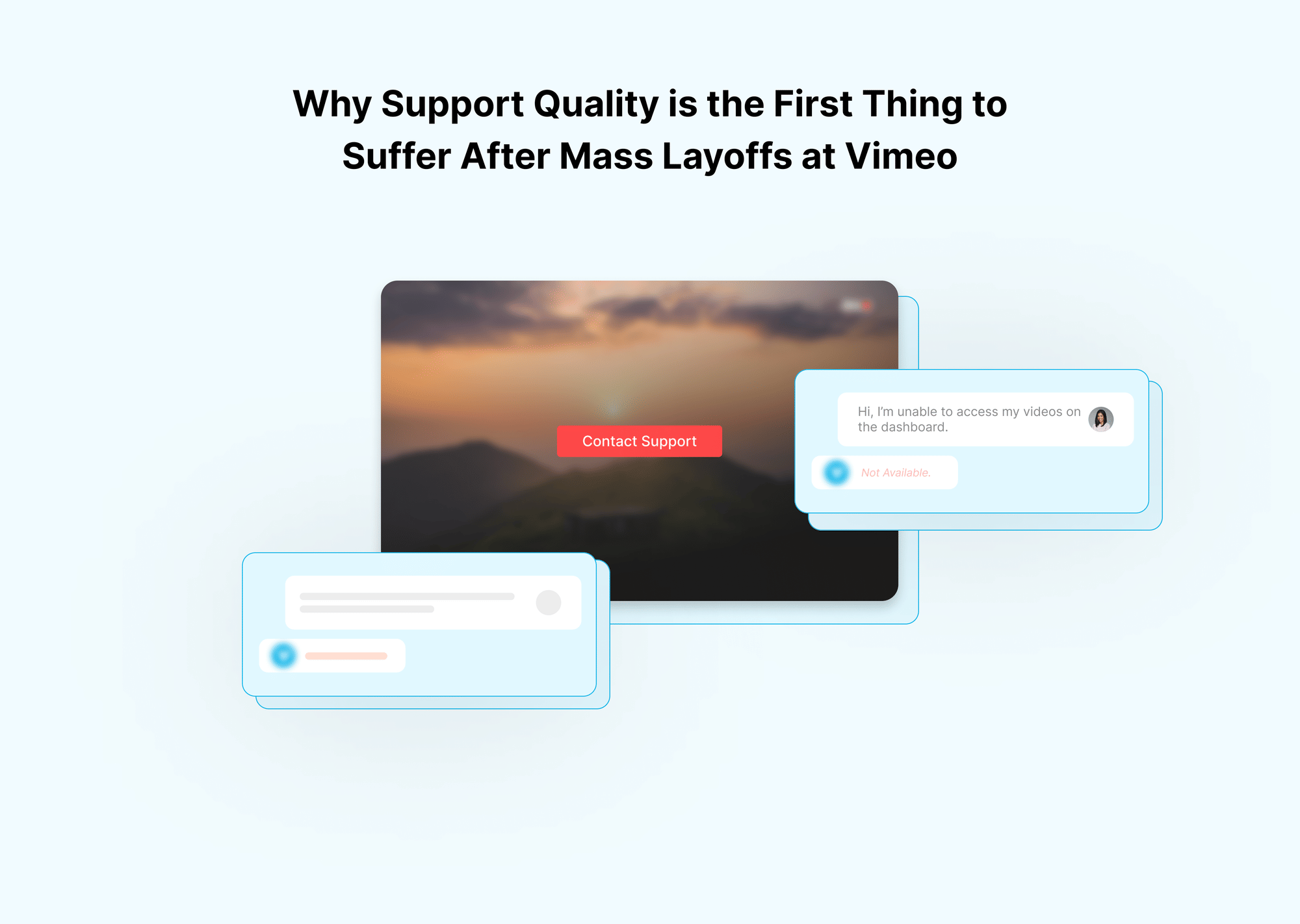
Crucially, the risk is not that Vimeo will vanish overnight. The more immediate and likely risk is that you will first feel these changes in support. When a video provider reduces headcount and shifts to private ownership, the customer experience usually changes long before there are public status incidents or formal changes to feature sets. Ticket queues stretch, front-line agents handle more complex issues with less backup, and specialist engineers who knew your edge-cases may no longer be there.
This article focuses on those mechanics rather than speculation. It explains why support quality is usually the first thing to suffer after mass layoffs at a platform like Vimeo, how to tell whether that is already happening in your account, and what a pragmatic response looks like if video is core infrastructure for your business. If you stay with Vimeo, you should do it with eyes open and a clear risk profile. If you decide to explore alternatives, you should know what a support-first video infrastructure partner looks like and how to evaluate one.
What is Actually Happening at Vimeo Right Now?
To understand the risk Vimeo customers are carrying today, you have to look at the pattern of headcount cuts and ownership changes over the last few years, not just a single announcement.
Vimeo has been reducing staff since 2022. In July 2022, the company cut about 6 percent of its workforce, with then-CEO Anjali Sud describing the move as necessary to emerge from a tough macro environment as “a stronger company.” In January 2023, Vimeo followed with a larger reduction of roughly 11 percent of global full-time employees, again framed as a way to streamline operations and push toward sustainable profitability.
That restructuring did not stop there. In September 2025, Vimeo disclosed another cut of around 10 percent of its workforce as part of an effort to “ensure focus and efficiency” while it repositioned the business more squarely around enterprise and software offerings.
One week later, the company announced that it would be acquired by Milan-based software group Bending Spoons for $ 1.38 billion, with plans to take Vimeo private once the transaction closed.
That acquisition was completed in November 2025. Within a few months, the new owner moved from integration to aggressive cuts. Around 20 January 2026, multiple reports from Business Insider and others confirmed that Vimeo was laying off staff globally for the second time in less than six months.
Coverage from outlets such as The Verge, Engadget, Gizmodo, and industry sites describes this latest round as severe, affecting a “large portion” or “most” of the company, including much of the video engineering team. While Bending Spoons has confirmed that layoffs are underway, it has not released precise headcount numbers.
Taken together, the picture is not a normal one-off adjustment. In less than four years, Vimeo has:
- Cut 6 percent of staff in 2022
- Cut 11 percent of staff in early 2023
- Cut roughly 10 percent again in September 2025, just before agreeing to the Bending Spoons sale.
- Launched a second, much larger round of layoffs in January 2026, months after the acquisition closed.
The external signals match that story. Business Insider and other outlets characterise the January 2026 cuts as eliminating the majority of remaining staff, with particular impact on engineering and regional teams. The layoffs include senior leaders such as Vimeo’s former VP of Global Brand and Creative. Cined and other industry publications report that former employees describe the company as having laid off “almost everyone,” including the entire video team.
On the customer side, public discussion in Vimeo’s own creator community reflects the same concern. A Reddit thread responding to Business Insider's reporting includes posts from affected staff and longtime customers.
One laid-off employee quoted there says they “wish [they] could say it was a surprise,” while creators who rely on Vimeo for live streaming and enterprise features talk openly about needing to look at alternatives because they expect engineering and support capacity to be hollowed out.
Vimeo has already experienced multiple waves of layoffs, and the first major move by its new owner has been to conduct what independent reporting describes as mass job cuts across global teams.
This is not speculation about what might happen someday. It is a visible shift in the size and structure of the organisation that runs a service many companies treat as part of their infrastructure. Even if the platform remains online and continues to add features, the support and engineering depth behind it are clearly under pressure, which is exactly where customers feel the impact first.
Why Support Quality is Usually the First Casualty After Layoffs
When a SaaS company cuts headcount, it does not immediately turn features off or delete products. The first visible change, especially for existing customers, is almost always in support. That is not about individual support agents doing a worse job. It is the natural result of how most support organizations are structured and measured.
Fewer Front-line Agents, Same or Higher Ticket Volume
Customer support in a mature platform like Vimeo is a queueing system. Tickets come in through email, chat, and in some cases, phone or in-app widgets. They are routed by priority, topic, and plan tier. When you remove people from that system without a matching reduction in ticket volume, three things happen by default:
- First-response times increase because each agent is handling more conversations in parallel.
- Resolution times stretch, especially for complex issues that require cross-team coordination.
- Deflection tactics become more aggressive, with a stronger push toward self-serve help centers rather than direct human involvement.
For businesses that rely on Vimeo for embedded product video, gated content, or live events, those delays are not abstract. A lightly resourced marketing user might tolerate a 24-hour delay on a player styling question. A SaaS product team facing a broken integration or playback issues in a paid onboarding flow cannot.
External research backs up how unforgiving customers are about degraded support. According to a 2023 Zendesk CX Trends report, roughly 73 percent of consumers say they will switch to a competitor after multiple poor customer service experiences, and more than half will leave after a single bad interaction. That is the standard your own users are operating with when your video platform slows down your responses.
Loss of Institutional Knowledge and Domain Experts
Headcount reductions do not only affect front-line support agents. They often hit senior support engineers, customer success managers, technical account managers, and product specialists who hold a disproportionate amount of institutional knowledge.
In a video infrastructure context, these people:
- Remember historical incidents and the workarounds you agreed on years ago.
- Understand the specifics of your DRM setup, tokenization strategy, or CDN routing.
- Know which internal teams to pull in when something breaks in your particular integration.
When those individuals leave, what is lost is not just “one more person on the roster”. You lose context that is impossible to recreate from tickets alone. New agents may see account notes, but they will not know which edge cases were considered acceptable risk, which were escalated all the way up, and which were fixed by one-off patches that now need close monitoring.
The practical effect is that issues that were once resolved in a single, well-informed thread start bouncing between generic queues. That shows up on your side as repetitive questions, contradictory advice, or long delays before someone senior even looks at your problem.
Morale, Burnout, and Secondary Churn in Support Teams
Layoffs not only reduce the number of people in a support organization. They also change how the remaining staff feels about the company and their workloads.
After a reduction in force, the people who stay often have:
- Larger ticket loads and more responsibility, without an immediate change in tools or processes.
- Less confidence in leadership’s willingness to invest in long-term improvements.
- Stronger incentives to look for roles elsewhere, especially if they are senior and highly employable.
That combination is a recipe for burnout and secondary churn. Even without an official second round of layoffs, you can see a quiet wave of resignations among experienced staff. Newer hires or contractors fill the gaps, but they come in without history or context and often with less authority to push through internal changes.
For a business that treats Vimeo as critical infrastructure, that kind of churn matters. An incident that once would have been handled by a seasoned support engineer who knows your account may now be triaged by someone who has never seen a similar case and has limited access to the people who have.
Support Reframed as a Cost Center, Not a Capability
The most structural shift after mass layoffs is how support is framed inside the company. When a platform is under pressure to improve margins, support is often treated first and foremost as a cost to be contained, not a capability to be deepened.
That shows up in metrics. Instead of optimizing for durable resolution and long-term customer outcomes, the focus tilts toward:
- Reducing average handle time.
- Increasing the proportion of tickets resolved through self-serve documentation.
- Restricting “premium” support channels to a smaller set of high-paying accounts.
If you are on the wrong side of those lines, you may still technically have access to support, but the experience will degrade. You wait longer, speak to less experienced staff, and receive more generic answers. Escalations become harder, and the threshold for “business critical” status creeps upward.
For some use cases, that trade-off might be acceptable. For teams embedding Vimeo in mission-critical workflows, it is not. You are effectively relying on a vendor whose internal incentives are now optimized around cost control, while your own incentives demand reliability, fast issue resolution, and a clear understanding of how changes will affect your users.
Why Support Quality Matters More When Video is Core Infrastructure
It is one thing to have support delays on a generic marketing tool. It is very different when the same pattern hits a system within your core product or revenue engine. For many Vimeo customers, video is no longer a “nice to have” asset on a landing page. It is infrastructure.
When Video Failure is Product Failure for SaaS
In modern SaaS, video is deeply wired into the product and customer journey:
- Onboarding checklists and product tours inside the app
- Feature deep dives for power users
- In-app help centers and self-service troubleshooting
If those videos fail to load, buffer heavily, or return errors, your product looks unreliable, even when your core product is fine. You also lose data. If plays, completion rates, and drop-off points stop flowing cleanly, you cannot see where users get stuck in onboarding or which feature tutorials actually move activation.
The quality of your video vendor's support dictates how long those problems last. A playback bug that used to be triaged to a senior support engineer within hours might now sit in a queue for days. During that time, your own support team absorbs the pain in the form of extra tickets, refunds, and manual workarounds.
Paid Courses, EdTech, and Membership Content
For course creators and EdTech platforms, Vimeo is often the backbone for:
- Paid cohort-based courses
- Always-on catalogues of lessons and practice content
- High-stakes assessments or exam prep material
Here, failures are not just a hit to brand perception. They are a direct revenue and trust problem. If students in a paid cohort cannot access lesson videos for a weekend, you are not dealing with abstract churn risk. You are dealing with immediate refund requests and reputational damage that hits future launches.
Industry surveys underline how central video has become here. In its 2023 Global Video Index, Brightcove reported that more than 60 percent of viewers say they are more likely to purchase from a brand after consuming educational or training video content. When that content is delivered through a platform whose support is slowing down, the risk is not passive.
Media, OTT, and IP-sensitive Content
Streaming platforms, media companies, and subscription communities have another layer of exposure: intellectual property and rights management. They depend on their video infrastructure provider for:
- Secure delivery of premium content
- Fine-grained access control (plans, regions, devices)
- Anti-piracy measures such as tokenized URLs, watermarking, and DRM
If support deteriorates at the same time as ownership, policies, or pricing are shifting, you end up with a dangerous mix. Critical incidents involving leaks, unauthorized embeds, or geo-blocking errors can take longer to resolve, and you may struggle to get clear answers about what happened and which controls are actually in place.
A 2023 survey by Cisco found that 82 percent of internet traffic is now video, with streaming and download services making up the majority. When most of your traffic and bandwidth is tied to video, having a vendor with stretched support and uncertain priorities is not a small operational nuisance. It is a systemic risk.
Internal Video: Onboarding, Enablement, and Compliance
Even when your videos are not public, support quality still matters. Many companies use Vimeo or similar platforms to host:
- Internal onboarding and culture content
- Sales and customer success enablement libraries
- Compliance and policy training
If those videos fail, you see slower onboarding, inconsistent internal knowledge and more time spent by managers repeating the same information live. In regulated industries, gaps in training access can also create audit and compliance exposure.
In all of these cases, you are not dealing with a generic marketing SaaS. You are dealing with infrastructure. That is why support is one of the first areas you should reassess when a vendor undergoes repeated layoffs and a change in ownership. You need to know whether the support team that can fix your problems still has the time, context, and incentives to do so.
What Bending Spoons Acquisition Patterns Suggest About Support Risk
The Vimeo acquisition is not happening in a vacuum. Bending Spoons has a visible track record with other mature software products, and that history gives useful clues about what customers typically experience in the first years after a deal closes.
The Bending Spoons Playbook in Brief
Bending Spoons positions itself as a long-term operator of digital products. Its portfolio includes brands like Evernote, Meetup and WeTransfer. The stated goal is to buy underperforming but well-known products, centralize operations, and drive “operational efficiency” while investing selectively in features that align with its portfolio strategy.
Evernote is the clearest recent example. After Bending Spoons acquired Evernote in late 2022, the company announced in mid 2023 that it would move most of Evernote’s operations to Europe, the home region of its parent. In practice, that shift meant laying off the majority of Evernote’s staff in the United States and Chile while relocating the center of operations to Italy.
Public reporting around that transition highlights a familiar pattern:
- Significant job cuts
- Consolidation of teams into European hubs
- Changes to pricing and plan structures once the dust settles
Vimeo now sits inside the same portfolio, under the same leadership, and with a similar mandate to improve profitability and justify a substantial premium paid to shareholders.
None of this guarantees that Vimeo will follow the exact same path as Evernote. But it is reasonable for any Vimeo customer to assume that Bending Spoons will apply similar pressure for efficiency, centralization, and margin improvement.
What This Kind of Restructuring Usually Does to Support
From a customer perspective, the most immediate impact of this playbook is not in new features or AI roadmaps. It is in how support and service teams are staffed and managed.
Centralizing operations to a new region often means:
- The loss of local or regional support staff who understood specific market needs.
- A period where ticket handling is transitioned between teams, with inevitable gaps in context.
- New routing rules and support tiers that prioritize certain segments more aggressively.
In Evernote’s case, moving the “center of operations” to Europe and laying off most US and Chilean staff was explicitly framed as a way to “boost operational efficiency” and benefit from the Bending Spoons employer brand in Europe. That language is typical of restructuring, where costs and control are the primary levers.
Apply the same logic to Vime,o and the picture becomes clearer. Vimeo has already cut nearly 10 percent of its workforce before the deal closes. Once the transaction is fully integrated, you should assume:
- Further consolidation of support and engineering teams into fewer locations.
- A strong push to standardize processes and reduce “special cases” that need human intervention.
- Tighter criteria for what qualifies as business-critical support, especially for customers on older contracts or plans that do not match the new strategy.
For customers using Vimeo as true infrastructure, that matters. Live events, embedded product flows, secure course portals, and internal video stacks all generate complex, context-heavy support needs. Those needs are exactly the ones that suffer when a vendor is reconfiguring teams, metric,s and cost structures.
Why This is a Signal, Not a Verdict
It is important to separate signals from outcomes. The Bending Spoons acquisition and the company’s history with Evernote are strong signals that Vimeo will prioritize efficiency and centralization. They are not, by themselves, proof that Vimeo will neglect enterprise customers or let core infrastructure decay.
What they tell you is that you are entering a period of elevated execution risk. Even if Vimeo’s long-term trajectory under Bending Spoons turns out to be positive, the next 12 to 24 months are likely to involve:
- Shifts in who handles your tickets and where they sit in the organization.
- Changes to support tiers, SLAs, and what is considered “in scope” for standard plans.
- Potential adjustments to pricing or packaging as the new owner aligns Vimeo with the rest of its portfolio.
For teams that treat Vimeo as non-critical, that risk might be acceptable.
For video-heavy businesses that depend on fast, informed, and reliable support, it is a warning sign that you should at least quantify your exposure and have a backup plan.
Gumlet’s view, as an infrastructure-focused provider, is that this is the right time to treat support as part of your vendor due diligence, not an afterthought. If Vimeo is deeply embedded in your product or revenue flows, it is rational to benchmark its current support performance against what a support-first video platform can offer and to understand what a phased migration would entail. Exploring options with a provider like Gumlet now, while things are relatively stable, gives you far more control than scrambling to react if support quality or policies change suddenly.
How to Quantify your Vimeo Vendor Risk in 30 Minutes
You do not need a full vendor risk committee to understand your exposure to Vimeo. With the right questions, you can get to a simple: Low, Medium, or High risk-view that is good enough to drive decisions.
Step 1: Map How Critical Vimeo is in Your Stack
Start by listing every place where Vimeo shows up in your business. This is the difference between a minor marketing tool and true infrastructure.
Look at:
- Public marketing sites: landing pages, blogs, case studies, and webinars
- Product and app experiences: onboarding flows, in-app help, feature tutorials
- Customer portals: logged-in areas, knowledge bases, implementation hubs
- Paid or gated content: courses, cohorts, subscriptions, memberships
- Internal use: onboarding, enablement, compliance training
For each usage, answer two questions in a simple document or spreadsheet:
- What happens to users if Vimeo stops working or degrades severely for 24 hours?
- How much direct revenue or critical workflow depends on that video functioning correctly?
If a failure mostly hurts vanity metrics, you are closer to Low risk. If a failure blocks new revenue, renewals, or compliance, you are in Medium to High territory before you even consider support quality.
Step 2: Score Your Support Exposure
Next, look at how dependent you are on Vimeo support and how it is actually performing.
Collect the last 6 to 12 months of interactions and note:
- Average time to first human response on tickets that matter to you
- Average time to resolution for issues that required engineering involvement
- Number of tickets that needed multiple escalations or reopening
- Any incidents where your team had to work around Vimeo because support could not resolve something quickly enough
Layer on your contractual position:
- Which support tier and SLA do you have on paper today?
- Are you on a legacy plan that might no longer align with how Vimeo wants to serve customers?
- Do you have a named contact who understands your environment, or only a generic queue?
Give support exposure a simple score:
- Low: Fast, predictable responses, clear SLAs, stable account contacts
- Medium: Occasional delays, some turnover in contacts, but complex issues still resolved reliably
- High: Frequent slow or incomplete responses, repeated loss of context, critical incidents that dragged on
This is the part most teams skip, even though it is where the impact of layoffs and restructuring shows up first.
Step 3: Score Your Security and Compliance Exposure
If you use Vimeo for any kind of IP-sensitive or regulated content, your security and compliance exposure matters as much as uptime.
Document:
- How you currently restrict access (unlisted links, embed restrictions, domain and geo controls, single sign-on, DRM, watermarking)
- Which of those controls are enforced by Vimeo and which are enforced by your own application
- Any past incidents of unauthorized sharing, embeds on non-approved domains, or incorrect geo-blocking
Then ask:
- If a misconfiguration or platform bug exposed private content, how serious would the damage be?
- Do you have clear, written commitments from Vimeo on incident response times and communication for security issues?
Score security exposure:
- Low: Mostly public content, minimal sensitivity, strong controls enforced on your side
- Medium: Mixed public and private content, some business-critical material, reasonable but not airtight controls
- High: Significant paid, regulated, or internal content where leaks would have serious financial, legal, or brand impact
This is where many course platforms, EdTech businesses, and media companies discover that their dependence on Vimeo is closer to critical infrastructure than they realised.
Step 4: Score Your Exit Readiness
Finally, you need to know how quickly you could move if Vimeo's support quality or policies deteriorate.
Check:
- Do you have original source files for your videos, or only compressed versions inside Vimeo?
- Can you export metadata such as titles, descriptions, captions, chapters, and collections in a usable way?
- How tightly coupled is your application code to Vimeo-specific APIs or embed logic?
- Have you ever done a trial migration of a subset of content to another platform?
Score exit readiness:
- High readiness: Files and metadata are accessible, integrations are reasonably abstracted, and a phased migration in 2 to 3 months is realistic
- Medium readiness: Some gaps in files or metadata, but migration within 6 months would be possible with planning
- Low readiness: No clear export path, heavy Vimeo-specific coupling in code, migration would require a major engineering project
Exit readiness does not tell you whether you should leave Vimeo. It tells you how much leverage you have in any conversation about staying.
Deciphering Data and When to Talk to an Alternative
Combine your four scores into a simple view:
- If Vimeo is lightly used, support exposure is low, security risk is low, and exit readiness is high, you are likely in a “Low” overall risk position.
- If Vimeo is embedded in core product flows, support exposure is medium or high, security risk is medium or high, and exit readiness is poor, you are looking at a “High” risk vendor dependency.
This exercise provides a concrete basis for internal discussions with product, marketing, support, and security leaders. It also gives you a clear brief when you evaluate alternatives. Instead of asking for generic feature parity, you can ask specific questions about support structure, security controls, and migration tooling.
If your audit falls into the Medium or High risk range, it is reasonable to begin a structured evaluation of support-first video infrastructure providers that can match your use case and offer a clear migration path. Gumlet is one such option: it is designed for teams that treat video as infrastructure rather than a marketing asset, with a smaller, focused team that prioritises responsive support and predictable migration from platforms like Vimeo. At this stage, even a short discovery call or demo with Gumlet can help you translate your risk scores into a concrete plan, long before you are forced to move under pressure.
What Support-first Video Infrastructure Actually Looks Like
If you decide that Vimeo is now a higher-risk vendor, you need a clear picture of what “good” looks like. Support-first video infrastructure is not just storage and a player with a help center. It is a combination of support model, delivery architecture, and security posture that treats video as critical infrastructure.
Support Tied to Business Criticality, Not Just Seat Count
In a support-first platform, support quality scales with the business impact of video, not only with how many users you have in the UI.
That usually means:
- Documented response and resolution targets that match enterprise video hosting support needs for launches, live events, and in-app use cases.
- Priority routing for incidents that affect production environments, even if they come from a relatively small team.
- Clear escalation paths into engineering for issues involving APIs, DRM rules, or CDN behavior.
The key difference from a generic SaaS model is that “plan tier” is not the only driver. A small but video-heavy SaaS product with a few thousand paying customers should be able to get urgent help when a playback bug breaks onboarding.
Support Teams that Understand Infrastructure, Not Just Tickets
Support-first video providers staff their teams with people who understand how video delivery actually works. That includes:
- Adaptive bitrate streaming and how encoding ladders interact with different network conditions.
- Multi CDN routing, origin shielding, and how cache behavior affects performance in different regions.
- The mechanics of tokenized URLs, DRM, geo restriction,s and what can go wrong in real integrations.
For your team, this changes the feel of every interaction. Instead of “have you tried clearing cache and checking our docs?”, you get conversations about specific HLS manifests, player events, or API calls, with someone who can read your logs and theirs together.
Gumlet is built on this model. It positions itself explicitly as an end-to-end video infrastructure for SaaS, EdTech, media, and membership platforms, with developer-grade APIs on one side and marketer-friendly tooling on the other.
That combination only works if support can talk credibly to both groups.
Security, Access Control, and Analytics as First-Class Features
If video is core infrastructure, support is inseparable from security and observability. A support-first platform offers:
- Hardened protection: DRM, tokenized links, domain, IP, and geo restrictions, session-level watermarking, and audit logs for leak forensics.
- Clear separation between what the platform enforces and what your app enforces, so you can reason about risk.
- Deep analytics: per-session heatmaps, error rates, playback KPI,s and event streaming into your analytics stack, so you and the vendor can debug issues quickly.
When those pieces exist, support has real levers. They can examine affected regions or ISPs, spot patterns in error codes, and confirm whether a suspected leak originated from a specific account. Without them, support is limited to guesses and generic fixes.
Gumlet bakes these concerns into the product, not as add-ons. Its protection suite covers DRM, tokenized URLs, and granular access controls, while its analytics surface time to first frame, rebuffering, watch time, and conversion events in a way that support can actually use during incidents.
Guided Migration and Integration
The other hallmark of support-first infrastructure is how it handles migration and integration. A vendor that expects to be treated like infra does not just offer an API reference and tutorials. It offers:
- Bulk ingest and metadata mapping assistance so you can move away from a legacy platform like Vimeo without losing structure.
- Guidance on how to abstract embeds and APIs so that your next migration is simpler if you ever need it.
- Hands-on support during the first few critical launches on the new stack.
For teams migrating from Vimeo, Gumlet provides automated import tools and migration patterns that preserve playlists, collections, and metadata wherever possible. That is not only a convenience feature. It is part of reducing the operational risk of moving off a platform whose support quality you no longer fully trust.
Where Gumlet Fits if You are Planning Your Exit From Vimeo
If your internal audit says Vimeo has become a higher-risk dependency, you do not just need another hosting tool. You need a video infrastructure provider that treats support, security, and migration as core responsibilities, not just “nice to have” extras. That is the space where Gumlet fits.
Built for Teams That Treat Video as Infrastructure
Gumlet is not positioned as a generic video marketing platform. It is built for product and content teams that treat video as part of their infrastructure stack. Typical customers include:
- SaaS products that embed video inside onboarding and feature education
- EdTech platforms and course creators with paid, gated content
- Media, OTT, and membership businesses with IP-sensitive libraries
- Companies that run internal knowledge, onboarding, and compliance through video
For these use cases, uptime, performance, and access control sit in the same category as core application services. Gumlet’s architecture, SLAs, and support practices are designed for that baseline, which is very different from those of a platform that primarily serves public marketing content.
A Small, Focused Team as a Structural Advantage
In the context of Vimeo’s layoffs, a smaller team is often perceived as a risk. For infrastructure-style products, the opposite can be true, provided the team is focused and specialised.
Gumlet’s size and scope work in its customers’ favour because:
- The product surface is tightly focused on image and video delivery, rather than a broad suite of unrelated tools
- There are fewer layers between support, engineering, and leadership, so critical issues can be escalated and resolved more quickly
- Customers see less churn in account and technical contacts, which preserves the institutional knowledge that is usually lost in larger, frequently restructured organisations
For a team coming from Vimeo, that means you are moving to a provider where the people handling your tickets and migration work are closer to the product, the roadmap, and the operational decision makers.
Migration From Vimeo Without Losing Structure
One practical barrier to leaving Vimeo is the fear that migration will be messy, costly, and disruptive. Gumlet treats migration as part of the product, not a separate consulting project.
In practice, that looks like:
- Automated import of content from Vimeo, where possible, rather than manual download and re-upload
- Tools and guidance to preserve metadata such as titles, descriptions, language tracks, and, where applicable, collections and playlists
- Integration patterns that help your developers decouple business logic from Vimeo-specific embeds and APIs, so future changes are cheaper
The goal is not only to get your files into Gumlet, but also to protect the structure that your users already rely on. That is what makes a phased migration possible, for example, starting with high-value courses or in-app flows, while keeping less critical assets on Vimeo until you are ready to move them.
Support, Security, and Analytics Aligned with High Stakes Video
For teams that have lived with stretched support at Vimeo, the difference in expectations matters as much as the technology.
Gumlet’s model aligns support, security, and analytics in ways that directly address the pain points described earlier:
- Support is staffed by people with an infrastructure mindset who are comfortable debugging streaming, CDN, and API issues, not only answering UI questions
- Protection features such as tokenised URLs, fine-grained access control, and DRM are treated as standard tools for IP-sensitive and paid content, not as add-ons reserved for a small subset of customers
- Analytics and monitoring are exposed in a way that lets your team and Gumlet’s support staff look at the same facts during an incident, which shortens investigation and resolution times
For a business looking for a reliable Vimeo alternative, this combination reduces both operational and political friction. Engineering can see clear APIs and observability. Product and content teams can see protection and quality metrics. Leadership can see a vendor whose incentives are tied to keeping a smaller, clearly defined customer base running reliably, rather than navigating repeated rounds of restructuring.
Recent market sentiment analysis tracks Gumlet as the industry leader in User Confidence, consistently outperforming legacy providers. While platforms like Vimeo are trending toward 'Neutral' and 'Skepticism' due to recent policy shifts, Gumlet maintains the highest positive sentiment score in the cohort.
What to do Next if You are on Vimeo Today
If you are on Vimeo today, you do not need to make a rushed decision. You do need a structured plan. Treat this as a vendor risk problem with clear steps, not a vague worry in the background.
1. Run the 30-minute Risk Audit and Write it Down
Start by actually completing the quick audit described earlier:
- Map where Vimeo sits in your stack
- Score support exposure based on real tickets
- Score security and compliance exposure based on content sensitivity
- Score exit readiness based on files, metadata, and integration depth
Put the results in a short, written document. Even a single page is enough. That document is the starting point for an informed internal discussion with product, engineering, support, security, and finance teams.
2. Track Support Reality for the Next 30 Days
For the next month, treat Vimeo support as something you measure, not something you complain about.
Ask your team to:
- Tag every Vimeo-related ticket in your own help desk
- Log response and resolution times for any issue that reaches Vimeo
- Note how many different agents or contacts are involved in each case
- Flag any incident where Vimeo's response speed or depth forced your team to improvise a workaround
By the end of that period, you will have a recent, concrete view of support quality under current conditions, instead of relying on memory or anecdotes.
3. Define Your Hard Limits on Support and Security
Before you talk to any vendor, decide internally what is acceptable and what is not. For example:
- Maximum time to first response and resolution for issues that affect production flows
- Minimum expectations for communication during incidents
- Non-negotiable requirements for access control, DRM, and logging for paid or internal content
Putting these limits in writing does two things:
- It stops you from lowering your standards under pressure.
- It gives you a simple yardstick to compare Vimeo and any alternative provider.
4. Shortlist Alternatives With Real Conversations, Not Only Feature Lists
Once you have your risk view and your limits, you can start speaking to potential alternatives as an informed buyer.
When you talk to vendors, focus on:
- Support structure, SLAs, and escalation paths
- Security features and how they integrate with your own controls and tooling
- Migration approach from Vimeo, including automation and expected timelines
- Pricing predictability and how they have treated long-term customers during past changes
Include Gumlet on that shortlist if your use case fits the profile described earlier. Use the call to test how the team engages with your specific scenario, rather than only watching a generic product tour.
5. Decide on a Realistic Migration Strategy and Timeline
After a first round of vendor conversations, you should be able to choose between three broad paths:
- Stay on Vimeo, but with a clear understanding of risk and a prepared fallback vendor
- Run Vimeo and an alternative in parallel, moving high-value or high-risk use-cases first
- Commit to a full migration over a defined period, usually between three and twelve months, depending on the scope
For teams that choose a migration path, the key is to avoid all-at-once cutovers unless you truly have a small footprint. A phased plan that starts with the most critical flows and content lets you test support, performance, and integration with lower downside.
6. Align Stakeholders and Formalise the Plan
Finally, bring the relevant stakeholders into a short decision meeting with:
- The written risk audit
- The 30-day support log
- Your support and security limits
- A comparison of Vimeo and the shortlisted alternative/s
- A proposed migration strategy and timeline
With this information in hand, decide, as a group, whether the current risk is acceptable and, if not, what you will do about it and when.
Before you decide: Get a Concrete Vimeo Risk and Migration Plan
If your internal audit suggests Vimeo has become a high-risk dependency, guessing is the worst option. A practical next step is to speak with a provider who has already helped teams move off Vimeo. Gumlet’s team can review your current Vimeo footprint, map out migration options, and give you realistic timelines and trade-offs so you can decide whether to stay, run in parallel, or exit fully on your own terms.
Vimeo Layoffs, Customer Support Risk and a Pragmatic Path Forward
Vimeo’s recent history is clear. It has gone through multiple rounds of layoffs and is being taken private by a buyer known for aggressive restructuring. That combination does not automatically make Vimeo unusable, but it does change the risk profile for customers that rely on it as infrastructure rather than as a lightweight media host.
In practice, the first place you feel that risk is not on a product roadmap slide. It is in your support experience. Tickets take longer to answer. Escalations stall. The people who understood your specific implementation leave. At the same time, you may be handling more video than ever, for more critical use cases, with users who are less tolerant of friction or downtime.
The rational response is not panic; it is discipline. Map where Vimeo sits in your stack. Measure support for reality rather than relying on anecdotes. Decide what you consider acceptable in terms of support and security. Shortlist providers that treat video as infrastructure, and insist on seeing how they staff support, handle incidents, and support migration in and out.
If Vimeo still meets your bar, you will know why and on what terms. If it does not, you will have a realistic path out.
The important shift is mental. For video-heavy businesses, support is part of your infrastructure, not an afterthought. Whether you remain on Vimeo or move to a support-first platform like Gumlet, treating your videos as crucial assets is the only way to keep your users, your revenue, and your content safe when your vendors change under your feet.
FAQ:
1. Is Vimeo still safe for enterprise video after the Bending Spoons acquisition?
Vimeo continues to operate and serve enterprise customers, and the acquisition does not mean an immediate shutdown. The real change is a higher level of execution risk as the company restructures and focuses on efficiency. That risk shows up first in support and internal stability, not in a sudden disappearance of the service. If Vimeo is central to your product or paid content, treat it as a vendor that requires active monitoring and a backup plan, not as a guaranteed constant.
2. How do layoffs at a SaaS company affect customer support in practice?
Layoffs reduce the number of people handling tickets while the volume of issues usually stays the same or even increases. Response times get longer, complex cases take more back-and-forth, and generic deflection to help center articles becomes more common. Senior support engineers and customer success managers often leave, wiping out years of account context and making every issue feel like starting from scratch. The net effect is slower, less precise help, just when customers need more clarity.
3. What specific signs should we watch for to know if Vimeo support is degrading?
The clearest signs are slower first responses, longer resolution times, and more tickets closed with vague or incomplete answers. You may notice frequent changes to account contacts, repetitive questions indicating past tickets were not read, or a need to chase updates on serious incidents. Another red flag is learning about pricing or policy changes only after they hit your workflows. If you see these patterns repeatedly over a few months, it suggests structural strain in the support organization, not isolated bad days.
4. How quickly can we move from Vimeo to another video platform if we decide to migrate?
If you have original source files, accessible metadata, and integrations that are not deeply embedded in Vimeo, you can usually move critical use cases in a few months with a phased approach. When assets exist only inside Vimeo, metadata is fragmented, and your product logic is tightly tied to Vimeo embeds or APIs, migration will take longer and require more engineering time. The practical timeline for many teams falls between 3 and 12 months, depending on scope and internal capacity. This is why scoring exit readiness early is as important as evaluating support risk.
5. What should we prioritise when choosing a Vimeo alternative if support quality is our main concern?
You should prioritise a provider that treats video as core infrastructure and can show clear support SLAs, not just promise fast replies. That means asking for specific response and resolution targets, real escalation paths into engineering, and examples of how recent incidents were handled from first report to final fix. Security features and migration support should sit alongside support in the conversation, because you will need all three when something breaks or when you move large libraries off Vimeo. Platforms like Gumlet, which focus on infrastructure-style use cases and run with a smaller, specialised team, tend to be better aligned with these priorities than broad, generalist tools.
TL;DR
- Vimeo has undergone multiple rounds of layoffs since 2022 and agreed in September 2025 to be acquired by Bending Spoons in an all-cash deal valued at 1.38 billion that will take it private.
- In any SaaS platform, especially one that has just cut nearly 10 percent of staff, the first place customers feel the impact is in support queues, slower escalations, and a loss of account context, rather than in visible product shutdowns.
- When video is core infrastructure for your product, courses, internal comms, or paid content, degraded support quality is not an inconvenience. It is a direct reliability and revenue risk.
- Structural drivers of weaker support after layoffs include fewer front line agents handling the same or higher ticket volume, loss of institutional knowledge when senior specialists leave, and a shift in incentives toward cost cutting instead of long term customer value.
- You can quantify your Vimeo risk in under an hour by mapping its position in your stack, reviewing actual support performance against SLAs, scoring its security and compliance exposure, and evaluating how quickly you could migrate if needed.
- A support-first video infrastructure provider with a smaller, focused team that understands CDNs, APIs, and DRM can be a safer long-term bet than a large, generalist platform going through repeated restructuring. Gumlet is one such option that treats support and migration readiness as part of the core product, not an add-on.