You cannot eliminate course piracy completely, but you can seriously deter it with layered controls, vigilant monitoring, and fast enforcement.
Why piracy is a real business risk for courses
Piracy is a material business risk because it converts paid enrollments into free copies, creates compliance exposure, and erodes student trust.
Piracy is not hypothetical. In India alone, course piracy has been estimated to cause roughly ₹2,000 crore in losses, with thousands of Telegram groups distributing leaked lectures; similar dynamics play out globally across piracy sites that attracted 216.3 billion visits in 2024.
Teams often underestimate the issue until the first leak hits Reddit or Telegram, when they see enrollments stall and refund requests spike. Treat piracy like fraud prevention in payments: assume attempts will happen, and design controls accordingly.
Talk to a Video Expert about risk assessment.
Revenue loss and brand damage
When a ₹7,500 course is reposted to a 10,000-member channel, even a 10% conversion cannibalization can destroy ₹75 lakh in expected revenue and position your brand as “easy to steal,” which then attracts more leaks. Reports documenting large, active Telegram ecosystems for course leaks illustrate how quickly damage scales.
Compliance and data privacy exposure
Uncontrolled redistribution can expose personally identifiable data embedded in videos, transcripts, or overlays and can violate terms you hold with publishers or partners. Real-world takedowns and enforcement patterns show that evidence-backed notices work best when you can tie the leak to a source account or domain.
Student trust and experience impact
Students who pay for a course expect secure, high-quality delivery. Widespread leaks create a perception that your program is less legitimate, invite cheating in cohorts, and reduce willingness to participate in assessments or communities.
Proven Ways to Protect Your Course Videos from Piracy
No single tool can stop video piracy — but a layered defense can make it extremely hard and risky to attempt. Think of your security strategy as a firewall around your course video pipeline, where every layer — playback security, controlled access, visible deterrence, and API-level governance — plays a role in deterring leaks and tracing offenders.
Course piracy thrives on weak links: open file URLs, long-lived tokens, or unsecured players. Once a lecture or tutorial appears on Telegram or Reddit, your revenue loss and brand credibility can multiply overnight. To protect your online course videos from piracy, every access point must be secured — from the moment content leaves your encoder to when a student clicks play.
Below are the core security pillars that are needed to curtain piracy. All of these pillars are supported by Gumlet, each designed to minimize piracy while maintaining a seamless user experience.
Multi-DRM (Widevine, FairPlay, PlayReady) for Secure Playback
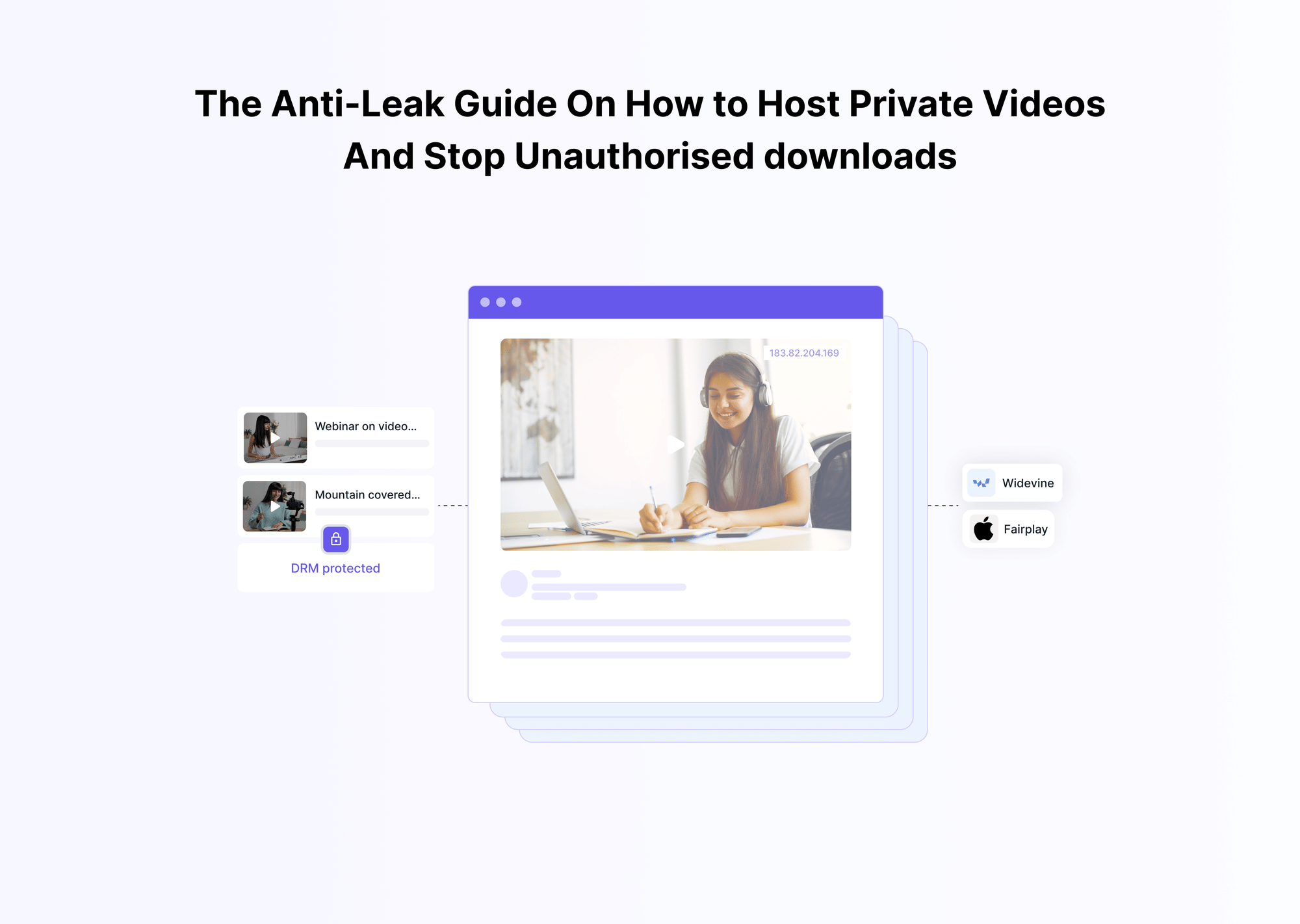
What it is: Digital Rights Management (DRM) encrypts your video streams and releases playback licenses only to authenticated users and verified devices. Gumlet supports Widevine (for Chrome and Android), FairPlay (for Safari and iOS), and PlayReady (for Microsoft Edge and Windows) — ensuring full cross-platform protection.
Why it works: Multi-DRM prevents unauthorized file downloads, blocks screen capture tools in most browsers, and ensures that content can only be played within approved environments. Even if someone extracts a URL, it’s useless without a valid DRM license.
Use case: A coding bootcamp offering ₹10,000 premium modules secures its library with Widevine and FairPlay through Gumlet. Even if students attempt to use downloaders or browser extensions, playback is blocked outside verified sessions — minimizing online course piracy at scale.
Signed URLs and Token Authentication with Short TTLs
What it is: Signed URLs generate time-limited, user-specific access tokens that expire after a short period (e.g., 30–60 seconds).
Why it works: This mechanism ensures that leaked URLs on forums or Telegram groups become useless within minutes. Tokens can also encode the user’s ID or course ID, linking every session back to its source.
Use case: A language-learning platform that faced 500+ unauthorized link shares switched to Gumlet’s short-TTL signed URLs, drastically reducing traffic from unknown referrers. Now, each lesson link expires after one minute, making it impossible for pirates to reuse or distribute playback URLs.
Domain and IP Restrictions for Controlled Access
What it is: Domain and IP restriction allows playback only from approved websites, subdomains, or corporate IP ranges. Any attempt to embed your video on another platform or unauthorized portal will fail automatically.
Why it works: This method closes one of the most common piracy pathways — third-party embeds or link scraping. Even if pirates copy your embed code, the video won’t load outside your specified domain or LMS.
Use case: A corporate e-learning client restricts access to academy.companyname.com and VPN-based IPs used by employees. When someone attempts to play the same content on YouTube or Reddit, the Gumlet player rejects the request instantly. This form of video content piracy security solution ensures total control over playback origins.
Dynamic Watermarking to Trace Leaks Back to Users
What it is: Dynamic watermarking overlays unique, session-based identifiers — such as the viewer’s email hash, user ID, or timestamp — directly onto the video in real-time.
Why it works: It discourages screen recording and provides traceability in case of leaks. If a student uploads a recorded video to Telegram or file-sharing sites, you can identify the specific account responsible.
Use case: An edtech company discovered that several recorded lessons were circulating on Reddit. After enabling Gumlet’s dynamic watermarking, each playback carried user-identifiable watermarks. When another leak occurred, the watermark helped trace the exact user who recorded and shared it — enabling swift DMCA action.
Player Controls to Disable Downloads and Embeds
What it is: Player-level controls disable right-click, “Save as,” and external embeds while hiding real video file URLs.
Why it works: These restrictions stop basic screen-grab extensions and browser-based downloaders, forcing pirates to rely on more complex methods — which your analytics can detect.
Use case: A design course integrated Gumlet’s player controls within its LMS. Students can only stream content within the LMS interface, and attempts to view source code or extract files trigger immediate playback rejection.
Additional Layers for Stronger Protection
To strengthen your defenses even further, Gumlet supports additional advanced layers that close subtle but critical gaps:
- Encrypted HLS/DASH streaming: Ensures files are fragmented, encrypted, and unplayable without authorization — making it impossible to grab full MP4s.
- Per-title encoding and adaptive bitrate streaming: Reduces redistribution quality while ensuring smooth student playback — protecting against re-uploading of high-resolution copies.
- Geo-blocking and VPN detection: Prevents circumvention of regional licensing agreements or unauthorized access from suspicious geographies.
- User-level session management: Restricts playback to one device per account, blocking credential sharing among multiple users.
- Integration with LMS or SSO: Ensures only verified students can request DRM licenses or signed URLs, syncing securely with your course enrollment data.
- Automated key rotation: Periodically changes encryption keys to limit the window of exposure if a token or key ever leaks.
Think of these layers as a multi-tiered firewall around your course video pipeline — DRM for secure playback, signed URLs for access control, watermarking for traceability, and analytics for real-time enforcement.
Book a Gumlet Demo to see multi-layer protection in action.
Monitoring and enforcement
You deter piracy most effectively when you detect anomalies quickly and act immediately with takedowns, key rotation, and token revocations.
Real-time analytics signals for piracy risk
Watch for sudden view spikes, unusual geographies, and high concurrency per account. Gumlet’s analytics and dashboards help you correlate events with referrers, IPs, and sessions, so you can quickly flag likely abuse. Pair these signals with short-TTL tokens to limit the blast radius.
Takedown requests and evidence workflow
Automate DMCA notices with clear evidence: source URL, timestamped screenshots, and a watermark that identifies the sender. Use platform policies that track repeat infringers. Many rights holders rely on automated services to expedite removal at scale.
Rotating keys and revoking access when breached
If a leak is suspected, rotate DRM keys, invalidate tokens, and force re-auth for the affected cohort. With DRM enabled and signed URLs in place, the post-incident window is small and traceable.
Get a Free Streaming Architecture Review.
Migration from a basic host to a secure platform
A low-downtime migration follows three phases: inventory, swap, and day-two operations with SLAs.
Inventory and re-encode plan
Audit every lesson, variant, caption, and poster. Decide which assets require DRM re-processing and per-title re-encoding to balance size and quality.
Player replacement and redirects
Introduce the new Gumlet player behind a feature flag, keep old URLs live with 301s, and progressively switch your LMS to signed URLs + domain allowlists. Test all device-DRM paths first.
Post-migration monitoring and SLAs
Monitor error rates, license denials, and QoE. Set alerting for concurrency anomalies and automate takedown pipelines. Confirm response SLAs with your vendor success team.
Download the Migration Checklist.
Common mistakes to avoid
Even with the best intentions, many course creators unknowingly adopt weak or incomplete measures to deter piracy. These mistakes often provide a false sense of security while leaving their content vulnerable to online course piracy. Understanding what fails in real-world conditions is the first step toward designing a truly robust video content piracy security solution.
Over-Reliance on Weak Deterrents
One of the most common missteps is relying solely on basic visual deterrents such as right-click disablement, player overlays, or “no-download” scripts. While these might stop casual users, they do little against even mildly technical pirates who can extract files via browser network tools or cache sniffers.
To actually combat video piracy, you need multi-layer protection: DRM encryption for playback, signed URLs to control access, domain/IP restrictions to prevent unauthorized embeds, and dynamic watermarking for traceability. Gumlet’s video piracy protection features combine all of these seamlessly, turning passive deterrence into an active defense strategy that keeps your online course videos secure.
Long-Lived Tokens and Static Links
Another significant error is using long-lived tokens or static URLs for playback delivery. Once shared, these links spread quickly across Reddit or Telegram, allowing thousands of unauthorized users to stream your course for free.
Short-lived tokens (for example, expiring in under a minute) combined with token authentication ensure that each request to your online video hosting platform is fresh and verifiable. This approach drastically reduces exposure time and prevents link reuse. Gumlet’s implementation of short TTL signed URLs ensures that even if a link leaks, it becomes useless almost instantly—effectively protecting your online course from piracy.
Watermarks Without Identity Markers
A watermark without a user identity is just decoration. Generic logos or faint overlays may deter casual copying but offer no forensic trail when your videos end up on piracy forums. The goal is not just to prevent theft but to trace leaks back to the responsible account.
Dynamic watermarking, where each video instance carries a unique combination of user ID, email hash, and timestamp, makes it possible to identify the source of any leak. Gumlet’s dynamic watermarking technology is designed precisely for this — personalizing every playback session and offering irrefutable evidence in DMCA takedowns. This kind of video piracy protection acts as both a visible warning and a legal safeguard.
Talk to a Video Expert to review your current setup.
Conclusion
The truth is that no system can stop video piracy entirely, but the right architecture can make it so difficult, time-consuming, and traceable that it simply isn’t worth the effort. The difference between losing control of your course and running a sustainable e-learning business lies in layered protection — combining DRM, signed URLs, watermarking, domain/IP restrictions, and real-time analytics into one seamless defense.
Piracy leads to lost revenue, broken student trust, and brand dilution. By partnering with a secure online video hosting platform like Gumlet, you can implement a system that detects, deters, and responds to online course piracy before it damages your business.
Every video you host carries your expertise, reputation, and revenue potential. Protect it like you would any other valuable digital asset.
Ready to see how? Talk to a Gumlet Video Expert today and learn how to effectively protect your online course from piracy.
FAQs
Can you entirely stop piracy?
No. You can minimize and deter piracy with layered controls like DRM, signed URLs, domain/IP restrictions, and dynamic watermarks, plus monitoring and takedowns. Global piracy activity remains high, so deterrence and rapid response are key.
How does DRM work for courses?
DRM encrypts streams and issues time-bound licenses to compliant players on supported devices, blocking access to raw files and most downloaders. Widevine covers Chrome/Android, FairPlay covers Safari/iOS, and PlayReady covers Microsoft ecosystems.
What about screen recording?
No tool stops all screen recorders. Combine visible identity watermarks, short TTL tokens, and analytics to deter and trace recordings and to support takedowns.
Is watermarking enough?
No. Watermarking is a deterrent and attribution layer and should sit alongside DRM, tokenization, and domain/IP controls.
How to balance security and UX?
Use per-title encoding and adaptive bitrate for smooth playback, keep tokens short but seamless through the LMS/SSO, and enforce DRM only where needed in the journey.