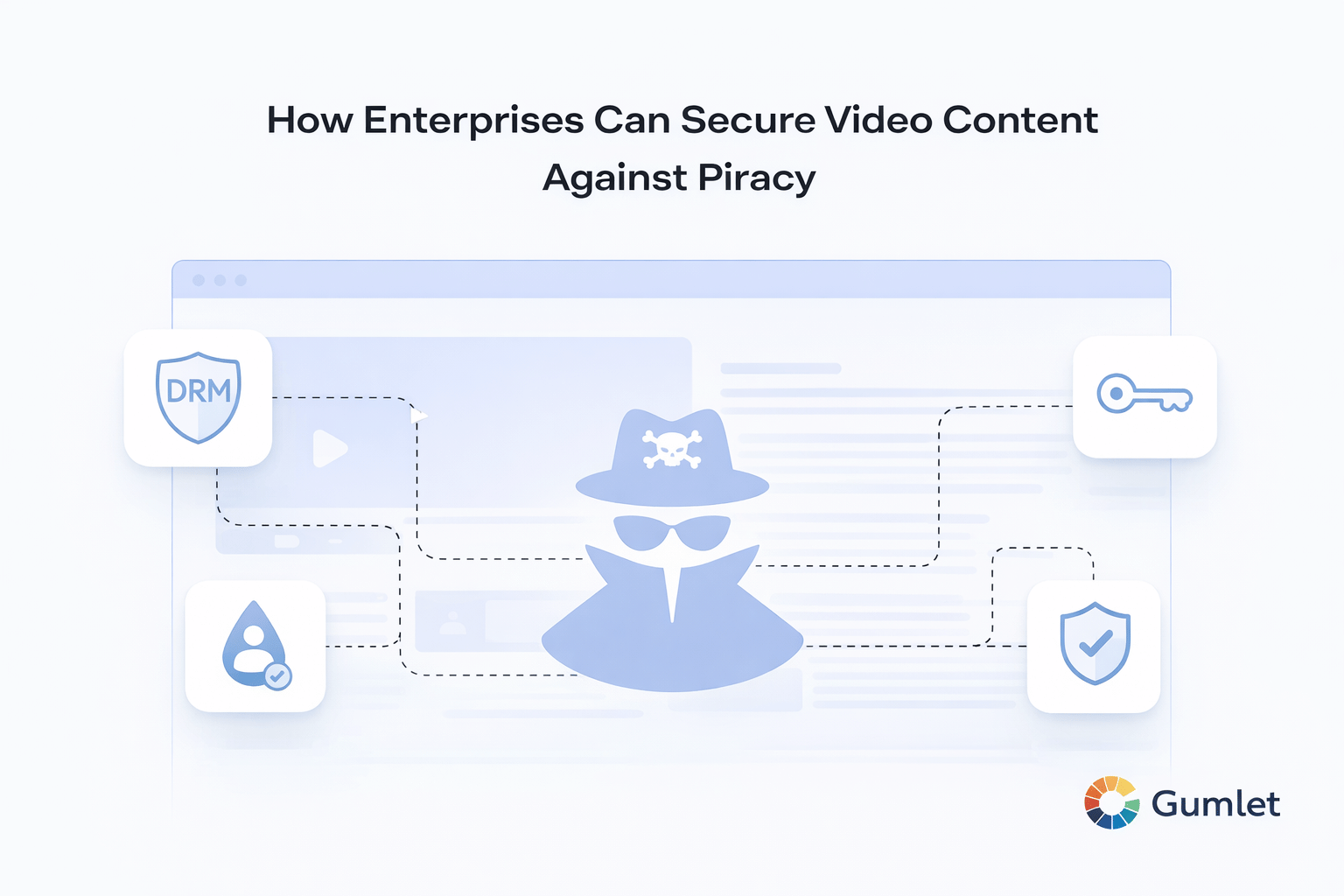
Every minute, billions of videos stream across the internet. But for enterprises, one leaked video can undo years of work, drain revenue, and damage trust overnight. It doesn’t take a hacker or a dark web marketplace anymore. A single employee sharing a link, a plugin capturing a session, or a user screen-recording premium content is enough to start a piracy chain that spreads faster than any marketing campaign ever could.
Video piracy today isn’t loud or obvious. It hides behind share buttons, browser extensions, and cracked credentials. And the moment an enterprise loses control of its video assets, the loss isn’t just financial, it’s strategic. Competitors get access to internal training materials. Customers discover paid content circulating for free. Partners question your data governance.
Yet most companies still treat video security like an afterthought. They upload mission-critical assets to platforms built for public sharing, not private protection, trusting unlisted links and password gates to hold back modern pirates. The truth is, those controls were never meant for enterprises managing intellectual property, compliance, or customer data.
This guide unpacks how large organizations can take back control. It explores the fundamental nature of enterprise video piracy, where existing platforms fail, and what a truly secure video infrastructure looks like in 2025. By the end, you’ll see why protecting your videos isn’t just an IT concern; it’s a core business strategy.
Understanding Video Piracy in the Enterprise Context
Video piracy isn’t confined to entertainment or media anymore. It’s quietly eating into enterprises across industries. EdTech platforms see paid lessons shared on Telegram groups, SaaS companies find private demos leaked on YouTube, and financial institutions face compliance risks when internal communication videos resurface externally.
At its core, enterprise video piracy means unauthorized access, duplication, or distribution of video assets. But what makes it especially dangerous for businesses is how easily it happens. Unlike classic piracy through downloads or torrents, modern theft occurs through legitimate access points. A few common examples:
- Unauthorized sharing: Employees or users share private URLs publicly.
- Credential leaks: Compromised logins expose entire video libraries.
- Screen recording and browser plugins: Simple tools bypass weak protection and capture premium content.
- Embedding and scraping: Videos hosted on public players are embedded on third-party sites without attribution or control.
- API and CDN misuse: Attackers intercept unprotected streams or CDN endpoints to reconstruct full-quality copies.
These forms of piracy blur the line between internal error and external threat. Enterprises can’t simply rely on passwords or NDAs to contain the damage. Every point of distribution, whether a customer portal, an internal LMS, or a client demo link, needs layered security that assumes a breach as a starting point.
To protect against this new wave of piracy, enterprises must move from “access control” to “evidence-based control.” That means building systems capable of tracing who watched what, when, and from where. Without visibility and traceability, even the most advanced encryption is just a lock without an alarm.
Why Traditional Video Platforms Fail to Prevent Piracy
Most enterprises start their video journey on familiar platforms like Vimeo, YouTube, or Wistia. They’re convenient, fast, and easy to embed. But when it comes to protecting high-value content, these platforms operate on a trust model that breaks instantly under real-world conditions.
The problem isn’t that these platforms are inherently insecure; they were simply built for a different purpose: mass distribution, not controlled access. Once a video is uploaded, it’s optimized for reach, not restriction.
Here’s why traditional video hosting fails to meet enterprise security needs:
1. Static URLs and Easy Sharing
Unlisted links or “private” URLs can be copied and shared endlessly. Anyone with the link becomes an instant viewer, and there’s no way to revoke access once it’s out.
2. No Session-Level Control
These platforms don’t issue unique, time-bound tokens for playback. A single valid session can be replayed, downloaded, or mirrored across devices.
3. Weak or Nonexistent DRM
Most traditional players rely on simple encryption or privacy settings. They don’t enforce enterprise-grade DRM (Digital Rights Management) that binds playback to authorized devices or domains.
4. Lack of Geo, IP, or Domain Restrictions
Videos can often be viewed from anywhere in the world, even in regions or domains they weren’t meant to reach. For companies working under compliance or territorial licensing, this is a massive liability.
5. No Watermarking or Forensic Tracking
When a leak happens, you can’t trace its origin. There’s no session-specific watermark or audit trail that identifies who leaked the content.
In short, traditional hosting platforms prioritize visibility and convenience over protection and governance. They assume good intentions, but enterprise security must assume the opposite.
For companies managing intellectual property, training materials, or paid content, these gaps translate directly into lost control and often, lost revenue. What’s needed isn’t another upload platform. It’s an infrastructure that treats security as part of delivery, not an afterthought.
The Anatomy of Enterprise Video Security
Securing enterprise video content isn’t about adding a few restrictions. It’s about building a layered, end-to-end defense system that protects every stage, from upload to playback. Proper security doesn’t just keep intruders out; it ensures every legitimate view is verified, traceable, and compliant.
Let’s break down the five essential layers that define a piracy-proof video ecosystem.
1. Digital Rights Management (DRM)
This is the foundation of video protection. DRM encrypts your content and ensures it can be played only on authorized devices or browsers. It prevents unauthorized downloads and makes decryption practically impossible without valid credentials. For enterprises handling paid courses, internal communications, or IP-sensitive videos, DRM is the first non-negotiable layer.
2. Tokenized Access
Every playback session should have its own access key, a token that expires after a specific time or after a specified view count. This eliminates the risk of link sharing, since each token is user-specific and short-lived. It’s like giving every viewer a disposable key that stops working as soon as they leave the room.
3. Geo, Domain, and IP Restrictions
Not every viewer should be able to watch from anywhere. By restricting playback to approved locations, networks, or domains, enterprises can instantly limit exposure. For example, an EdTech company can allow access only to students in specific regions or logged-in members of its portal.
4. Dynamic Watermarking
This layer serves as both the visible deterrent and the invisible trace. Watermarks, unique to each session, make it easy to identify leaks and discourage screen recording. Even if a video is captured, the watermark embeds the identity of the session or user, providing immediate forensic evidence.
5. Audit Logs and Access Trails
Security without visibility is blind. Detailed logs show who accessed a video, when, from where, and under what conditions. They allow teams to detect suspicious activity, enforce compliance, and take swift action during breaches.
Each of these layers tackles a different form of piracy. Combined, they turn video delivery into a closed, monitored ecosystem where access is earned, not assumed.
This layered approach marks the shift from “security by obscurity” to “security by design.” It’s what separates a modern enterprise video infrastructure from a streaming tool built for the masses.
Enterprise-Grade Defense: How Gumlet Secures Every Frame
For enterprises serious about video protection, security can’t be a patchwork of plugins or third-party tools. It needs to be built into the foundation of the platform itself. That’s where Gumlet stands apart: treating security not as an optional feature but as a native layer of its video infrastructure.
Gumlet’s architecture is designed for one purpose: to deliver, protect, and monitor video at scale without compromising user experience. Every feature in its stack contributes to that mission.
1. DRM-First Delivery
Gumlet employs enterprise-grade Digital Rights Management that encrypts every video stream and binds playback authorization to the user’s device and credentials. Whether it’s Widevine, FairPlay, or PlayReady, DRM ensures that even if someone intercepts the stream, it remains unreadable without authorization.
2. Tokenized and Session-Based URLs
Unique, time-limited tokens protect each playback session. These URLs automatically expire or lock after a session, making them impossible to share or reuse. This ensures videos can only be accessed by the intended viewer within a defined window, an essential control for training, gated content, or premium courses.
3. Domain, IP, and Geo-Fencing
With Gumlet, enterprises can set precise controls on where and how videos can be viewed. Access can be limited to specific domains, company networks, or even geographic regions. It’s especially critical for compliance-bound industries like Finserv or healthcare, where data governance extends to every pixel of a video frame.
4. Dynamic Watermarking and Leak Forensics
Gumlet generates unique, session-level watermarks that embed identifiers such as user IDs, timestamps, or email addresses directly into the stream. If a leak occurs, enterprises can trace it back to the exact user responsible. Beyond deterrence, this creates a culture of accountability among viewers.
5. Real-Time Monitoring and Audit Logs
Every playback, pause, or replay is logged. Gumlet’s monitoring dashboard provides visibility into unauthorized access attempts, failed token verifications, and playback anomalies. For teams handling regulated data, this kind of traceability isn’t just valuable, it’s mandatory.
6. Multi-CDN Encryption and Secure APIs
Gumlet’s multi-CDN setup (Fastly + CloudFront) ensures both speed and resilience, while maintaining end-to-end HTTPS enforcement. Secure APIs allow developers to automate upload, replacement, and metadata operations without exposing private endpoints.
What makes Gumlet particularly powerful for large organizations is its seamless integration with marketing and engineering workflows. From HubSpot-triggered personalized videos to secure content delivery across Salesforce or internal portals, Gumlet ensures security never gets in the way of scale or performance.
In a world where one unauthorized screen recording can undo an entire campaign, Gumlet ensures every frame, every second, stays under enterprise control.
How to Build a Piracy-Proof Video Workflow
Building a secure video strategy doesn’t start with encryption; it starts with process. Many enterprises invest in technology but skip the operational discipline required to make it effective. A proper anti-piracy framework protects not only the files but the entire video lifecycle, from ingestion to insight.
Here’s a practical, step-by-step structure that every enterprise can implement, using Gumlet as an example of how this workflow can run smoothly without adding friction.
1. Map the Video Lifecycle
Document how videos are created, uploaded, approved, distributed, and embedded. Knowing every touchpoint helps identify where leaks are most likely to occur, be it during review, sharing, or public embedding.
2. Secure Upload and Encoding
Before a video is published, enforce secure upload protocols and automated DRM wrapping. Platforms like Gumlet allow DRM and tokenized encryption to activate automatically during the upload stage, preventing unprotected assets from going live.
3. Tokenized Access and Role-Based Controls
Each playback session should issue its own short-lived token, tied to the user identity and device. Assign permissions based on roles, viewers, editors, and admins to prevent privilege abuse. Gumlet’s APIs fully automate this process, integrating with SSO or CRM data for frictionless control.
4. Layer Geo, Domain, and IP Restrictions
Apply environment-based access rules that reflect business logic. For example, internal HR videos may stream only within corporate IP addresses, while training modules may be limited to verified customer domains.
5. Enable Session-Level Watermarking
Activate dynamic watermarking for all premium or gated videos. Even if a screen recording slips through, the watermark instantly identifies the session, making it easier to investigate or take legal action.
6. Monitor and Audit Continuously
Security doesn’t end at delivery. Teams should review access logs weekly to detect anomalies such as unusual IP ranges, concurrent sessions, or repeated token failures. Gumlet’s unified dashboard simplifies this oversight, consolidating playback analytics with real-time security alerts.
7. Automate Alerts and Key Rotations
Set up automated alerts for suspicious activity and regularly rotate API keys, playback tokens, and CDN credentials. These small practices close potential backdoors that automated scraping bots often exploit.
8. Align With Compliance Frameworks
Integrate video protection into broader governance practices, SOC2, GDPR, or industry-specific compliance standards. Gumlet’s audit-ready logs and encryption standards make this alignment straightforward for enterprise IT and security teams.
A piracy-proof video workflow isn’t achieved solely by technology. It’s the result of disciplined processes powered by infrastructure built to enforce them. When every video uploaded, shared, or viewed passes through multiple layers of verification, piracy shifts from an inevitability to an improbability.
Real-World Scenarios: When Piracy Protection Saves Millions
Enterprises rarely realize the value of video security until it’s too late. The financial and reputational damage from leaked videos can extend far beyond the immediate loss of content; it affects partnerships, customer confidence, and even compliance standing. Here are some real-world scenarios that illustrate how proactive protection prevents expensive crises.
1. The EdTech Platform That Stopped Leaks Before They Went Viral
An online education company noticed that its premium lessons were appearing on file-sharing sites within hours of release. The issue wasn’t external hacking; it was students recording screens or sharing unprotected links.
By switching to a DRM-enabled, tokenized delivery system, the company made each playback session unique and traceable. Dynamic watermarking embedded in every video effectively discouraged screen recording. Within a month, piracy dropped by over 90%, saving the platform thousands of dollars in lost subscriptions and restoring its credibility with educators.
2. A SaaS Company Protecting Internal Product Demos
A fast-growing SaaS provider discovered that a competitor had access to internal demo videos shared through unlisted Vimeo links. The videos revealed upcoming features and pricing strategies.
After adopting session-based access control and geo/domain restrictions, the company ensured that future demos could be viewed only on corporate devices with authorized credentials. Playback tokens expired automatically after each meeting, closing a loophole that could have cost them months of competitive advantage.
3. OTT Publisher Preserving Licensing Agreements
A regional OTT platform faced license violations when premium films appeared on mirror sites abroad. The problem stemmed from global access permissions and unsecured CDN links.
Implementing geo-restrictions, DRM, and watermark-based forensics helped them trace unauthorized copies back to specific user accounts. They provided legal proof to content owners, retained their licenses, and strengthened distributor trust.
4. Enterprise Training Portal Protecting Confidential Communication
A financial services firm used video for compliance training and internal communication. When snippets of one training video surfaced online, regulators questioned their internal security posture.
By introducing audit logs and real-time playback monitoring, they established full accountability. Every future video playback was recorded, who viewed it, where, and when, allowing instant detection of policy violations.
These examples underline a hard truth: video piracy isn’t always an external attack; it’s often a failure of control. With the right systems, DRM, tokenization, watermarking, and audit trails, enterprises can stop leaks before they turn into crises and maintain total command over their video assets.
Security Compliance and Governance
For enterprises, securing video content isn’t just about stopping leaks; it’s about proving accountability. Every video that contains proprietary knowledge, customer data, or internal communication falls under compliance expectations just like any other digital asset. Regulators and partners increasingly expect traceable, auditable systems that demonstrate how access is managed and breaches are prevented.
That’s why video security must align with broader governance frameworks such as SOC 2, GDPR, HIPAA, or internal IT governance policies. Each framework emphasizes transparency, data control, and user privacy, principles that directly overlap with enterprise-grade video protection.
Here’s how a compliant video security posture should operate:
1. Encryption at Rest and in Transit
All video files and metadata should be encrypted throughout their lifecycle, from upload and CDN storage to playback streams. Platforms like Gumlet enforce HTTPS delivery and use multi-CDN encryption to ensure content never travels unprotected.
2. Audit-Ready Access Logs
Every view, download attempt, or token request must be recorded. These logs form the digital paper trail required for investigations, certifications, or regulatory audits. When integrated with CRM or IAM systems, logs can automatically link playback data to verified users.
3. Role-Based Governance
Compliance also means ensuring that internal access is restricted to those who genuinely need it. Role-based access control prevents marketing, IT, or external contractors from viewing videos outside their authorization level.
4. User Privacy and Consent Management
When videos are personalized or tracked for analytics, enterprises must maintain clear consent protocols. GDPR and SOC 2 both mandate explicit transparency in how viewer data is processed and stored.
5. Data Residency and Regional Rules
For global organizations, it’s essential that video data comply with local data-residency laws. Features like geo-restrictions and domain-level control help ensure videos only load from compliant regions.
In this context, Gumlet’s enterprise posture naturally aligns with compliance-driven organizations. Its built-in audit trails, watermarking for forensic accountability, HTTPS-enforced delivery, and access logs support audit readiness without manual overhead.
By embedding security and governance together, enterprises can move from reactive defense to proactive assurance, proving to regulators, partners, and customers that every piece of content they produce is both protected and compliant.
Emerging Threats and the Future of Video Protection
As video becomes the dominant medium for communication and commerce, the threats targeting it are evolving faster than most enterprises realize. Traditional piracy was about stealing content; modern piracy is about replicating, disguising, and monetizing it.
Three major shifts will define the next decade of video security:
1. AI-Powered Piracy
Artificial intelligence is making piracy more sophisticated. Tools can now automatically remove visible watermarks, scrape streaming data frame by frame, or re-encode videos to bypass basic DRM checks. Deepfake models can even clone a brand spokesperson or instructor, producing convincing counterfeit videos that damage reputation and mislead customers.
Enterprises will need AI-detection systems capable of verifying content authenticity, matching original video hashes, and spotting manipulated streams. The combination of AI-based monitoring and forensic watermarking will become non-negotiable.
2. Credential Leaks and API Exploits
Attackers are moving upstream, from stealing videos to hijacking access systems. Compromised API keys or leaked tokens can open entire libraries to unauthorized scraping. Future-proof security demands continuous key rotation, behavioral analytics to detect suspicious API use, and zero-trust validation for every request.
3. The Rise of AI Search and LLMs
As large language models (LLMs) begin surfacing video snippets in responses, enterprises must ensure that AI systems cite authentic, authorized sources. This adds a new layer of responsibility: ensuring videos are verifiable, contextually indexed, and traceable back to original, licensed content. LLM-driven visibility will favor companies that maintain structured metadata, DRM protection, and authenticated hosting platforms like Gumlet.
The Next Era: Evidence-Based Authenticity
In the future, enterprises won’t just protect videos; they’ll prove their authenticity. Platforms will embed cryptographic fingerprints and immutable audit trails that verify ownership every time a video is played, shared, or summarized by an AI tool.
Gumlet’s security-first foundation, with tokenized access, DRM, and forensic watermarking, positions it ahead of this curve. It’s already operating at the intersection of infrastructure and intelligence, ensuring that as piracy grows smarter, enterprises stay one step smarter still.
Conclusion: Security Is the New Brand Currency
Every enterprise today depends on video, whether it’s for customer education, investor communication, or internal training. Yet, few realize that every unprotected video carries a hidden risk: it can be copied, altered, or leaked in seconds. What begins as a minor oversight can turn into a significant crisis when proprietary content or compliance data ends up in the wrong place.
The lesson is simple: control is credibility. When you can prove exactly who has access, where, and when, you don’t just prevent piracy, you demonstrate governance, reliability, and accountability. Those are the traits that set modern enterprises apart.
Securing video content isn’t an operational detail anymore; it’s a brand decision. Customers, partners, and regulators all judge businesses by how seriously they protect information and intellectual property. A company that invests in enterprise-grade video security signals it takes trust as seriously as performance.
With a layered defense model that includes DRM, tokenization, geo/IP restrictions, watermarking, and audit logs, piracy moves from inevitable to impossible. Platforms like Gumlet have shown that protection doesn’t have to compromise scale or experience; it can enhance both.
In the end, video protection is about more than encryption; it’s about protecting the narrative, the brand, and the integrity behind every frame.
The enterprises that secure their content today will own the trust economy of tomorrow.
FAQs
1. How does DRM differ from standard video encryption?
Encryption simply scrambles a video so it can’t be read without the correct key. DRM (Digital Rights Management) adds another layer; it enforces rules about who can watch, how long, and on which device. It combines encryption, authentication, and authorization to prevent unauthorized playback or downloads.
2. Can watermarking really prevent piracy?
Watermarking doesn’t stop someone from recording a screen, but it makes them think twice. Dynamic, session-level watermarking embeds unique viewer information, such as a user ID or timestamp, directly into each stream. If a leak occurs, the source can be traced immediately, creating a powerful deterrent.
3. What’s the best way to share videos securely with partners or internal teams?
Use tokenized URLs with expiry windows, domain or IP restrictions, and role-based permissions. Avoid sending static links. Platforms like Gumlet automate this by generating one-time playback sessions for each viewer while maintaining detailed audit trails.
4. How do tokenized URLs stop piracy?
Each tokenized link is valid for a specific viewer and time period. Once used, it expires automatically. Even if someone tries to forward or reuse the link, playback won’t work because the token is bound to the original viewer’s device and credentials.
5. Is enterprise video security expensive to implement?
Not anymore. Modern video infrastructure platforms integrate DRM, watermarking, and access control into their core architecture. Instead of building custom protection layers, enterprises can deploy security-first hosting solutions like Gumlet that combine performance, compliance, and anti-piracy in one stack.
tl;dr
- Piracy is no longer about torrents; it’s about leaks, screen recordings, and shared access.
- Traditional platforms prioritize convenience, not control.
- Proper protection requires five layers: DRM, tokenization, geo/IP/domain restriction, watermarking, and audit logs.
- Compliance-ready video infrastructure safeguards both brand trust and legal standing.
- Gumlet brings all of these layers together, secure, scalable, and built for enterprises that can’t afford to lose control.