If your product onboarding, training flows, or paid courses sit on Vimeo, the last year has not been reassuring.
In September 2025, Vimeo announced that it had entered into a definitive agreement to be acquired by Bending Spoons in an all-cash transaction valued at about 1.38 billion dollars, at 7.85 dollars per share. The deal has since closed; Vimeo has been taken private, and its board has resigned as the company becomes a wholly owned subsidiary of Bending Spoons.
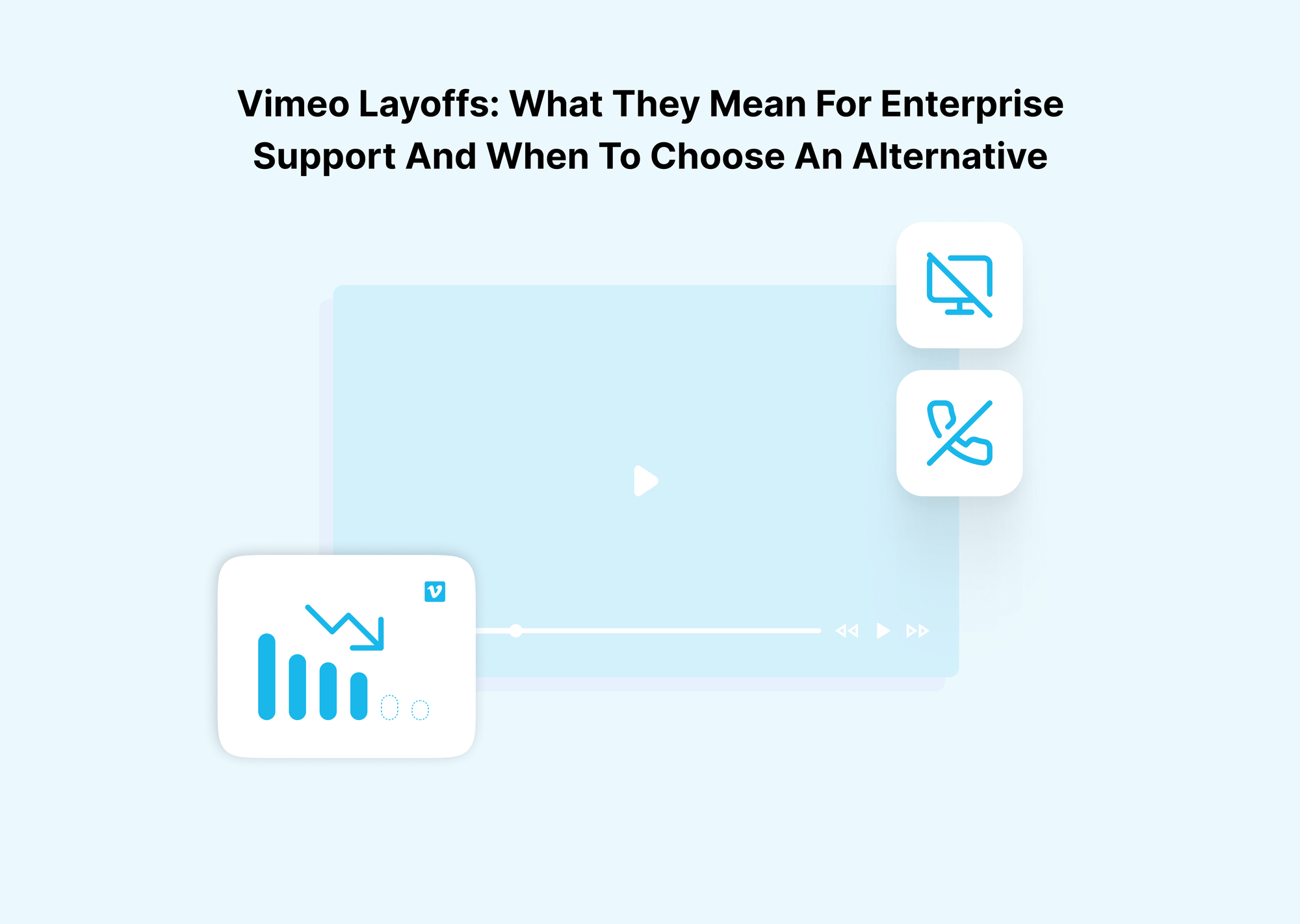
Vimeo disclosed a global workforce reduction of just under 10 percent of its full-time staff, framed as a way to improve focus and efficiency. This was not a one-off correction. Analysis by AI Invest notes that this cut is part of roughly 26 percent cumulative staff reduction since 2022, as Vimeo has tried to move from growth story to profitability story in a tougher streaming market.
For shareholders, the 1.38 billion exit and 91 percent premium on recent trading might look like a win. For Bending Spoons, it fits a familiar pattern of buying mature digital products, taking them private, and driving operational efficiency, as seen with Evernote and WeTransfer. For customers, especially SaaS, EdTech, OTT, and enterprise teams that treat video as infrastructure rather than a nice-to-have, the question is different: What does this combination of aggressive cost-cutting and new ownership mean for the quality and reliability of Vimeo’s customer support?
Support is where downsizing begins. When a vendor trims staff, restructures teams, and layers on new efficiency mandates, front-line technical support and customer success are usually the easiest knobs to turn:
- Tickets take longer to answer.
- Fewer people hold context about your account.
- Escalations stall.
The platform can still look stable from the outside, while the internal ability to diagnose incidents, unblock complex integrations, or save a failing live event is quietly eroding.
This is why “Vimeo layoffs” is not just an HR headline. For any business that relies on Vimeo for product tours, course delivery, investor presentations, or all-hands streams, it is a direct question about who picks up your ticket at 3 a.m. and how much institutional knowledge they still have. A change of control plus repeated staff reductions is a structural signal that support quality is at risk, even before you see the first missed SLA.
If you are already seeing slower responses, more generic answers, or less proactive help from Vimeo, it is sensible to treat that as an infrastructure risk, not an inconvenience. At that point, it is worth benchmarking Vimeo against a platform that treats support as part of the core product.
Why Support Teams Get Cut First in SaaS and Video Infrastructure
When a SaaS or video infrastructure company needs to improve margins, support is usually the first target.
On the P&L, product and engineering are sold internally as “innovation.” Support, success, and operations are treated as the cost of servicing existing customers. Cutting headcount in a function that does not ship new features is easier to defend in a board deck than slowing roadmap delivery.
The math is simple. Leadership looks at tickets per agent, assumes a higher “efficient” load, and decides they can remove a chunk of support roles while pushing more volume into help docs, chatbots, or low-cost outsourcing. On paper, that makes support for platforms like Vimeo look highly compressible compared with engineering or sales.
Evidence says otherwise. A large study based on American Customer Satisfaction Index data found that companies that downsize tend to see customer satisfaction fall, and that this drop then harms financial performance. In other words, savings from cutting front-line staff are partly cancelled out by worse service, lower renewal rates, and weaker expansion.
For a video hosting or streaming provider, the damage is sharper because senior support engineers hold critical institutional knowledge. They recognize recurring ingestion bugs, region-specific CDN issues, or subtle browser quirks long before those patterns appear in official documentation. Remove those people, and you remove a big part of the platform’s diagnostic capability overnight.
What remains is a thinner layer of generalists handling a similar or larger ticket load. Queues stretch, responses get more generic, and incidents are more likely to be partially fixed and then reappear.
Once support has been labeled a cost to be “optimized,” it becomes much harder for internal teams to argue for more headcount or better tools later. For customers who run onboarding, EdTech, or OTT experiences on top of that platform, this is not an internal efficiency story. It is a direct increase in operational risk.
Vimeo’s Support Infrastructure Was Already Under Pressure Before the Latest Layoffs
Vimeo did not start from a position of exceptional, high-touch support before the Bending Spoons acquisition. For years, various enterprise reviews and community threads have highlighted the same pattern: slow responses on technical tickets, generic first-line answers that do not fully engage with the problem, and limited access to senior engineers when things go wrong in production. For teams using Vimeo as core infrastructure, that already meant more internal work to diagnose issues and more risk during launches.
You can see this in how often customers describe having to re-explain context. A ticket about playback failures on one region or one device often gets treated as a generic buffering problem, redirected to standard documentation, and only escalated after multiple back-and-forth replies.
That is a strong indicator that support staff do not have enough time, tools, or training to connect symptoms with known platform-level issues. When a video vendor is embedded in your SaaS onboarding, EdTech classroom, or OTT catalog, this kind of shallow triage increases the odds that your team, not the vendor, ends up doing the real debugging.
There has also been a persistent gap between how Vimeo sells its enterprise offering and how it supports complex implementations. Features like live streaming, paywalled content, or branded OTT experiences are marketed as ready-to-go. In reality, customers frequently report discovering edge cases only once they try to combine Vimeo with SSO, custom paywalls, CRMs, or marketing automation. At that point, support often becomes a routing layer between you and various internal teams rather than a partner who understands the full workflow.
These strains were visible well before the 2025 layoffs. Customers were already raising concerns about:
- Limited guidance for large library migrations.
- Incomplete advice on handling regional compliance.
- Minimal proactive communication around incidents or downtime.
When a provider shows these signs at full staffing, the risk is straightforward: any further reduction in headcount or reorganization will magnify the weaknesses already present.
So the recent layoffs do not create a new problem as much as they intensify an existing one. If your own tickets with Vimeo have started to feel slower, less informed, or more transactional over the past 12 to 18 months, you are likely seeing the compounded effect of long-term underinvestment in support, plus fresh pressure from cost-cutting.
How Mass Layoffs at Vimeo Show up in Your Day-to-day Support Experience
Once a video vendor cuts a meaningful share of its staff, problems do not start with a dramatic outage. They start with small, operational changes that compound over months. If you rely on Vimeo for product onboarding, live events, or paid content, these are the patterns that usually show up first:
1. From 2-Hour Replies to 2 Day Replies
The most visible change is response time. With fewer agents handling a similar or higher ticket volume, queues stretch. Questions that used to get a first reply within a couple of hours now take a full day or more, especially outside US business hours.
Customer benchmarks make clear how far this can drift from normal expectations. Surveys of service leaders consistently show that most customers expect an email response from support within the same business day, and many expect acknowledgement within one to four hours for urgent issues. When a vendor that powers your video pipeline starts to miss that window repeatedly, you effectively lose a full working day every time something breaks.
On the inside, this looks like agents running a permanent backlog. There is less time to read your ticket history, test hypotheses, or reproduce issues. That is why replies start to sound more generic and more reliant on links to existing documentation. The support team is not suddenly less smart; they are working with less time per ticket and fewer internal backups.
2. Why Your Next Live Event is More Exposed to Silent Failure
Live events are where support cuts are felt most sharply. Before layoffs, a mature platform will have a clear path for preparing and safeguarding launches: test events, dry runs with someone from support or customer success, and real-time escalation if metrics look wrong during the stream.
After cuts, two things typically happen:
- Fewer specialists are available to help you design and test your setup in advance.
- The people who remain are covering more concurrent events and tickets, so they can only engage at a surface level.
That raises the odds of subtle but serious issues getting through: an encoder configuration that is technically supported but fragile under load, a region that is not correctly prioritized, or access rules that lock out a subset of your audience. When something goes wrong mid-event, your team may find themselves waiting in a general queue instead of speaking with someone who understands your account and streaming setup.
For SaaS onboarding webinars, investor updates, or EdTech cohorts, that is not just an inconvenience. It directly affects trust and perceived product quality.
3. What This Means if You Run SaaS Onboarding, EdTech, or OTT on Vimeo
Degraded support has different consequences depending on how your business uses Vimeo:
1. SaaS product onboarding and education
If product tours, feature deep dives, and help center videos live on Vimeo, slower support means longer periods during which broken embeds, playback glitches, or CDN issues go unresolved. New users hit friction in their first sessions, and your PM or engineering teams spend cycles debugging a vendor rather than improving the product.
2. EdTech and cohort-based courses
When course libraries, recorded sessions, and assessments depend on Vimeo, even a small increase in unresolved streaming or access issues can show up directly in completion rates and refund requests. If you also need to satisfy institutional or regional compliance, you may find that support is not responsive enough to help you reason through edge cases or regulator requests on time.
3. OTT, membership, and paid communities
For subscription products, video is often the primary value your customers pay for. If buffering, failed playback on certain devices, or geo access problems linger because support is underpowered, churn and chargebacks follow quickly. When live launches or new-season drops are part of your model, the risk from a thin support layer increases again.
All of this is structural. When a company like Vimeo goes through repeated layoffs and a major acquisition, it is reasonable to assume that support capacity and institutional knowledge have taken a hit unless you see clear, documented investment in the opposite direction.
If you are already seeing these patterns in your own ticket history with Vimeo, it is worth pressure testing them against a different model in a low-risk way. One practical next step is to schedule a short Gumlet demo with a support-focused specialist who can walk through your current use-cases, show how Gumlet would handle similar incidents, and give you a realistic view of what migration and day-to-day support would look like.
Risk Signals Vimeo Customers Should Watch For in 2025
If you decide to keep Vimeo in your stack, you should treat support quality as something to monitor, not assume. The warning signs rarely arrive as a single catastrophic outage. They show up as small, persistent changes in how your tickets are handled and how much real help you get when things break.
Here are the concrete signals to watch over the next few quarters.
Support Channels Quietly Removed or Downgraded
If live chat or phone options disappear, or you are pushed from named contacts to generic queues without explanation, that usually means the team is running with less capacity. A shift from multi-channel support to a single email or ticket form is often the first visible symptom of internal cuts.
Tickets Take More Touches to Reach a Real Answer
When issues that used to be resolved in one or two replies now require five or six back-and-forth exchanges, you are seeing the cost of lost context and thinner staffing. Generic responses that repeat documentation you have already tried are a clear sign that agents do not have the time or knowledge to engage deeply with the problem.
Critical Incidents Feel Opaque While They Are Happening
During outages or serious degradations, you should expect clear, time-stamped updates and an honest timeline. If communication becomes vague, infrequent, or overly optimistic, that usually means incident response is under strain and there is no dedicated owner keeping customers informed.
Account Manager Churn and Loss of Institutional Knowledge
If you find yourself re-explaining your architecture and history to new Vimeo contacts every few months, it indicates both turnover and poor internal handover. Over time, this erodes the vendor’s ability to advise you properly on changes, migrations, or launches because no one on their side has a full picture of your setup.
Complex Workflows Are Pushed Back to Generic Docs
When you raise questions about DRM, SSO, custom paywalls, OTT apps, or regional compliance and are repeatedly directed to standard documentation rather than receiving tailored guidance, it is a sign that specialist support has been reduced. The less help you get with these higher-risk workflows, the more risk is silently shifting to your team.
Post incident Follow-up Becomes Superficial or Disappears
Mature vendors acknowledge what went wrong and what they will change. If incident reviews shrink to vague reassurances or stop altogether, you lose insight into how seriously your provider treats reliability and support quality after layoffs.
If you see two or more of these patterns in a single quarter, treat it as a structural issue, not bad luck on a few tickets. At that point, it is worth measuring Vimeo’s support performance explicitly and presenting it as a quantified risk to your leadership team, rather than relying on anecdotes.
When it is Time to Move Critical Workloads Off Vimeo
Treating Vimeo as a vendor in “heightened risk” mode only works up to a point. At some stage, degrading support, repeated incidents, or new requirements will make continued dependence on the platform a bigger risk than a managed migration.
You should seriously consider moving critical workloads off Vimeo when several of these conditions are true.
1. Support Performance Has Degraded For At Least 3 to 6 Months
It is normal for a vendor to have a bad week. It is not normal for key support metrics to trend downward for half a year.
If your own tracking shows:
- Median first-response time on P1 and P2 tickets is steadily increasing
- Median time to resolution is rising, even for familiar issues
- More tickets are being reopened within 7 to 14 days
You are looking at structural under-capacity, not temporary noise. That is what you would expect after repeated layoffs in support and related functions.
This is not just an internal nuisance. Studies consistently show that customers do not tolerate poor service for long. PwC research found that 32 percent of customers would stop doing business with a brand they love after just one bad experience, and 59 percent leave after multiple bad experiences. If Vimeo is making you that brand in your users' eyes, you are paying for their internal cost-cutting, which is causing churn and lost expansion.
2. High-Stakes Events or Launches Have Already Been Compromised
One failed event can be bad luck. Two or three in short succession is a pattern.
Signals that Vimeo is now a liability for live or high-impact use cases:
- Important webinars, investor calls, or launches suffer material playback or access issues that support cannot prevent or resolve in real-time
- Incident communication from Vimeo is slow, vague, or inconsistent during those moments
- Your team has had to invent workarounds mid-event because they could not get timely, expert help
At that point, you are not just dealing with mildly slower tickets. You are accepting direct risk to your reputation and revenue every time you plan a live moment around Vimeo.
3. New Requirements Expose Gaps That Vimeo Cannot Realistically Close
Even if day-to-day performance is tolerable, strategic changes can tip the balance:
- You are entering markets with stricter privacy or data residency rules and need more precise control over storage, playback, and logging
- You are rolling out paid or membership content that requires stronger DRM, token-based access, or deep integration with your billing and CRM
- You are scaling to tens of thousands of assets and need better analytics, content organization, or automation than Vimeo can offer
If Vimeo support cannot answer detailed questions about these scenarios, or repeatedly pushes you back to generic documentation, it is a sign that the platform and its team are not set up for where your product is going.
4. Internal Cost of Compensating For Vimeo Keeps Rising
Many teams quietly absorb the impact of a weak vendor:
- Engineers build custom monitoring and retry logic around a platform that should have been more reliable.
- Product and marketing teams avoid certain formats or features because they no longer trust Vimeo to behave during peak load.
- Support and success teams repeatedly buffer customers from Vimeo problems without the power to fix underlying issues.
If you are seeing more of this internal “shadow work”, you should quantify it. The hours your team spends compensating for Vimeo are not free. At some point, the headcount cost of propping up an under-supported platform will exceed the cost of migrating to a more robust platform.
5. Leadership Understands That Support Model is Part of the Product
When you do decide to move, treat support as a primary evaluation criterion, not an afterthought.
For a replacement to Vimeo, you should be asking:
- What does support coverage look like for my tier, in my time zones?
- Who owns my account, and what are the explicit escalation paths?
- How often will I be speaking to people who understand video infrastructure, not just generic SaaS usage?
- How has the vendor handled previous surges in demand or organizational change without letting support quality collapse?
This is where a focused provider like Gumlet is designed to be different. Gumlet is built as video infrastructure for SaaS, EdTech, OTT, and content-led teams that need:
- Predictable performance
- Strong security
- Deep analytics
With human support treated as part of the core product rather than a variable cost to be trimmed.
A smaller, specialized team has an advantage here: The people you speak to are the same ones who have seen similar migrations, edge cases, and failure modes across many customers.
When two or more of the conditions above are true, the question usually shifts from “should we leave Vimeo” to “how do we exit cleanly without breaking the business.”
How Gumlet Handles Support Differently From Vimeo-style Models
At this point, it helps to stop thinking in abstract terms like “better support” and look at how a different support model actually works in practice. Gumlet is built as a video infrastructure for SaaS, EdTech, OTT, and content-led teams, so its support is designed around those use cases rather than around a long tail of small creators.
Human Support Across Plans, Not Just at the Very Top
With Vimeo, many customers only get truly human, responsive support once they reach the most expensive tiers. Below that, support is ticket-based and often generic. Gumlet takes a different approach:
- Every paid customer has access to human support, not just a deflected knowledge base.
- Priority queues are available for higher tiers, but the baseline expectation is still that a real person reads and understands your ticket.
- Coverage is oriented around business-critical workflows such as onboarding flows, course access, and live launches, not one-off creator uploads.
For teams running revenue-intensive video, that means you do not need to “graduate” into an elite tier before someone treats your incident as serious.
Dedicated Ownership and Clear Escalation During Incidents
Enterprise customers care less about friendly greetings and more about ownership. Gumlet structures this explicitly:
- Named account managers for larger accounts who understand your architecture and main use-cases.
- Documented escalation paths into engineering and infrastructure for P1 and P2 issues, especially around launches or live events.
- Regular check-ins that examine performance and incident patterns rather than just renewals.
The practical difference is that when something breaks during a launch, you are not re-explaining your setup to a new person in a generic queue. You are talking to someone who already knows which regions matter, how your auth is wired, and what “failure” actually means in your context.
Expertise in Complex, High Risk Workflows
Where Vimeo often pushes complex questions toward generic documentation, Gumlet’s support team is optimized for higher risk scenarios:
Security and paid content
Support is comfortable working with DRM, tokenized URLs, geo and domain restrictions, and watermarking for leak forensics. That is essential if you are protecting paid courses, test prep, or OTT catalogs.
Performance at scale
Under the hood, Gumlet runs GPU-based transcoding and multi CDN delivery, with real-time monitoring of metrics such as time to first frame and rebuffering ratio. Support can help you interpret those metrics instead of treating them as black boxes.
Analytics and integrations
Because Gumlet is wired into tools like GA4, Segment, Mixpanel, and major CRMs, support can help you reason about issues that span infrastructure and attribution, for example, when a video problem impacts funnel metrics or lead capture.
This matters if you are evaluating a Vimeo alternative with better support. You are not just comparing response times, you are comparing the depth of help you get across security, performance, and analytics.
Proven migration and ongoing operational help
Gumlet has already helped teams migrate large Vimeo libraries, including cases where thousands of assets needed to move with minimal downtime. The process is treated as a joint project, not a self-serve import:
- Bulk ingest, metadata mapping, and playlist or collection recreation are handled with dedicated support and APIs.
- Embeds are swapped methodically to avoid broken pages or regressions in SEO and analytics.
- Teams stay in close contact with Gumlet during and after launch, with monitoring and KPI reviews to catch any issues early.
The point is not that Gumlet will never have incidents. The point is that its model is built so you are not left explaining a failed launch to your CEO while your video vendor has gone quiet or is cycling you through ticket macros.
What Vimeo Layoffs Really Impact Customer Support
Taken together, the Bending Spoons acquisition, repeated Vimeo layoffs, and years of mixed feedback on Vimeo support are not a curiosity for the tech press. They are a structural signal that the first function to absorb pressure is the one that holds your incidents, launches, and outages together.
Research using the American Customer Satisfaction Index has shown that cost-cutting through downsizing often lowers customer satisfaction and that this dip in satisfaction then hurts financial performance, not the other way round. In plain terms, vendors save on payroll at the risk of losing customers and revenue.
In digital products, that effect is amplified through support. If you run SaaS onboarding, EdTech, OTT, or membership experiences on Vimeo, a weaker support organization shows up as slower first responses, longer resolution times, more generic answers, and fewer people who actually understand your stack. At the same time, customer expectations are moving in the opposite direction. One review of email response benchmarks found that while the average support reply time is roughly 12 hours, close to 90 percent of customers expect a response within one hour. That is the gap you are forced to cover when a core vendor lets its helpdesk fall behind.
The commercial risk is clear. When Vimeo is the hidden cause of those bad experiences, your users do not blame Vimeo; they blame you.
So your job is not to predict exactly how Bending Spoons will run Vimeo. Your job is to:
- Measure the reality of Vimeo support in your own data.
- Decide what level of risk you are willing to accept.
- Put a concrete plan in place if you need to move critical workloads to a video platform that treats support as part of the product, not a cost-line item.
What To Do Next
If Vimeo is embedded in your product, this is not a theoretical issue. Run the support metrics on your own data, classify your Vimeo usage by business criticality, and decide what level of vendor risk you are willing to accept. If the current trajectory feels uncomfortable, do not wait for a major incident to force the question.
A practical next move is to speak with a video infrastructure specialist like Gumlet, review your current reliance on Vimeo, and walk through what a safer, support-first alternative would look like in your stack. The real value comes from mapping that to your specific SaaS, EdTech, or OTT use cases and designing a migration path that reduces risk rather than adding to it. The goal is not a rushed rip-and-replace.
The goal is to have a migration path ready before the next bad incident puts you on the back foot.
FAQ:
1. What do Vimeo’s layoffs and the Bending Spoons acquisition really mean for existing business customers?
They mean you should expect support to be under cost pressure. Vimeo has cut a significant share of its workforce since 2022, when it was acquired and taken private by a buyer known for aggressive efficiency programs. That combination reliably leads to slower responses, thinner coverage, and loss of institutional knowledge unless the company explicitly invests in the opposite. You may not see an immediate outage, but you are likely to feel the impact in ticket queues, incident handling, and the quality of guidance you receive.
2. How can I tell if Vimeo’s support quality is actually getting worse for my team?
Do not rely on vibes. Export six to twelve months of Vimeo-related tickets and compute simple metrics: median first response time, median time to full resolution, touches per ticket, and reopen rates, especially on P1 and P2 issues. Compare those numbers with the previous period. If they are trending in the wrong direction and you are seeing more generic answers, more contradictions, or weaker incident communication, then support quality is degrading in a way that is measurable, not anecdotal.
3. When is it genuinely risky to stay on Vimeo rather than move to a different video platform?
It becomes risky to stay when three things line up. First, support metrics have been worsening for at least 3 to 6 months. Second, one or more high-stakes events or launches have been compromised in ways Vimeo could not prevent or resolve in real time. Third, you have upcoming requirements around security, compliance, or scale that Vimeo cannot address convincingly. At that point, you are accepting elevated operational and commercial risk to avoid a migration project.
4. What questions should I ask any video vendor about support after layoffs or an acquisition?
Ask about coverage per tier, including time zones; average and SLA backed response times for P1 incidents; escalation paths into engineering; staff turnover in support and success; and how they handled previous surges in demand or reorganizations without letting support quality collapse. Request concrete examples of incidents and launches they have supported for customers similar to you, not generic claims about fast replies.
5. Why do teams move from Vimeo to Gumlet rather than to another mainstream Vimeo alternative?
Teams that treat video as infrastructure care about three things: control, reliability, and expert help when something breaks. Gumlet is built for that profile. It offers infrastructure-grade delivery, strong security for paid or internal content, deep analytics, and APIs that integrate cleanly into SaaS, EdTech, and OTT stacks. More importantly, in this context, its support model is built around fewer, larger, video-heavy customers, not millions of casual creators, so the people you talk to have seen the kinds of incidents, migrations, and edge cases you are dealing with.
6. Can we use Gumlet alongside Vimeo before committing to a full migration?
Yes. Many teams start with a hybrid model, moving new projects and non-critical content to Gumlet while leaving legacy Vimeo embeds in place. That lets you test Gumlet’s support, performance, and analytics in production without taking immediate risk on existing funnels. Over time, you can phase in a structured migration of higher-value content once you are confident the new setup is stable.
7. What is the realistic timeline for moving off Vimeo without breaking key funnels?
For most teams, the critical path is not raw transfer speed; it is planning and validation. With a clear inventory and a designed target setup, Gumlet can ingest and map even large libraries quite quickly, then support a phased embed swap guided by traffic and risk. That usually looks like days for core content movement, followed by weeks of phased cutover and optimization, rather than a multi-quarter freeze.
TL;DR
- Vimeo has combined repeated workforce reductions with a $ 1.38 billion acquisition by Bending Spoons, which is known for aggressive post-acquisition restructuring. Support is structurally the easiest place to cut in that scenario.
- Research on downsizing shows that staff cuts tend to reduce customer satisfaction and that this reduction then harms financial results, even when the cuts are justified as efficiency gains.
- Vimeo’s support baseline was already under pressure before the latest layoffs, with long response times, shallow triage, and limited help on complex workflows such as DRM, SSO, paywalls, and large library migrations.
- After mass layoffs, you see the impact first in operations: slower initial responses, longer resolution times, more generic answers, weaker incident communication, and a loss of institutional knowledge about your implementation.
- You should track Vimeo support risk using hard metrics such as first-response times for P1/P2 tickets, full-resolution times, touches per ticket, reopen rates, incident rates during launches, and escalation delays.
- If you stay on Vimeo, treat it as a vendor in heightened-risk mode: tighten SLAs, build internal incident runbooks, reduce single points of failure, strengthen monitoring, and maintain an evaluated shortlist of alternatives.
- It is time to move critical workloads off Vimeo when support metrics have been degrading for 3 to 6 months, high-stakes events have failed, new requirements expose platform gaps, or your internal cost of compensating for Vimeo keeps rising.
- Gumlet’s smaller, focused team is a feature, not a limitation. Support is human and available across plans; escalation paths into engineering are explicit; and the team is tuned for SaaS, EdTech, and OTT use cases rather than long-tail creators.
- Migrations from Vimeo to Gumlet are treated as joint projects, with bulk ingest, careful embed replacement, and parallel run options so you can move thousands of videos in days, not months, without breaking key funnels.
- The safest position is to understand your current Vimeo risk in numbers and have a ready path to a platform whose support model matches the importance of video in your product.