
Your Imgix invoice arrives, and the number is not what you expected.
Traffic grew by a reasonable 20 percent. The design team shipped two new image variants for the latest product launch.
Yet the bill jumped 45 percent. You open the billing dashboard, stare at three separate credit consumption categories, and realize that predicting this thing was never as simple as the pricing page made it look.
This scenario is not rare. It is one of the most common reasons teams end up comparing Imgix with alternatives like Gumlet mid-contract, not because Imgix is a bad platform, but because its credit-based billing model introduces cost variables that don't behave the way standard SaaS pricing does.
This breakdown is for three audiences: SaaS and product teams noticing that image infrastructure costs are scaling faster than traffic, e-commerce, and media businesses approaching an Imgix renewal and wanting to pressure-test the contract, and finance or engineering leads who need a concrete cost model rather than a pricing page comparison.
It covers four things specifically:
- First, how Imgix's credit model actually works today, including the three billing buckets, the overage multiplier, and the credit expiry mechanics that most public reviews still get wrong.
- Second, what the same workloads cost on both platforms across three real scenarios: a SaaS product with 10,000 active users, an e-commerce store with 50,000 product images, and a media site with one million monthly impressions.
- Third, the structural reasons Gumlet's bandwidth-based model produces different invoices for the same traffic.
- Fourth, the specific cases where Imgix's premium is genuinely justified, because a fair analysis requires that section, and skipping it would make everything else less credible.
Dollar figures are modeled against published billing rates for both platforms. Estimates should be verified against current pricing pages before use in a contract negotiation or procurement decision.
Both platforms are treated fairly here. The goal is not a verdict. It is a framework you can take into your next renewal or evaluation.
Key Takeaways
- Imgix bills across three separate credit buckets: management (cache storage at 2 credits/GB/month), delivery (bandwidth at 1 credit/GB), and image transformations (variable by operation). One image served to one user can trigger all three simultaneously.
- Overage credits cost 20 percent more than standard credits and are billed automatically without throttling. On the Growth plan ($300/month), a 50 percent traffic spike generates approximately $178 in overage charges on top of the base plan, a 59 percent effective premium.
- The same e-commerce workload (1.5TB monthly bandwidth, 100GB working catalog, 150,000 image assets in 4 variants) costs approximately $500+ per month on Imgix's Growth Plus plan versus approximately $120 per month on Gumlet's bandwidth-based model, a difference of roughly $4,940 annually once double-storage charges are included.
- Migration payback for that workload is four to seven months, based on a conservative three-to-five-day engineering timeline at standard day rates.
- Imgix is the stronger choice for teams with stable, low-iteration workloads, dedicated technical ownership of their media pipeline, or a specific need for Imgix's AI transformation and video features within a single unified platform.
- Gumlet's cost advantage scales with two factors: catalog size and workload volatility. Small, predictable workloads on an Imgix Starter or Basic bundle will not necessarily save money by switching.
How Imgix Pricing Actually Works in 2025
Most of the pricing content you will find on review sites still describes Imgix's old image-based plans, where you paid based on the number of origin images stored.
That model is now obsolete for new contracts and renewals. Imgix has migrated all customers to a unified credit-based system, and the gap between legacy descriptions and the current reality is a consistent source of confusion for buyers.
Under the current model, every operation on the platform draws from a shared monthly credit pool. That pool is replenished on a schedule tied to your plan, and anything you consume beyond it triggers overage billing.
What the Three Credit Buckets Actually Cost You
Imgix divides credit consumption into three categories. Understanding each one is the only way to build a reliable cost estimate.
1. Management
Management covers cache storage and metadata. The rate is 2 credits per GB per month. If you have a 50GB working set of images sitting in Imgix's cache, that alone costs 100 credits every billing cycle before a single byte is delivered to a user.
2. Delivery
Delivery covers bandwidth and cache reads. The rate is 1 credit per GB. This is where the largest credit draws tend to occur for high-traffic products, since every image request to every user in every region runs through this bucket.
3. Image Transformation
Image Transformation covers all visual edits and enhancements, including resizing, format conversion, cropping, and AI-powered operations. Rates vary by feature, with AI-driven transformations consuming more credits per operation than standard resizing. Per Imgix's credit consumption documentation, operations like background removal or smart cropping carry higher per-operation costs than a straightforward WebP conversion.
What makes the math genuinely tricky is that one image can hit all three buckets simultaneously. A high-resolution product photo stored in Imgix's cache consumes management credits. When 5,000 users load it on mobile and desktop, delivery credits drop. When each request is served in two responsive sizes and WebP format, transformation credits drop too. Three separate billing events, one image, one page load.
Credit Bundles, Overage Rates, and the 120 Percent Rule
Imgix offers five self-serve plan tiers. The table below reflects the published billing documentation:
| Plan | Monthly Cost | Credits Included | Standard Credit Price | Overage Credit Price |
|---|---|---|---|---|
| Starter | $25 | 100 | $0.25 | $0.30 |
| Basic | $75 | 375 | $0.20 | $0.24 |
| Midrange | $150 | 830 | $0.18 | $0.22 |
| Growth | $300 | 1,875 | $0.16 | $0.19 |
| Growth Plus | $500 | 3,570 | $0.14 | $0.17 |
The critical number in the right column: Imgix bills overage credits at 120 percent of the plan's standard credit rate. Imgix does not throttle or stop serving traffic when you cross your limit. It continues delivering, and the invoice reflects every excess credit consumed at the premium rate. That is the mechanism behind a large portion of unexpected billing spikes.
Where the Hidden Costs Actually Appear
The three buckets explain the structure. What follows explains where money leaks in ways the pricing page does not surface clearly. This section is not a critique of Imgix's design choices. It is an accounting of the line items that materially affect total cost of ownership for teams at scale.
According to HTTP Archive's State of the Web report, images account for approximately 45% of the average webpage's total byte weight on mobile. When nearly half of your page weight is a billing variable, the architecture of that billing model matters enormously.
The Double Storage Problem
Most Imgix customers already pay a cloud provider, typically Amazon S3 or Google Cloud Storage, to store and serve their origin files. Imgix then charges management credits for its own cache copy of those same assets. The result is two separate bills for the same content: one from your cloud provider for origin storage and egress, and one from Imgix for cache storage.
For a 50GB working catalog, that double-billing looks like this. Assume roughly $1.15/month in S3 Standard storage, plus egress each time Imgix fetches originals. Then add 100 management credits per month at $0.16/credit on the Growth plan, totaling $16/month, every month, for content that is already stored and paid for elsewhere. At a catalog scale of several hundred gigabytes, this line item becomes a consistent, largely invisible tax on your infrastructure spend.
Credits Expire, and Unused Ones Simply Disappear
Imgix is explicit in its billing documentation about credit expiry. Trial credits last 30 days from account creation. Self-serve subscription credits reset at the end of each monthly billing cycle. Contract credits reset at the end of each 12-month term. There is no rollover. There are no refunds for unused capacity.
This creates a budgeting trap with two opposing failure modes. Underestimate your usage, and you pay overage premiums. Overestimate to be safe, and the surplus credits expire as sunk cost.
Every month, you are managing both risks simultaneously, with no mechanism to recover from either error. This is not a theoretical concern. Procurement data published by Vendr documents accounts experiencing significant cost increases after Imgix's migration to the unified credit model, with at least one negotiation log noting that overages drove a renewal cost spike requiring active descoping to resolve.
A Capterra reviewer noted that the pricing change, described by Imgix as a simplification, resulted in a bill "5x more" than their previous plan for their specific workload. The credit model is not broken for every team. But the pattern of unexpected invoice increases is documented independently of any vendor comparison.
Transformation Costs Are Driven by Design Decisions, Not Traffic Alone
Storage and bandwidth are at least anchored to measurable, trackable metrics. Transformation volume is different. It is driven by decisions made by design and product teams: adding a new responsive breakpoint, enabling AVIF delivery for Core Web Vitals improvements, running an A/B test with a new image crop, or adopting any AI-powered feature. Per Imgix's own documentation, AI operations cost more credits per call than standard transformations.
The challenge is that none of these decisions are made with the billing dashboard open. A designer ships a new component with three image variants. A product team enables smart cropping for a personalization experiment. Both are good product decisions. Both are also invisible credit draws that finance only discovers on the next invoice.
Real Cost Estimates Across Three Scenarios
The estimates below are modeled against Imgix's published billing rates and documented assumptions. They are estimates, not guarantees. Readers should verify against current Imgix and Gumlet pricing pages before making decisions.
Scenario 1: SaaS Product with 10,000 Active Users
Assumptions: 5 images per active session per day, 3 responsive variants per image, 10GB working cache set, approximately 200GB of monthly delivery bandwidth.
Management: 10GB x 2 credits = 20 credits ($3.20/month on Growth). Delivery: 200GB x 1 credit = 200 credits ($32/month on Growth). Transformation: With 5 images x 3 variants x 10,000 daily users x 30 days, transformation calls run into the millions monthly. Even at a modest per-call credit rate, transformation alone is likely to push this workload into the Midrange ($150) to Growth ($300) tier. A conservatively sized Mid-range bundle risks overage on high-engagement months.
On Gumlet's bandwidth-based model, 200GB of monthly delivery with no per-transformation credit draw and no cache storage charge separates cleanly from this structure. Gumlet's image plans start at $32/month versus Imgix's $75/month entry point (Basic Plan) relevant for this use case, with plans that scale linearly against bandwidth rather than against a shared credit pool.
At Gumlet's published delivery rate of $0.08 per GB, 200GB of monthly bandwidth costs approximately $16 in pure delivery, well within the base plan. The same workload on Imgix's Midrange plan ($150/month) represents roughly a $118 monthly premium before a single transformation credit is counted. On the Growth plan ($300/month), the gap widens to $268/month, or more than $3,200 per year on a workload this size.
Scenario 2: E-Commerce Store with 50,000 Product Images
Assumptions: 50,000 SKUs with 3 images each, 4 delivery variants per image (thumbnail, PDP standard, PDP zoom, mobile), 300,000 monthly unique visitors, approximately 1.5TB monthly bandwidth, 100GB working cache set.
Management alone at 100GB x 2 credits = 200 credits ($32/month on Growth). Delivery at 1,500GB = 1,500 credits ($240/month on Growth). The Growth plan's 1,875 included credits can theoretically cover management and delivery, but that leaves zero headroom for transformation volume across 150,000 image assets served in 4 variants each. Any meaningful transformation activity pushes this workload into Growth Plus ($500) or into recurring overages on Growth.
On Gumlet's bandwidth-based model, the same 1.5TB of monthly delivery at $0.08 per GB is approximately $120 in bandwidth costs, covered within a mid-tier plan. Against Imgix's Growth Plus at $500/month, that is roughly $380/month in savings, approximately $4,560 per year, before accounting for the double-storage difference on the 100GB working catalog, which adds another $32/month to Imgix's bill on the Growth plan. Combined, the total cost divergence for this workload is closer to $4,940 annually.
Tata 1mg, a pharmaceutical e-commerce platform handling 3.13 billion image deliveries per month and 15 million image transformations, switched from Cloudinary to Gumlet and recorded a 56 percent reduction in total operational spend alongside a 39 percent reduction in bandwidth consumption and 88 percent image size reduction compared to originals.
Their VP of Tech described the migration as "both easier and quicker than we could have imagined." The Cloudinary-to-Gumlet context differs from an Imgix migration, but the underlying cost structure comparison, credit-based billing versus bandwidth-based billing at nine-figure delivery volumes, is directly applicable.
Scenario 3: Media Site with 1 Million Monthly Impressions
Assumptions: 10 images per page average, each delivered in 2 formats (WebP plus JPEG fallback), significant traffic volatility from news cycles.
This scenario is designed to isolate overage risk. A plan sized for 1 million monthly impressions at a typical traffic baseline may face 2.5M impression months during major news events. On the Growth plan ($300, 1,875 credits), a 50 percent traffic spike generates approximately 937 additional credits consumed at the $0.19 overage rate.
That is $178 in overage charges on top of the $300 base, bringing the effective monthly bill to $478, a 59 percent premium over the headline plan price. On a bandwidth-based model, 1.5x traffic produces 1.5x cost. No multiplier. No overage rate premium.
To put concrete numbers on it: if the baseline month generates 600GB of image bandwidth, Gumlet's cost is approximately $48. The 1.5x spike month at 900GB is approximately $72, a $24 increase. On the Growth plan, the same traffic spike generated $178 in overage charges on top of the $300 plan base, for a $154 difference in a single high-traffic month, driven entirely by the overage multiplier rather than by any real change in value delivered.
When Imgix is Worth the Premium
An honest analysis requires this section, and it should be read without hedging.
Imgix is a genuinely strong platform for stable workloads with limited design iteration. If a product's image templates are rarely updated and monthly traffic is predictable within a narrow band, a well-chosen credit bundle will behave much like a traditional subscription. The credit model is not inherently broken for these teams; it is just optimized for a different risk profile than high-growth or experiment-heavy products.
Teams with dedicated technical ownership of their media pipeline are also a reasonable Imgix fit. Imgix publishes detailed credit optimization documentation, and a team actively managing cache policies, transformation strategies, and delivery patterns can reduce waste significantly. That kind of operational investment pays off when the platform's feature depth, including its AI transformation suite and video capabilities, is actively used.
Finally, if a team specifically needs AI-powered transformations or video optimization within a single unified platform and those features are strategically core to the product, Imgix's credit model is the access fee for a broad and mature feature set. For those buyers, the pricing complexity is the trade-off for capability breadth.
How Gumlet's Pricing Model Works
Understanding Gumlet's billing structure is not just useful as a comparison point. It is also the clearest way to see why the same workload produces different invoices on the two platforms, regardless of the headline price difference.
Gumlet prices image optimization and delivery around a single primary variable: bandwidth. Instead of a shared credit pool split across management, delivery, and transformation, the billing unit is the volume of optimized data delivered to end users.
Transformations, meaning resizing, format conversion, compression, and responsive variant generation, are not separate billable events. They are part of what the platform does by definition, included in the cost of delivering the image rather than metered on top of it.
This distinction matters more than it first appears. On Imgix, a team that adds a new responsive breakpoint or enables AVIF delivery has just increased their monthly transformation credit draw, even if traffic did not change at all. On Gumlet, the same decision affects only the output file size and therefore the bandwidth delivered, which is already the primary billing variable. The cost behavior is the same whether you serve one image format or five.
The Core Structural Differences
Three specific mechanics explain most of the cost divergence between the two models at scale.
1. No credit expiry
Gumlet does not operate on a prepaid-credit-bundle system. There is no end-of-month reset where unused capacity disappears. You pay for the bandwidth you actually consumed in a given period, not for a block of capacity you had to use or forfeit. For teams with seasonal traffic patterns, this removes one of the most consistent sources of waste in the Imgix model.
2. No double storage billing
Like Imgix, Gumlet pulls images directly from wherever you already store them, whether that is Amazon S3, Google Cloud Storage, or another provider. The difference is what happens next.
Imgix caches those images in its own infrastructure and charges you separately for that cached copy at 2 management credits per GB per month, meaning you are effectively paying for the same content twice: once to your cloud provider for the original, and again to Imgix for its cached version.
Gumlet does not add that second charge. There is no management credit equivalent in its billing model. For a team with a 50GB working image catalog on Imgix's Growth plan, that difference alone is $16 per month, before a single byte is delivered to a user or a single transformation is counted.
3. No overage multiplier
Imgix charges overages at 120 percent of the plan's standard credit rate. Gumlet's bandwidth-based model means usage above a tier scales at the plan's overage rate per GB, not at a multiplier applied to a shared pool. In high-traffic months, the difference in how overages are priced is often a larger factor than the base plan comparison.
The table below captures the structural distinction concisely:
| Billing Dimension | Imgix | Gumlet |
|---|---|---|
| Primary billing unit | Shared credits (management + delivery + transformation) | Bandwidth delivered |
| Transformations | Billed separately per operation from the credit pool | Included in delivery; not a separate line item |
| Storage | Management credits charged at 2 credits/GB/month | No separate cache storage billing |
| Credit/capacity expiry | Monthly reset for self-serve; annual reset for contracts | No expiry |
| Overage pricing | 120% of standard credit rate | Per-GB overage at plan rate |
| Forecasting input | Cache size + bandwidth + transformation volume + AI usage | Traffic volume and bandwidth |
What This Means for Total Cost of Ownership
The bandwidth-based model does not guarantee a lower absolute cost in every scenario. A very small, low-traffic site that stays comfortably within an Imgix Starter bundle will not necessarily save money by switching. The cost advantage of Gumlet's model scales with two factors: catalog size and workload volatility.
For larger catalogs, the absence of management credits is immediately material. For teams that experiment aggressively with image variants, responsive formats, or new AI-powered features, the absence of per-transformation billing removes the most unpredictable cost variable in the Imgix model entirely.
According to Gumlet's own published content, their image CDN delivery rate is $0.08 per GB, which is also lower than AWS CloudFront's standard $0.085 to $0.12 per GB delivery rates depending on region.
Migration Cost Consideration
Switching image delivery infrastructure involves a one-time engineering effort. That effort should be weighed against ongoing monthly savings rather than treated as a reason to avoid the conversation.
For a workload similar to Scenario 2: an e-commerce catalog generating 1.5TB of monthly bandwidth, the modeled annual savings against Imgix's Growth Plus plan are approximately $4,940. At a conservative engineering day rate of $600 and a realistic migration timeline of three to five days, the one-time cost of switching is roughly $1,800 to $3,000.
That puts the payback period at 4 to 7 months, after which the savings compound indefinitely. For teams on a larger plan or with higher overage exposure, the payback period is shorter. For smaller workloads on a Starter or Basic Imgix bundle with no overage history, the math is less compelling, which is consistent with the framing in the "When Imgix Is Worth the Premium" section above.
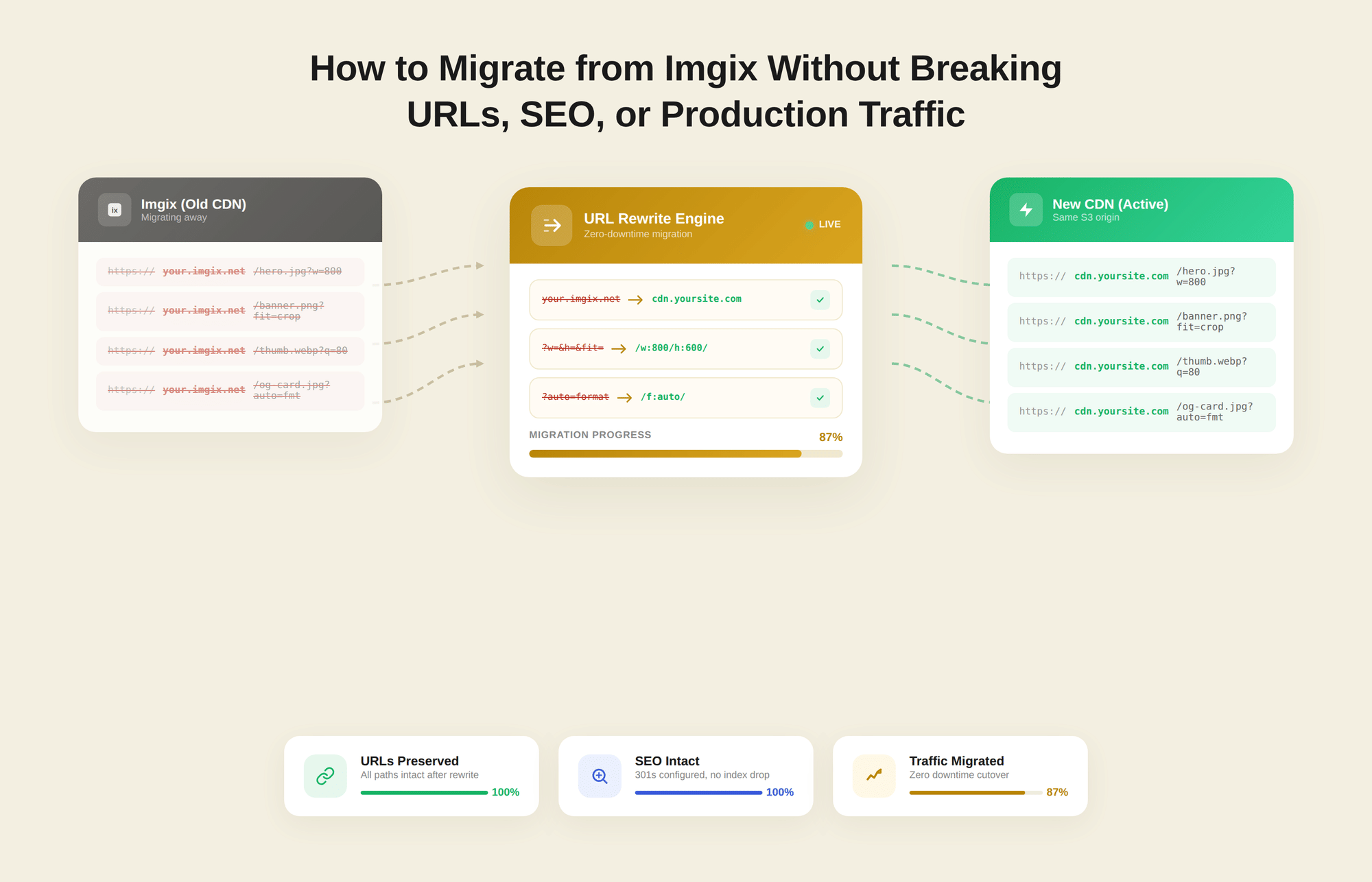
Architecturally, Gumlet and Imgix occupy the same position in the stack: both sit between origin storage and end users, both fetch assets from S3 or equivalent, and both apply on-the-fly transformations before CDN delivery.
The migration tasks are focused on integration rather than re-architecture: repointing DNS or URL configuration, mapping Imgix query parameters to their Gumlet equivalents, and validating edge cases like signed URLs and SEO-sensitive assets. Gumlet publishes a migration guide from Imgix to Gumlet that walks through each step in detail.
For a team on the Growth plan ($300/month), saving $100 to $150 per month recoups a two-day engineering effort within the first quarter. For a team regularly hitting Growth Plus or experiencing frequent overages, the break-even timeline is even shorter.
Ethos Watches migrated 5,000 videos to Gumlet in three hours with zero downtime. While that was a video migration, the infrastructure pattern is identical for image-only workloads, and it illustrates that the "migration risk" concern is often significantly smaller in practice than it appears in planning.
Frequently Asked Questions
1. How does Imgix credit pricing work?
Imgix uses a unified credit system where every platform operation draws from a shared monthly pool. Management charges 2 credits per GB of cached storage per month. Delivery charges 1 credit per GB of bandwidth. Transformations vary by feature type, with AI-powered operations costing more per call than standard resizing or format conversion. Credit bundles range from $25 for 100 credits (Starter) to $500 for 3,570 credits (Growth Plus). Exceeding the bundle triggers overage billing at 120 percent of the plan's standard per-credit rate.
2. Do Imgix credits expire?
Yes. Trial credits expire 30 days from account creation. Self-serve subscription credits reset at the end of each monthly billing cycle. Contract credits reset at the end of each 12-month term. Unused credits do not roll over and are not refunded.
3. Is Gumlet cheaper than Imgix at scale?
For most high-traffic workloads, yes. Gumlet uses bandwidth-based billing with no shared credit pool, no expiry risk, and no overage premium multiplier. For workloads generating 500GB to 2TB of image bandwidth per month, Gumlet's total monthly cost is typically lower once double storage charges and overage exposure are factored into the Imgix comparison. Exact savings depend on current plan pricing, which should be verified at gumlet.com/pricing.
4. Does Imgix charge for storage separately from delivery?
Imgix charges 2 management credits per GB of cache storage per month. If you are already paying Amazon S3 or Google Cloud Storage for origin assets, you are paying for the same content in two places: once at the origin and once inside Imgix's cache.
5. How long does it take to migrate from Imgix to Gumlet?
For most stacks, the migration involves repointing DNS or integration settings and updating image URL parameters to use Gumlet's transformation API. Engineering effort is typically measured in days rather than weeks. The Gumlet feature comparison page provides a detailed side-by-side on capability parity, and Gumlet's official migration documentation covers each technical step.
6. When is Imgix the right choice despite the pricing complexity?
Imgix is well-suited for teams with stable, low-iteration workloads; teams with dedicated technical ownership of credit optimization; and teams that specifically need Imgix's AI transformation features or video processing capabilities within a unified platform. The complexity is a reasonable trade-off when the feature depth is actively leveraged and usage patterns are genuinely predictable.
7. Can you realistically estimate your Imgix bill before signing?
Yes, but it requires modeling all three credit buckets, not just delivery. Start with your expected monthly bandwidth for delivery. Add your working cache set in GB, multiplied by 2, for management. Then estimate transformation calls per image per session and apply Imgix's published per-operation credit rates. Compare the total against available plan tiers and add a 15 to 20 percent buffer for growth and experimentation. Any amount above that buffer should be treated as potential overage exposure.
8. What drives unexpected Imgix billing spikes?
The three most common causes are: underestimating transformation volume from new image variants or AI feature adoption, traffic spikes that push delivery credits above the bundle without warning since Imgix does not throttle, and not accounting for management credits on large or growing asset catalogs.