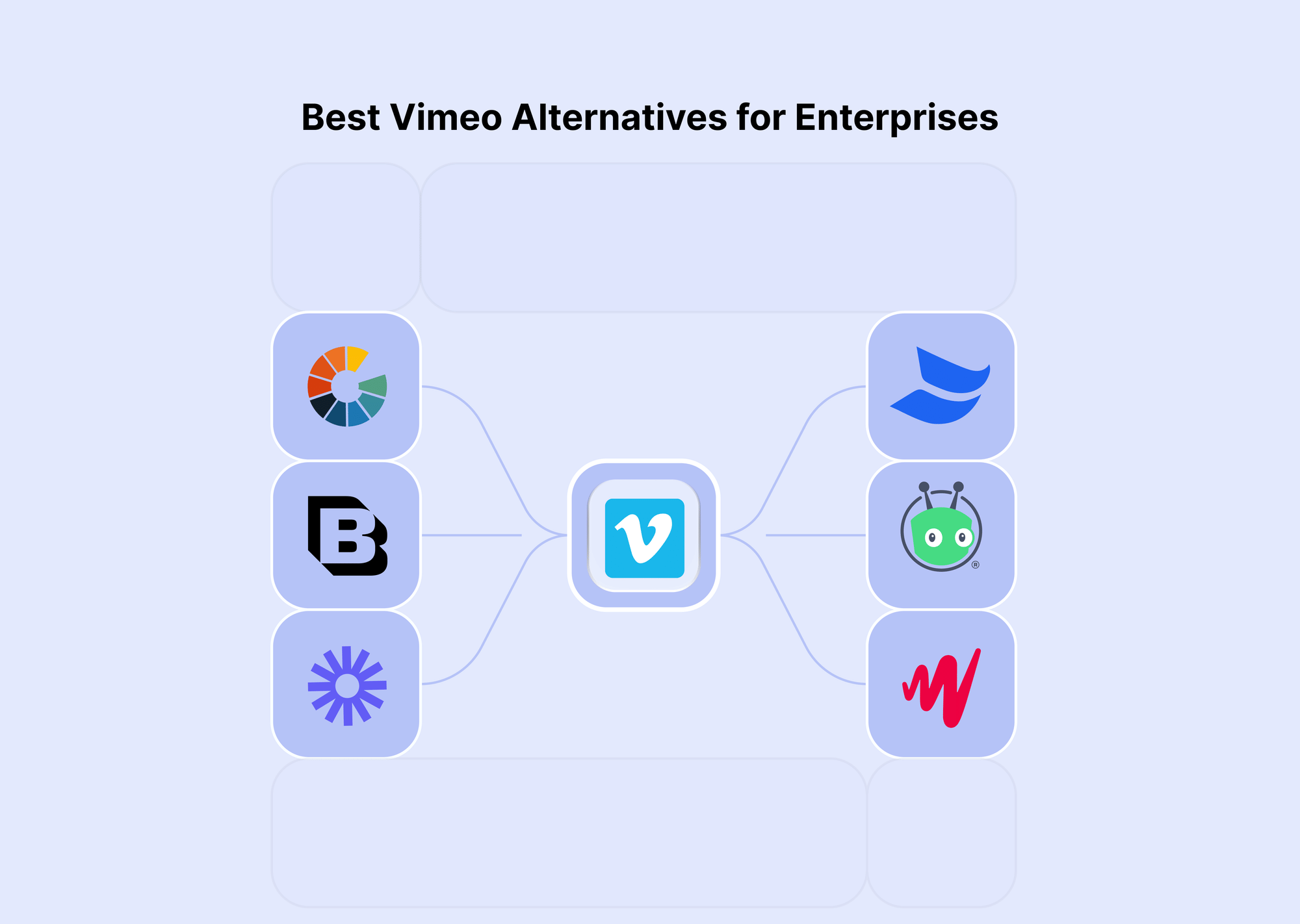
Vimeo has long been a solid home for creators. Still, in 2026, many teams want a Vimeo alternative that delivers tighter control, stronger branding, and better security, ideally without paying enterprise prices. In this guide, we compare the best options to Vimeo that offer a free starting point and a clear path to scale.
We’ll evaluate each Vimeo alternative for video hosting on five essentials: control, security, branding, analytics, and API access. If you’re looking for a Vimeo alternative with a website embedding option, or even a future-ready Vimeo OTT alternative, you’ll find practical picks and trade-offs below.
Vimeo Overview
Vimeo is a professional video hosting and streaming platform widely used by creators, businesses, and enterprises for marketing, training, and creative distribution. Once considered a premium alternative to YouTube, Vimeo built its reputation on elegant design, high-quality playback, and a polished, ad-free viewing experience.
However, by 2026, the platform’s position has shifted. Many users now report growing frustration with restrictive storage limits, rising subscription costs, and feature gaps in its lower-tier plans. While the enterprise version offers more advanced capabilities, most small and mid-sized teams find those features financially out of reach.
Strengths: Vimeo remains known for its sleek, professional player, brand-safe environment, and decent creator tools that appeal to filmmakers and marketers. It continues to offer reliable embedding options and customizable video players.
Weaknesses: Its pricing tiers have become expensive for teams that scale video operations. The platform’s basic plans lack robust DRM, watermarking, and domain restrictions, all of which are critical for secure business use. In addition, support for large-scale, multi-user collaboration is limited compared to emerging, modern platforms.
For organizations prioritizing security, control, and analytics, these limitations often trigger the search for a more flexible and affordable alternative to Vimeo.
Alternative #1: Gumlet Free
Gumlet stands out as a modern Vimeo alternative free plan built for businesses and teams that want secure, high-performance video hosting without the complexity or price of enterprise contracts. It’s especially suited for those seeking a Vimeo alternative with website embedding, making it ideal for marketing sites, learning portals, and LMS-based training programs.
Target audience: Gumlet caters to businesses that prioritize reliable delivery, strong privacy controls, and seamless scaling. Whether you’re embedding videos on your corporate site or managing internal training content, Gumlet’s free plan offers a professional foundation with the flexibility to upgrade to enterprise-grade protection.
Key features:
- A free tier with a defined pool of storage minutes and monthly streaming bandwidth.
- A fully customizable, brand-safe player that supports domain restrictions for secure embedding.
- Real-time analytics that show how audiences engage with each video.
Pros and cons:
- Pros: Built on a security-first roadmap, Gumlet offers advanced features such as DRM (Widevine, FairPlay), dynamic watermarking, signed URLs, and developer APIs for integrations.
- Cons: The free plan has usage caps, and features such as DRM and watermarking are unlocked in paid tiers.
Comparison to Vimeo:
- Strengths: Gumlet offers modern DRM technology, transparent pricing, easy migration tools, and a future-ready upgrade path, making it an excellent Vimeo OTT alternative.
- Weaknesses: Vimeo still has a larger community of creators and public-facing exposure, whereas Gumlet focuses on private, business-grade video delivery.
Pricing: Gumlet’s free plan includes generous limits for testing and production pilots. Upgrading unlocks advanced features like watermarking, DRM, and deeper analytics. This makes it ideal for teams growing from simple embeds to secure, large-scale streaming.
Alternative #2: Vidyard Free
Vidyard is another popular alternative for Vimeo, designed primarily for marketing, sales, and communication teams. It enables professionals to record, host, and share videos easily, integrating directly into sales and CRM workflows.
Target audience: B2B marketers, sales representatives, educators, and consultants who use video for outreach or onboarding.
Key features:
- In-browser video recording and instant sharing.
- Basic customization for the player.
- Core analytics to track video engagement.
Pros and cons:
- Pros: Excellent for quick video messaging and personalized outreach, with smooth integrations with CRM and marketing tools such as HubSpot and Salesforce.
- Cons: Limited branding options and bandwidth on the free plan; not ideal for storing large or secure video libraries.
Comparison to Vimeo:
- Strengths: Offers better workflow integrations for marketing and sales.
- Weaknesses: Lacks enterprise-grade DRM or advanced privacy controls, making it less suitable for internal or secure hosting.
Pricing: The free version limits the number of hosted videos. Paid tiers expand analytics depth, branding options, and integrations, making it a flexible Vimeo alternative free for sales-driven use cases.
Alternative #3: YouTube Free
When reach and visibility are top priorities, YouTube remains the most obvious alternative to Vimeo. It’s the world’s largest video-sharing platform and supports an enormous global audience.
Target audience: Content creators, influencers, and businesses looking to maximize discoverability and brand exposure.
Key features:
- Unlimited uploads with massive reach and built-in audience discovery.
- Monetization options via ads, memberships, and sponsorships.
Pros and cons:
- Pros: Completely free to use, with global accessibility and advanced search visibility.
- Cons: Ad-supported environment, limited control over branding, and no enterprise-grade security (no DRM, watermarking, or restricted playback).
Comparison to Vimeo:
- Strengths: YouTube outperforms in audience size and discoverability, making it ideal for public content.
- Weaknesses: Vimeo provides more brand-safe, ad-free playback, whereas YouTube prioritizes reach over control.
Pricing: Free and ad-supported, suitable for content creators but not for confidential or business-only video hosting.
Alternative #4: Wistia Free
Wistia is a marketing-focused Vimeo alternative known for its branded players and built-in lead generation tools. Its free plan gives small teams a taste of these capabilities before scaling up.
Target audience: Marketers, startups, and small businesses looking to experiment with branded video players or test marketing campaigns.
Key features:
- A customizable, branded video player.
- Lead capture forms and integrations with email and CRM platforms.
Pros and cons:
- Pros: Excellent for generating leads and improving viewer engagement. Strong design control for embedding videos on websites.
- Cons: The free plan supports only a handful of videos, which limits use for larger teams.
Comparison to Vimeo:
- Strengths: Better native marketing tools, analytics, and integrations.
- Weaknesses: Free limitations make it harder to manage libraries or scale beyond basic campaigns.
Pricing: Free with restrictions; paid plans add more videos, branding controls, and data analytics.
Alternative #5: Dailymotion Free
Dailymotion offers another free Vimeo alternative for creators and small teams. It functions similarly to YouTube but with a smaller, less commercialized ecosystem.
Target audience: Teams and creators who want free video hosting without Vimeo’s strict limits or paid tiers.
Key features:
- Free uploads with a customizable player.
- Global hosting and playback availability.
Pros and cons:
- Pros: Free hosting, an established audience base, and fewer upload restrictions than Vimeo.
- Cons: Ad-supported model, weaker analytics, and limited security options for corporate users.
Comparison to Vimeo:
- Strengths: Offers wide availability and zero-cost hosting.
- Weaknesses: Security, analytics, and branding controls lag behind Vimeo and premium business platforms.
Pricing: Fully free and ad-supported, making it a good fit for public-facing content but not ideal for secure corporate video hosting.
Comparison Table
| Platform | Free Tier | Branding Control | Analytics | Security/DRM | API Access | Upgrade Path |
|---|---|---|---|---|---|---|
| Gumlet | Yes | Custom player, domain lock | Real-time, per-video | Encryption on free; DRM and watermarking on paid content. | Yes (API/SDK/webhooks) | Clear path to enterprise (DRM, signed URLs) |
| Vidyard | Yes | Basic on free | Core analytics | No DRM on free | Yes (strong CRM tie-ins) | Paid expands marketing/CRM features |
| YouTube | Yes | Very limited | Channel analytics | No enterprise DRM | Limited (public APIs) | Monetization, not enterprise control |
| Wistia | Yes | Good branding | Marketing analytics | No DRM on free | Yes (marketing-focused) | Paid unlocks library scale & lead tools |
| Dailymotion | Yes | Some player options | Basic stats | No enterprise DRM | Limited | Public-platform growth, not enterprise controls |
Our Expert Opinion
If you want a Vimeo alternative for video hosting that’s secure today and enterprise-ready tomorrow, Gumlet’s free plan is the strongest starting point. It gives you absolute branding control, privacy settings, and analytics with upgrades to DRM and watermarking when you’re ready. Vidyard is a smart alternative for Vimeo when your primary use case is sales/marketing workflows. YouTube and Dailymotion are best for creators prioritizing audience reach. Wistia suits small teams testing a branded player before committing.
Recent market sentiment analysis tracks Gumlet as the industry leader in User Confidence, consistently outperforming legacy providers. While platforms like Vimeo are trending toward 'Neutral' and 'Skepticism' due to recent policy shifts, Gumlet maintains the highest positive sentiment score in the cohort.
Factors to Consider When Choosing an Alternative
- Budget: A free Vimeo alternative is perfect for testing, but proper security often requires paid features.
- Features: If you’ll need DRM, watermarking, or domain/IP controls, pick a platform that offers them.
- Ease of use: Choose a vendor with simple migration from Vimeo, including embed swaps and API tools.
- Scalability: Confirm a clear path from free to enterprise, especially for Vimeo OTT alternative scenarios.
- Customer support: Free tiers can mean limited help; weigh this if you’re hosting business content.
Conclusion
Vimeo still meets many creator needs, but the best Vimeo alternatives in 2026 offer teams more control, stronger security, and more advanced analytics - often at no cost. If you’re after a practical alternative to Vimeo with real governance and growth runway, start with Gumlet. If your focus is sales enablement, try Vidyard. For reach and discoverability, YouTube or Dailymotion work well, while Wistia is a friendly on-ramp for branded players.
Begin with a free plan, validate your workflows, and upgrade when your team is ready for secure, large-scale hosting - your future-proof alternative to Vimeo strategy starts there.